"We were serious act at first, trying to be this techno, pro-struggle-oriented civil-rights movement type of thing," says Digital Underground's main man Shock G from a hotel room in Oakland. Of course, for those who remember the first time they heard D.U., serious wasn't a word you would use to describe them. The group, consisting of rapper and producer Shock, rapper Money-B, DJ Fuse, singer Schmoovy Schmoov and drummer/producer Chopmaster J, was constantly morphing, and that was what always kept their fans guessing, laughing and shaking their asses. Party fun via musical lessons studiously gleaned from George Clinton's P-Funk mothership was most definitely what Digital Underground was known for, with rolling, juiced-up hit singles (and groundbreakingly popular MTV videos) like "Doowutchalike" and "The Humpty Dance." Ironically, Digital was very serious about the album's original main concept: Sex Packets. An idea developed by Shock's roommate Earl Cook (a.k.a. group vocalist Schmoovy Schmoov), Sex Packets were pills that would control the mental images that gave men and women wet dreams. Shock laughs: "Schmoov actually had, in his briefcase, the plans to create and get study and research going for these things. He was trying to get a grant from the government to develop them." Shock admits "we made up a lot of shit surrounding the album," including his aliases Humpty Hump, The Piano Man and MC Blowfish. "We were deliberately throwing out all the hip-hop rules, trying to break them," Shock remembers. "I always wanted Digital Underground to be this big supergroup, but we didn't have all the true characters yet. If I had a vision of a kind of guy we needed, I'd just be that guy." They brought it all in and let it all hang out. "We were like Fuck it, we're gonna be on some Funkadelic shit, and do all kinds of different songs and wear all kinds of different hats," he says. "All of us tugging in different directions made it a really rich gumbo album." Surely a great time in hip-hop, revisit the LP below...
Shock G humps his way through their funky classics below...
"There have been many impressive collectives in the history of hip-hop, but none can compare to the impact, the illness, the innovation and the size of the mighty Wu-Tang Clan. The Staten Island-based lifeforce boasted nine members, all of whom could melt a mic at the drop of a dime: the RZA, the GZA, Ol' Dirty Bastard, Inspectah Deck, U-God, Raekwon The Chef, Ghostface Killah, Masta Killa and Method Man. At the epicenter of the group was producer/MC RZA, who in 1992 was fresh off a soured record deal with Tommy Boy Records. Eldest Clan member GZA was also on the rebound in '92, after releasing a full-length (as the Genius) on Cold Chillin' that he claims wasn't properly promoted. GZA, RZA and Ol' Dirty Bastard had been in a Brooklyn/Staten trio called All In Together back in the late '80s, and were well aware of each other's abilities. RZA had turned to producing his own music, and had a swarm of MCs coming through his Staten Island studio. "I had done different demos and worked with everyone in the Clan before 36 Chambers," he recalls. "My apartment was always the spot to come and rhyme." With a plan in place to form an MC army, RZA brought seven MCs (all but Masta Killa) together for a soon-to-be monumental self-released single in 1992, "Protect Ya Neck." After it jumped off, labels came calling and the Wu-Tang landed on Loud. Although their incredible debut wasn't an instant smash, it slowly built to an undeniable roar." Cont'd below...
"The album helped bring NYC hip-hop back to the forefront, momentarily stealing the spot away from Dre's left coast revolution. Boasting multiple singles, like "C.R.E.A.M." and "Can It All Be So Simple," 36 Chambers comprised a never-ending array of verbal styles and Kung Fu motifs. Says Raekwon, "It was like being in the Superfriends. You don't have the same power as the next n!gga, but you're all amazingly strong. That's what we was." RZA's tracks were also a revolution of their own, frequently pitting penitentiary-steel beats against mournful piano samples and itchy-fingered bass lines. "When we finished that album I thought it was the illest hip-hop record ever made," RZA beams. "I played that record as much as a person who had bought it." - Brian Coleman (More below).
Postcard + RZA and GZA chop through Wu-Tang's first classics below...
"At first there was no concept at all," Paul recalls. "I was just in it for the beats and rhymes. But once we sat down and talked, we realized that the name would be most important. So we came up with Gravediggaz and built the concept around it. The guys' personas had to come right after the group name, of course. Rakeem said, 'Yo, I'm gonna call myself the RZArector,' and then that became RZA for short. So that's the first time he used that name.... Then Poetic said he'd be the Grym Reaper because he had the The Brothers Grimm group," Paul continues. "And at first I was like, I'll be the Pall Bearer (laughs), but then I chose The Undertaker, because I was the dude who prepped everything. [Author's note: Frukwan was The Gatekeeper.] After all that, we knew we'd be coming from a dark place. And my tracks at the time were already there." Importantly, and potentially unwittingly, Paul and the crew were creating a sub-genre within hip-hop at the time, which would come to be known as "Horrorcore." Paul explains the marketing, "Gangsta rap had already been so exploited at the time, so we went with horror. And then the guys would drop some non-horror hip-hop jewels in there from time to time. Basically, all three guys were in full character at recording sessions, starting from the earliest days. I didn't have to keep reminding them." Speaking on the recording process, Paul says, "Every verse we did and liked was always accepted, there was never any argument about whether we should re-do anything. We just knew." A death-defying demo was done by late 1992, with approximately six tracks on it. "I thought that what we had come up with was amazing, and I shopped that demo for a year," Paul explains. "But nobody would bite. Jive was interested at one point but someone there said, 'Why would you want to sign them? They're old and played out.' That was pretty depressing." Despite the industry's apathy to the Gravediggaz album, all was not lost. He remembers, "It was literally a week before the time we agreed that we were going to give up, in late '93, that Jon Baker at Gee Street came through." Click play, cont'd below...
Paul says that songs from the demo that Gee Street signed were the same as they appeared on the final album. "We didn't redo any of the demo songs," he explains. "They were on the album the same way. Tascam 8-Track cassette and [Akai] S900 samplers, straight up." ... Paul explains a producer technique he used, to get the most out of his motley crew of MCs: "I used to play those guys against each other, to push them. Poetic would rhyme in a normal way, and I'd be like, 'C'mon, man, you can't let RZA outdo you!' Or I'd tell RZA, 'Yo, Poetic ate you up on his verse.' Then they'd come back with something closer to what I wanted. I'd tell each of them that the other one was better - especially with RZA and Poetic - and they'd battle right there on the spot." ... Although the group was two years old by the time their album came out in late summer of '94, a bit of serendipity - or was it karma? - helped these misfits attract more ears to their sound. Paul says, "A lot of Wu-Tang fans were checking the Gravediggaz out because we were kind of an affiliate, so that wasn't a bad thing." RZA also brought in guest MCs from his orbit who contributed to Gravediggaz songs with which they were involved, including Scientific Shabazz (Shabazz The Disciple) and Killah Priest.... The album had two different titles, depending on where it was purchased. For most of the world, including Gee Street's birthplace in the UK, it was Niggamortis. In the US, it was changed to 6 Feet Deep. Paul says, "I think they figured the title Niggamortis wouldn't fly at places like Target or Wal-Mart. But it was always Niggamortis to us." Released in 8/94, the album reached #36 on the Billboard "Top 200" album charts and sold quite respectably, driven almost exclusively through its push at retail by the single and Hype Williams-directed video for "Diary Of A Madman."
Paul concludes, "That's probably the most fulfilling record I have ever made in my career. It stands right next to 3 Feet High And Rising and Psychoanalysis. For me, Gravediggaz was done to show the world that I wasn't wack. And to prove the same thing about the rest of the guys, too. People weren't looking out for me, Poetic, Frukwan or RZA in late '92.... It was all about achieving something collectively and gaining common ground. It was creative and it was harmonious." - Check The Technique Vol. 2 by Brian Coleman. If you don't own his books, please pick up a copy because there's some amazing content in there about 6 Feet Deep and many other classic albums. "Yo, I got one last question / Who killed Tommy's Boy?" Revisit the LP above, and some promo below... art by Cros2.
"If one album encapsulates the racial strife in L.A.'s concrete jungle before the 1992 riots, AmeriKKKa's Most Wanted is it. The densely sequenced, frenetic Bomb Squad production laid down the rich sonic terrain for Ice Cube to rage against Oreo-cookie-sellouts, gestapo tactics, and female manipulation on this West Coast counterpart to Public Enemy's Nation of Millions. Humor and vitrol are juxtaposed, producing a visceral classic: "I think back when I was robbin' my own kind / The police didn't pay it no mind / But when I started robbin' white folks / Now I'm in the pen with the soap-on-a-rope." (Vibe, 6/02). The Adler Hip Hop Archive has a clipping that says, "It's the end of gangster rap," Chuck D said of Ice Cube's solo debut AmeriKKKa's Most Wanted in a fax from Public Enemy publicist Harry Allen last week. "That shit's so hard it's scary. You gotta cut it off, catch your breath, and then turn it back on. Cube says the word 'bitch' 83 times on that album." Chuck may be overstating the case. A preliminary Bitch Count revealed 51 occurrences of the B word. A F#ck Count, however, turned up 72 f#cks, or variations thereof (motherf#cker was included; pretty f#cking often, in fact), among them hiphop's first Andrew Dice Clay sample." In his 30th Anniversary Retrospective, Dart Adams adds, "Ice Cube’s output and evolution between 1988 and 1992 is easily one of the best and most impactful 5 year periods of any Rap artist in the genre’s history. It’s insane to think that span only covers Ice Cube between the ages of 18 to 23. By the time he was 25, he was considered a legend who was instrumental in launching several Rap careers, including Yo-Yo, Del The Funkee Homosapien (and Souls Of Mischief & Hieroglyphics), Threat, Da Lench Mob, Anotha Level & Kausion amongst others." Lastly, check out Brian Coleman's The Making of Ice Cube’s AmeriKKKa’s Most WantedHERE. Happy 30th Anniversary, listen to it HERE.
"I started doin' my thing when I was like 15 or 16. Hallway style, in the staircases," recalls Raekwon The Chef, one of the Wu-Tang Clan's mightiest swords. "It was like a hobby back then. You know, punch the beatbox out with your face towards the wall." Straight from these humble recreational Staten Island beginnings (Rae's first crew was called the Rec Posse) rose one of the most important forces in the history of hip-hop: the Wu-Tang Clan.... Only Built was recorded in early 1995, mostly in the basement of RZA's newly-purchased Shaolin duplex. No nonsense involved, just beats and rhymes.... (Classic Material: Only Built 4 Cuban Linx, 1995). Rae breaks down a few classics below...
Released on this day in 1999, Peanut Butter Wolf's debut studio album "My Vinyl Weighs A Ton" is one the most important releases to come out of indie hip-hop in the late 90s. In the March (1999) issue of CMJ New Music Monthly, Brian Coleman reviews the album saying, "San Francisco's Stones Throw label has been pumping out amazing underground hip-hop for over two years now, and it's about time that the label's proprietor, DJ Peanut Butter Wolf, finally get his chance to shine. As he proves on his debut full-length, he's not only Stones Throw's CEO and A&R Director, but also its best musical resource. As a producer, Peanut Butter has an obvious love for both hard drums and tossing changes into a track mid-song, making damn sure that you're paying attention. Outside of the three supreme DJ-centered tracks (including the breathtaking epic "Tale Of Five Cities," which features Kid Koala, Rob Swift, Shortkut, Cut Chemist and J-Rocc, among others, cutting like mad), it's the vocalists who make this the truly props-worthy package. Planet Asia kills on "Definition Of Ill" and "In Your Area," Rasco rips up "Hold Up" and "Run The Line," the skills of the late Charizma are remembered with "Keep On Rockin' It," and the Lootpack and Kazi represent solidly on "Styles, Crews, Flows, Beats" and "Breaks 'Em Down," respectively. For the best of what the left coast has to offer, you won't do much better than this." Listen to it HERE, and the original review is below...
"No one will ever forget the almighty Slick Rick, in part because of the four nonsensical words that started his illustrious MC career: "La Di Da Di." Released as the B-Side of Doug E. Fresh and the Get Fresh Crew's 1985 smash hit "The Show," the famed vocal has endured even longer than its flip. Sampled by dozens of producers, covered by lyrical ascendant Snoop Dogg, cut up by DJs ad infinitum, and memorized by most Americans old and/or schooled enough to remember the hip-hop explosion of the eighties, it endures as Rick's defining rhyme, and is still part of his stage show." - Check The Technique, Brian Coleman. Is this the greatest B-Side of all-time? Watch Slick Rick & Doug E. Fresh performing their classic, La Di Da Di!, live below and "Um, don't cry, dry your eye..."
Happy Born Day, Slick Rick! The 12" and signed photo cont'd below...
Jeru The Damaja's classic debut album, 'The Sun Rises In The East,' was released on this day in 1994. Entirely produced by DJ Premier, the album was released through Payday and is an important piece of the Gang Starr Foundation's legacy. Jeru linked with Gang Starr around 1989 and a few years later he was featured on the posse cut, 'I'm The Man,' from Gang Starr's 'Daily Operation.' However, it wasn't until '93 when Guru included 'Come Clean' on an Ill Kid Records sampler that the buzz for Jeru really began to grow. In '94, Gang Starr dropped another posse cut called 'Speak Ya Clout,' off 'Hard To Earn,' and I was feenin' for that Jeru debut. As for Premo: "While his name isn't on the front cover, producer DJ Premier is as essential to this album as Jeru himself. Primo is already a legend in the beat field ... but with Jeru he goes further against the grain with a collection of simple but dense beats. He uses flutes, harmonic discord, bugged-out sound effects, even static to fill in his compositions." The Source/Miss Info adds, "As for Jeru, the music both contrasts and compliments his disjointed flow and deep poetical lyricism." From start to finish, this is a masterful album displaying both beats and lyrics in razor sharp form. For many, this is not only their favorite DJ Premier-produced album but their favorite album as a whole. Years later, Brian Coleman would revisit 'The Sun Rises In The East' for the 'Classic Material' album review up above, check that out and below is the You Must Learn episode with Jeru the Damaja taking us track by track through the album, discussing stories such as: waiting and watching for Nas to create Illmatic, his inspiration drawn from his family, friends, and predecessors, and lots more. This album still gets a ton of burn!
From Brian Coleman's 'Check The Technique' Vol.2: There are few releases in hip-hop history with as much mystery behind them as KMD’s second full-length, Black Bastards. After many recording locations, road miles and wild samples, Black Bastards was just about finished when an almost unthinkable tragedy struck. On April 23, 1993, Subroc was killed by an oncoming car as he was trying to cross the Long Island Expressway on foot. He was only 19 years old. In April of ‘94, less than a year after Subroc’s tragic death, the first single, “What A Nigga Know” was released on Elektra. A video for the song was also shot and readied. Unfortunately, the album, whose cover boldly depicted a cartoon “Sambo” being hanged, didn’t even receive the insult of being shelved or pushed back by Elektra Records upon its completion in 1994. Instead, it was outright refused. It wasn't until years later—much like the artist formerly known as Zev Love X, who would shed his old name, image and vocal style and emerged as MF Doom -- the album would be resurrected and released on multiple labels. Doom shares, "Black Bastards was a dope album and it feels right that it finally came out, no matter how that happened. I look at it now and say, ‘OK, I definitely see what we was trying to do.’ I just wish more people would have seen the same thing back then.” MF Doom the character was born out of pain. Real pain. The pain of loss and the pain of rejection. Hiding behind that mask wasn’t a joke, it wasn’t an act. It was an alter-ego wrought out of necessity." Read more in Brian Coleman's book 'Check The Technique' Vol.2. The above interview and editorial give additional backstory, but Coleman's book goes much deeper with a track by track breakdown and commentary from artists, A&R Dante Ross, Pete Nice of 3rd Bass, and a whole lot more. Some extra promo pieces are below...
I'm currently reading Shea Serrano's 'The Rap Year Book' (The Most Important Rap Song From Every Year Since 1979, Discussed, Debated, and Deconstructed) and still slowly making my way through Volume 2 of Brian Coleman's classic series, 'Check The Technique.' Both have been exceptional reads and I highly recommend them. I'm working through 'Check The Technique' slowly because I like to enjoy the behind the scenes stories on each album while listening to the projects and it's been hard to find time to really sit with uninterrupted. Also, the book weighs like 4lbs, its staying at home to read, lol. I really appreciate the illustrations and 'Book of Rap Lists' feel of 'The Rap Year Book,' while it's the stories and small pieces of promo that I enjoy most about 'Check The Technique.' Either way, you should have both in your physical collection. Combined, the books contain 750-800 pages of hip-hop history and will cost you roughly $40 via Amazon (less for used copies).
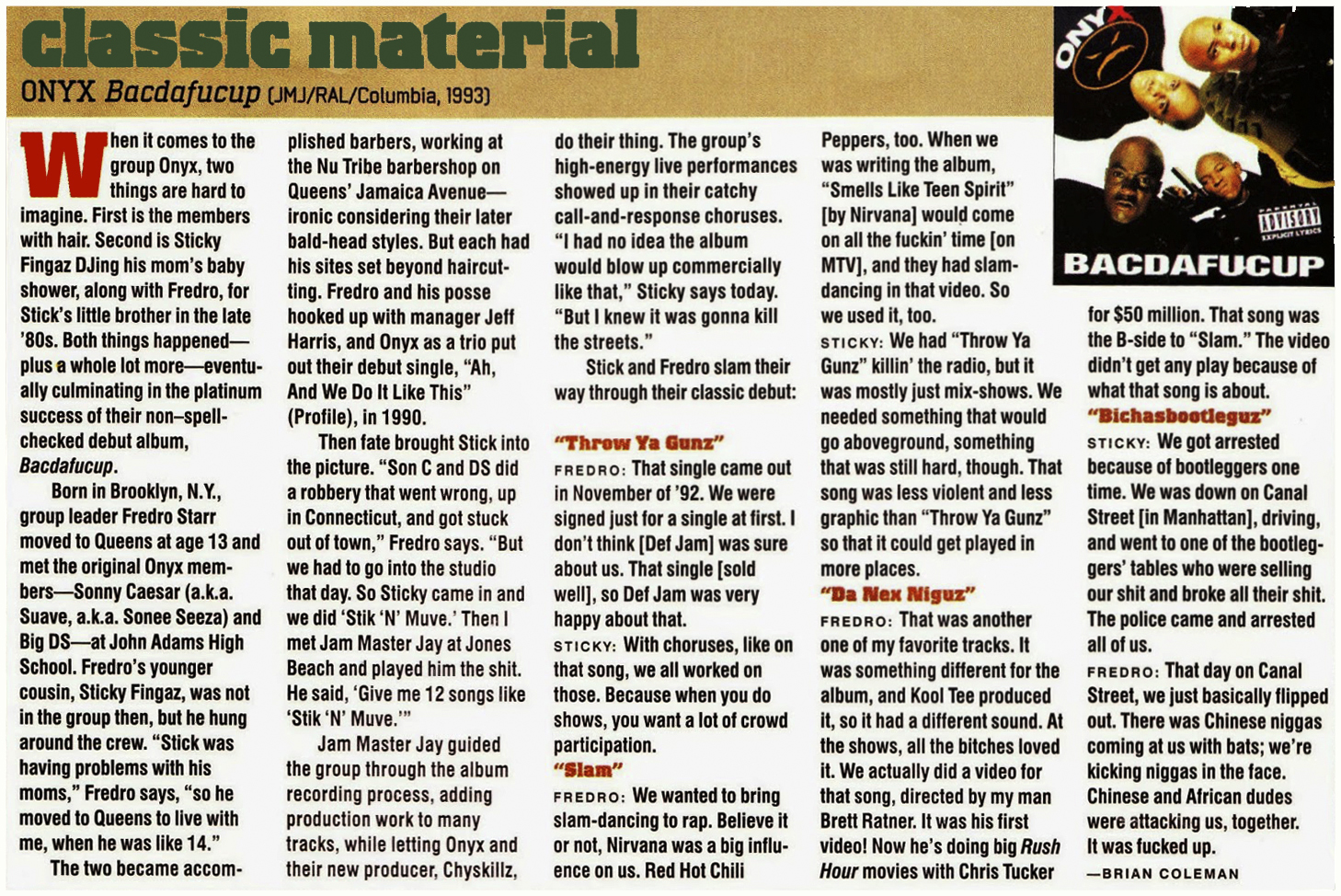
‘Bacdafucup’ was the debut album from the South Jamaica Queens group, Onyx (Fredro Starr, Sonny Seeza, Big DS (R.I.P.) and Sticky Fingaz); it was released on this day in 1993 via Jam Master Jay Records/Rush Associated Labels. The lead single was 'Throw Ya Gunz,' which hit the streets and mixshows hard in late '92 into early '93. I remember coppin' it on cassette single at The Wiz on Queens Boulevard, lol. The track was a hit in its own right, but when they followed it up with ‘Slam’ 6-7 months later, that’s when they were introduced to the mainstream audience. By then, fans knew to expect Sticky Fingaz as the anchor and for him to close out each track with his high energy, off the wall style. The bald-headed, black gear style was poppin' up everywhere; even pioneering groups like RUN DMC got down with it (and it confused the hell out of me). In 1994, at The Source Awards, Sticky Fingaz busted several shots into the ceiling during the intro to ‘Throw Ya Gunz.’ It was before IG, Twitter & Snapchat, but it was still a risky move. No gun was found when police later checked them backstage. Another day we'll discuss their second album 'All We Got Iz Us' and how that album & GZA's 'Liquid Swords' got us through the winter of '95. As a bonus, you can check the full 12" for 'See You In Hell,' below; it's Onyx rappin' over Rampage's dope 'Wild For The Night' beat.
Although known to the world as an unpredictable, skilled and hilarious MC, Redman came up in hip-hop as a DJ, around age 12... While DJing in clubs around his hometown of Newark, NJ, MCing was always in the back of Red's mind. He recalls: "I always kind of wanted to MC, but I really got into it when I heard EPMD and Biz Markie. I knew that I had that same energy inside me. Everybody else was more technical, but EPMD was more slow with their flow, natural." As fate would have it, Redman met his idols in '91, at a Newark club called Sensations. DJing at the time for Newark MC DoItAll (from Lords of the Underground), Redman stood in the back as his friends took turns freestyling for Erick and Parrish before the show, trying to impress the two, who had recently begun building their Hit Squad family. "My boys told Erick I could rap, too, so E asked me to freestyle. I started spittin' and EPMD put me on stage that night." Shortly after bringing him on tour with them (he doubled as K-Solo's DJ), Erick and Parrish hit up Def Jam for a Redman LP deal... The album was mostly recorded at Charlie Marotta's North Shore Soundworks studio on Long Island. E Sermon oversaw the process, but Redman was left to figure out things on his own more often than not. "I was under a lot of pressure to learn," Redman remembers. "E showed me a couple (of recording) moves, threw me in the studio and just left me there. But I picked up shit real quick, and Erick was always around if I needed him." After a couple months in the lab, Redman emerged with a killer piece of wax that mixed loose-limbed humor and deeply funky beats lived up to the new layers to the Hit Squad sound. Released in September '92 the LP went gold behind hit singles "Blow Your Mind" and "Time 4 Sum Aksion." The Sooperman Lover tells us how he freaked the funky fly stuff on his debut..." cont'd below via Classic Material in XXL by Brian Coleman. Click play, too!
The full Classic Material feature in XXL is below...
"The Fugees, who exploded out of the then-burgeoning North Jersey scene - around Newark and The Oranges - were a trio of artists with vastly different experience and talent. Wyclef, the eldest, was Haitian-born and Brooklyn-bred. South Orange's Lauryn Hill, the youngest, was perhaps the most stunningly and undeniably talented. Pras had Brooklyn roots and an ear for the streets... The group's Bayyan-produced 1994 debut, Blunted On Reality, was far from satisfying... Even with mediocre sales of 275,000, Ruffhouse gave them the advance they needed for a second album. "We had $135,000, took a little advance and bought studio equipment with the rest," Pras recalls. The results: a top-of-the-line home studio downstairs in Wyclef's uncle's home in East Orange - the Booga Basement..." Peep the video to the classic lead single, "Fu-Gee La" + more continued below...
"The Fugees' masterpiece was released in February 1996, eventually blown up by a song that wasn't even a single. Mixing Caribbean flavor with Hill's R&B power-pipes while beating about a hip-hop heart, the album appealed to music fans of all stripes, eventually selling nearly six million units in the US and, according to Pras, 18 million worldwide. "Clef brought the musicality, Lauryn brought the soulfulness and I brought the ruffneck," he explains. "And when it meshed together it was perfect." Enjoy Wyclef & Pras breakdown several classics from the album below. Peace to Brian Coleman.
Brian Coleman is a noted music journalist and historian, with four nonfiction books to his name: Buy Me, Boston: Local Ads & Flyers, 1960s - 1980s; Check the Technique Volume 2; Check the Technique; and Rakim Told Me, in addition to hundreds of freelance articles in publications including XXL, Scratch, The Source, Wax Poetics, URB, CMJ, and many more. To commemorate the upcoming release of his Check The Technique Volume 2 book - "25 classic albums from the '80s and '90s are lovingly and extensively profiled by acclaimed rap journalist Brian Coleman in this impressive volume, making it mandatory reading for all Hip-Hop junkies" - DJ Ayres and DJ Eleven of The Rub selected records from the new book for this dope mix of classic records. Listen to The Rub's throwback mix below...