Showing posts with label Press Kit. Show all posts

February 23, 2025

Prince Paul "Prince Among Thieves" (Press Kit, 1999)


While still just a Long Island high school student, Prince Paul Huston began his recording career in 1986 when he joined rap music's original hip hop band, Stetsasonic, as its resident "surgeon on the mix." In addition to DJing for the six-man group, Paul seized his internship with Stet to flex his fledgling production skills on cuts like the driving title song to 1988's much-heralded In Full Gear LP. However, it wasn't until a trio of eccentric and hugely talented hip hop-bred teens from Paul's Amityville, L.I. neighborhood enlisted his production guidance that Paul would emerge as the eclectic visionary that he remains known as today. De La Soul's platinum-certified 1989 masterpiece, 3 Feet High And Rising, established Prince Paul's signature sound; a collage of funky soul loops, old school club tracks and breakbeats, samples from childrens' records and virtually anything else in reach all woven together by ingeniously choreographed audio skits. Having risen to hip hop's upper echelon of console controllers, Paul's wizardry left its mark on 3rd Bass' "The Gas Face" and "Brooklyn-Queens" (both from the gold-certified The Cactus Album), Cypress Hill's "Latin Lingo"-remix and the title cut from Big Daddy Kane's gold-certified 1989 LP, It's A Big Daddy Thing among many others. Paul and De La Soul would also refine 3 Feet's creative peaks with 1991's equally outstanding, gold-certified De La Soul Is Dead and 1993's superb, but commercially neglected Buhloone Mindstate.


Around this time, De La's commercial struggles, coupled with the dissolution of Stetasonic and Paul's aborted deal for his own label, Dew Dew Man Records, sent the musical brainiac into a period of introspection that would greatly shape his future recordings. Teaming with Wu-Tang Clan's sound architect, RZA, former Stet bandmate, Fruitkwan, and former Tommy Boy soloist, Too Poetic, in 1994, Paul blazed another trail  for hip hop when he formed one of the music's first supergroups -- the faux "horror-core" quartet, Gravediggaz. If the group's image played up the campy side of ghostly games, its debut LP, 6 Feet Deep, reflected a smart-aleck intelligence that reveled in the mockery of the music industry and all its trappings. In his most recent work, Paul's disillusionment with the record industry has driven him to sagely seek collaborations and projects that are compatible with his own creative visions. 1996's Psychoanalysis LP rejuvenated Paul by providing him an unbound forum with which to express his mental musings. His remix to the Kool Keith-helmed Dr. Octagon project's "Blue Flowers" of the same year drew kudos from hip hop's critical cognoscenti. And his contributions to Chris Rock's Roll With The New spawned the hilarious Puff Daddy hit single spoof, "Champagne," and received a Grammy Award for Best Comedy Album of 1997. His latest project, "A Prince Among Thieves," synergizes the varied talents at Prince Paul's hands for a cinematic and musical opus of unprecedented scope for hip hop music. - Press Kit (Tommy Boy Records, 1999). 

June 30, 2024

MC Ren "Kizz My Black Azz EP" (June 30, 1992)


Before there was a group called N.W.A. there were individually, angry, young Black males; roaming through darkened alley ways, surviving the roughest of street tests and emerging, once again as survivors. All of them had a story to tell; all of them wanted to be heard; all of them searched for an answer. But the true base of power for any group has been the individual strength and character of its members. And now, since they've stepped the fuck off! another MC emerges for the fall out -- "The Black N!gga that they call Ren." At a time when we were starving from a lock of hosts to boast about the west coast, Ren was rehearsing for his debut. "I had a rep at Roosevelt Jr. High, me and DJ Train (of JJ Fad)." M.C. Ren went on to high school with his reputation in tow. By the time he graduated, Eazy-E, from around the corner, was knocking on his door. Back in 1987, "Eazy was trying to get me and Train to sign on Ruthless for a solo deal, but Ice Cube had left to go to school. Eazy had me write some material for the N.W.A. album, so me and Train's solo project had to be put on hold." Now, Ren is ready to rock the mic on his own. He's out to show and prove what he is made of, 'cauz "Real N!ggaz Don't Die." Listen to Kizz My Black Azz, cont'd below...


Kizz My Black Azz, the debut EP on Ruthless/Priority, is the first sign of life since N.W.A.'s EFIL4ZAGGIN. This six track EP was produced by Bobcat, a member of the Boogie Men Production team, which ironically produces some of Ice Cube's songs. "The Final Frontier" is the first single to hit the streets. "The Final Frontier" expresses Ren's lyrical intent to handle all MC's that think gangsta rap is just a category. "Rap is getting away from where it started," explains M.C. Ren. "Everybody is trying to be like Hammer and have a band playing behind their raps." The hook on this will have even the most passive of listeners thinking of Ren, whenever real rap is the subject, "Who iz it? - The Black N!gga that they call Ren." The intro kicks in with the 'back in the day' piano riff from "The Bridge Is Over," and is woven throughout the entire cut with a nice sax handling the breaks, while Ren flows like melted I-C-E. "Right Up My Alley" begins as a neighborhood eviction of the local smokers (crack addicts) from the alley in which Ren reigns supreme and turns into the news story of the week. Our reporter Ren spins the rhymes and weaves the tell tell story of the day to day events in the alley; "90% of the black males from the streets got a spot in their neighborhood where all the dirt goes down -- gambling, drinking, dope-selling -- you know." - Press Kit (Priority Records, 1992). Also, check out the write-up in The Source (August, 1992) below...
August 24, 2022

Tha Alkaholiks "21 & Over" (August 24, 1993)


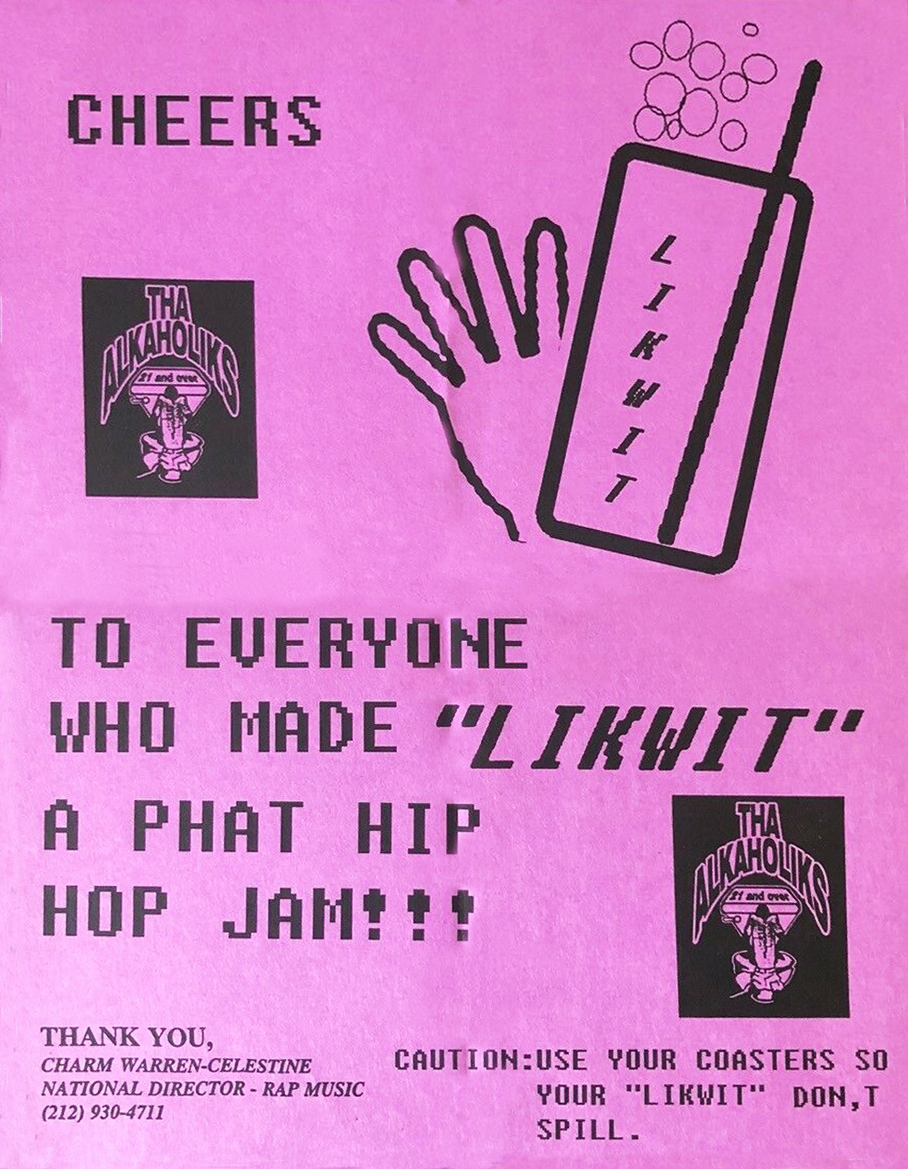
Ohio natives turned West Coast underground kings, Tha Alkahokiks have long been one of hip-hop's best-kept secrets: hilarious lyrical acrobats who have never received the critical or commercial support they deserve. Assembled by gangsta rapper King Tee, they offer a witty, anarchic, and party-friendly alternative to the stone-faced, largely humorless gangsta rap that ruled the West Coast throughout much of the early '90s. With the punch lines and comic timing of comedians and undeniable skills and killer delivery of topnotch MCs, rappers J-Ro and Tash have more than enough talent and energy to back up their endlessly clever boasting. Producer, DJ, and occasional MC, E-Swift is the group's secret weapon, an unjustly underrated beatsmith whose rubbery grooves and infectious production help make Tha Alkaholiks perhaps the greatest party group in hip-hop history. With titles like "Last Call," "Mary Jane," and "Only When I'm Drunk," Tha Alkaholiks will never be mistaken for members of some sort of latter-day temperance movement, but their music, rhymes, and beats are so irreverent, infectious, and just plain fun that their booze-loving shtick never gets old. Brief (only ten songs) and filler-free, 21 & Over is perhaps the quintessential West Coast party album, as well as one of the most promising debut albums of the '90s, regardless of genre. - Old School Rap & Hip-Hop. On their press kit, they encouraged fans "not to drive when they drink" and "chose to title their album 21 and Over... In other words, alcohol is not the end all and be all to Tha Alkaholiks - they simply like to drink and have fun." Art above by Alphonze. Revisit the album below...


21 & Over is an undeniable classic via Loud Records in 1993.

August 20, 2022

Clipse "Lord Willin'" (August 20th, 2002)


Like the cosmic universe, the world of hip-hop is made up of planetary foundations represented by stylistically regional hip-hop genres -- East Coast, West Coast, the Mid-West, and the Dirty South. Every few years, however, like a lunar eclipse, a hip-hop act emerges to interrupt the shine of conventional hip-hop. This year Malice and Pusha T a.k.a. the Clipse have arrived to introduce the Virginia streets to the hip-hop universe. The past few years have been full of contribution for the quiet state of Virginia. Almost overnight, VA has become an innovative ground for hip-hop culture. While noteworthy talent such as Missy Elliot, Timbaland and Teddy Riley have proudly represented Virginia on the radio and in the clubs, the Clipse will bring the uncharted aspect of Virginia streets to the forefront with their Star Trak/Arista debut, Lord Willin'. The creation of the Clipse is the culmination of events that began in the late 1980s. Both Malice (Gene Thornton) and Pusha T (Terrence Thornton) were born in the heart of hip-hop's birthplace, the Bronx, New York; home to hip-hop giants like KRS-1, and the late Big Pun. Residing in the Gunhill Road section of the Bronx, a young Malice and Pusha T migrated to Virginia in the early 1980s. First to move was the older brother, Malice who quickly developed a reputation as a lyrical wordsmith. Three years later, Pusha T joined his brother and the duo began to combine their Kool G Rap, Juice Crew, Eric B & Rakim and Large Professor influences with the unique sounds of Virginia. It was during a cipher that Malice caught the attention of an unknown producer named Pharrell Williams. Cont'd below + revisit the LP...


Impressed by what he heard, Williams promised to work with Malice and Pusha T to produce a demo tape. As Malice and Pusha T began to develop their craft and recognize their potential to have an effect on the hip-hop world, they began to formally be known as the Clipse. Meanwhile, Pharrell along with his classmate, Chad Hugo, began to take the hip-hop world by storm and establish themselves as one of the brightest production teams in hip-hop. Once established, Pharrell and Chad, known as the Neptunes, helped the Clipse land a deal on Elektra in 1999, where they released the buzz-single "The Funeral." The single struck a cord with street heads and garnered the Clipse some well-deserved attention, making them two to watch for the new millennium. Since their official signing to Arista-affiliated Star Trak Entertainment, their street single "Grindin'" has been pure fire in the clubs and on the mixtapes. "Grindin'" has created a buzz of anticipation from the streets to hear what this duo has to bring to the game. Additionally, the video for "Grindin'," has been highly requested on B.E.T., M.T.V. and other local music stations. Their next single, "When The Last Time," geared for radio and club play, is scheduled to impact radio this summer. Lord Willin' the Clipse will introduce the Virginia streets to us on August 20th. - Press Kit, 2002. As Pusha T said, "Still giving you classics, that's the only thing that dates me." Take it back to '02 and revisit Clipse's Lord Willin'.

August 13, 2022

Cypress Hill "Cypress Hill" (August 13, 1991)


Cypress Hill wants to get two things straight. First, because of their name, many people think they're from Brooklyn; they're not. Cypress Hill refers to Cypress Street in Southgate, a section of Los Angeles about five minutes from Watts and South Central. Actually, it's not really a hill, but as Sen Dog (one of Cypress Hill's rappers) says, "you can't tell us it's not Cypress Hill. We love that street. We've got rock and rollers, we got rappers, we got singers. We take good care of it, too. We don't let anyone come in and mess it up writing graffiti all over the place or anything like that." Or, as B-Real (the group's other rapper) adds, "'Cypress Hill' means we're on top. We have to be on top of business whether it's business of hip-hop or the business of the block." Speaking of "the block" brings up the second possible misconception: While these tough times -- on the mean streets of L.A. in particular -- are reflected in their lyrics, Cypress Hill is not another pseudo-gangsta act from Southern California. "We're not just some more brothers from Compton," explains B-Real, "and some of them aren't even from there, anyway." "Yeah, they've never gangbanged because their moms would let them," Sen Dog quickly adds, laughing. "They want to pump out second-hand information that they never even went through," B-Real continues. "Everything on our record is from our own experience. We don't want to teach you, we don't want to preach to you. We want to be known as funky awareness: first, you've got to be funky, and then it's hardcore awareness, revolving a story around our experiences or our homeboys' experiences." Cypress Hill, their self-titled debut album, is shaped by this group ethic of funky awareness. The record is full of their real-life experiences, and with DJ Mixmaster Muggs' incredibly funky, clever beats and samples, it's bound to raise eyebrows.... 


"Pigs," a rowdy singalong dedicated to some of Cypress Hill's "best friends," is reminiscent of the childhood nursery rhyme ("this little pig went to market"). Wrapped around a lazy, swaggering bass-line, the lyric stance on "Pigs" does not represent the group leaping onto anyone's bandwagon. "We get harassed by the police all the time because we look like gangbangers," says Muggs. "They tell me my tires are too flat, or we match someone's description. I've heard every possible excuse three or four times, not just once." Where "Pigs" is spare and casual, "Kill A Man" rushes at you with a stomping drum beat, peppered by high-pitched horns and random shouts. It would be very easy to look at the title and dismiss the track as ultra-violent, but that's not the point. As Sen Dog explains, "It's not about killing a man, but it's about understanding how one kid could do that. We don't glorify it." Again, B-Real has put his own experiences into the groove. "You know 'Kill A Man' when I go, 'Say some punk tried to get you for your auto/what are you gonna one time play the role model/no, I think you play like a thug.' Well the other night someone did try to steal my car. That happens all the time." Throughout the album, Cypress Hill makes one innovative contribution after another in the hip-hop artform. Check out B-Real's crazy, but engaging vocal style, or the "Duke of Earl" sample at the beginning of "Hand On a Pump"; or the live bass, percussion and guitar on the Spanglish "Latin Lingo." In this age of anti-drug hysteria, Cypress Hill also has the honesty to endorse one of their favorite pasttimes "on the record," with "Light Another" + "Blunted." Cont'd...


One of the reasons that the Cypress Hill album is so comfortable, engaging and inventive is that the members aren't newcomers to the hip-hop scene. Co-writer, lyricist and background rapper, 25-year old Sen Dog was born in Cuba and moved to Southgate at age 14. Sen comes from a very musical family.... Ever since he was young, Sen, his brothers and sisters were stars of the local church choir. After dropping out of high school in 1981, Sen started a group with his brother, Mellow Man Ace called DVX, and invented the Spanglish, Latin lingo style. Some time before Mellow Man Ace embarked on a solo career, he and Sen were joined in DVX by a young, gifted writer named B-Real. Now Cypress Hill's lead rapper, 21-year old B-Real has lived in Los Angeles all his life. For as long as he can remember, his biggest dream was to be a writer or a journalist. B-Real would spend hours in class writing essays and poems, but eventually he was turned off by school and dropped out. "A lot of the things they teach you in school are watered down. That's why I left..." Soon, B-Real's desire to write led him to hip-hop. "I guess I'm a writer now... If you're writing what you feel and if it's getting out, then you're accomplishing what you want...." Soon, Sen and Ace decided to pair B-Real with another young hip-hopper, a DJ and producer named Mixmaster Muggs. Mixmaster Muggs moved to Southgate from Queens right before he started high school. In Queens, he was heavily into breakdancing which led to his DJ-ing... Even though he is only 22 years old, Muggs was down with East Coast hip-hop from the beginning, back in the days when the Treacherous Three, Funky Four Plus One and Run-DMC ruled the day. In tenth grade, Muggs bought his first piece of equipment (a set of Technics 1200's)... After coming to L.A., he briefly hooked up with B-Real; Muggs was also the cornerstone of 7A3, who had a song on the "Colors" movie soundtrack. Soon after, Muggs left 7A3 and began laying down tracks for Cypress Hill. In its present configuration, Cypress Hill has been working together for three years. - Press Kit, 1991. Today marks another anniversary for this classic album! Dig back into it and more from Cypress Hill in the extensive archives below...

July 21, 2022

House of Pain "Fine Malt Lyrics" (30th Anniversary, 1992)


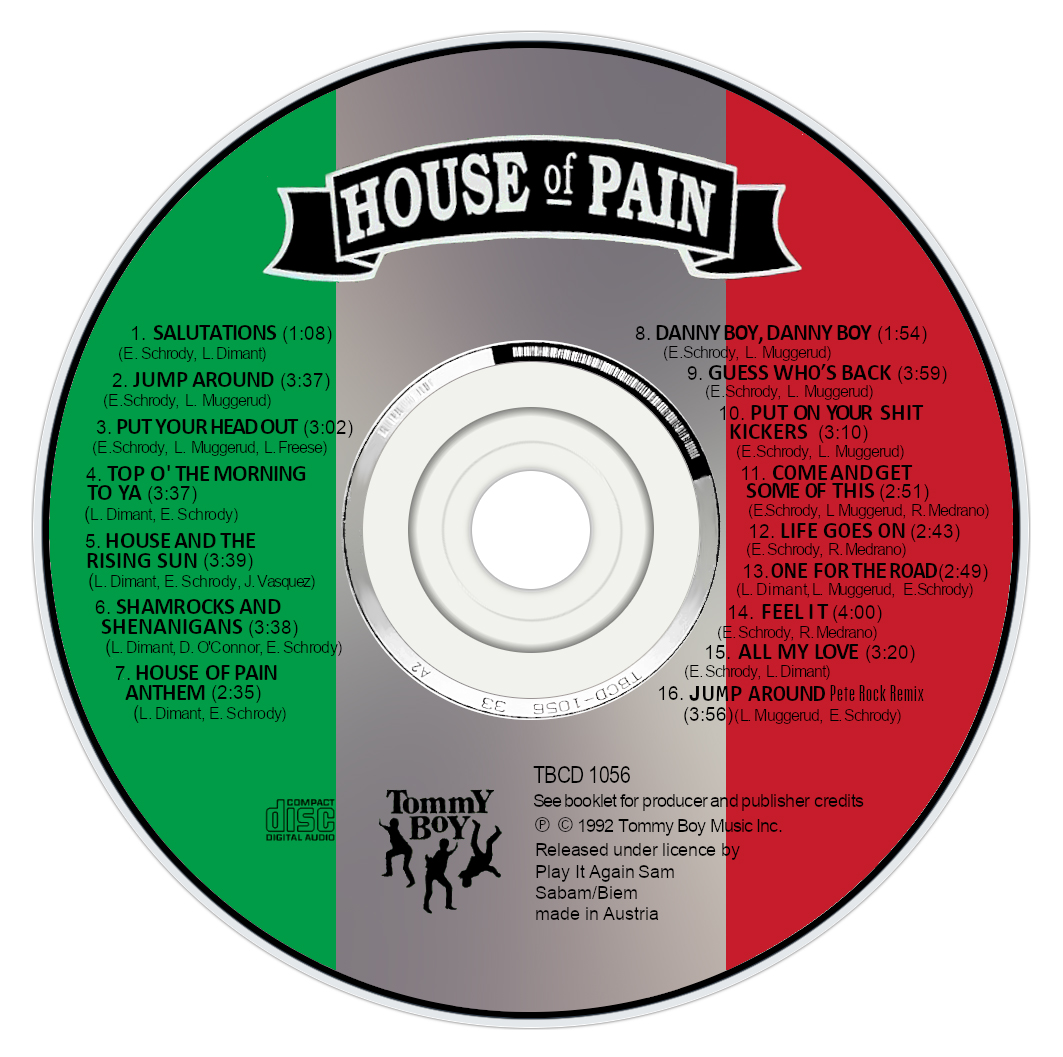
"We're animals trying to be men," laughs Everlast, lead rapper of the Irish-American rap act House of Pain. Explaining the inspiration for the group's name, he describes the movie "The Island of Dr. Moreau," "It's about a scientist who tries to turn animals into men, and the place where he took them to punish them was the House of Pain." Danny Boy and DJ Lethal round out the trio that produced the gold smash single "Jump Around," and a debut album filled with dense, diverse samples and a rap style that recalls the kind of shit-kicking you hear at a party or on a basketball court. "If you get on the basketball court, talking shit is half the game," Everlast says. "I look at the lyrics like a basketball, like I'm bouncing them off the beat." Everlast is sporting a basketball jersey in their video for "Jump Around," but it wasn't the jersey of his hometown Lakers. He wore Boston Celtics green, a nod to the heritage of both himself and rapping partner Danny Boy -- as is House of Pain's shamrock emblem, "Fine Malt Lyrics." "It definitely does fit the 'Irish' stereotype," Danny Boy says of their image, "but it just happens, as do we." "We don't try to be preachers of Irish history, or Irish politics," adds Everlast. "It's just two guys who happen to have Irish blood, you know, happen to have a taste for some beer once in a while, and like to kick funky rhymes." The group got together in 1990, after Everlast left the Rhyme Syndicate. "The name of the group came from an old punk band I used to have," says Danny Boy. Adds Everlast, "When I saw the name written down at his house, it clicked with me, and later on I figured out it was because of the "Island of Dr. Moreau" movie that I'd seen when I was young." // (Revisit the album while you continue reading below) .....


Everlast (Erik Schrody, age 22) and Danny Boy (Danny O'Connor, 23) met at Taft High School, which is also the alma mater of Ice Cube and Divine Styler. "There was a whole spectrum of people with different music preferences," states Everlast, "from punk rockers, to rappers to hard rocks." "You knew who was a B-boy and who wasn't," says Danny Boy. "You knew who liked rap and who didn't. Of course we weren't going to click." The House of Pain crew is rounded out by Latvian-born DJ Lethal (Leor Dimant), who worked on Everlast's previous solo projects as part of Ice-T's Rhyme Syndicate. DJ Lethal's mix changes colors from the psychedelic dub style of the "House of Pain Anthem," through the infectious "Top O' The Morning To Ya" - laced with woozy harmonica and slippery scratches - to the jazzy shifts of "All My Love." "I'm like jumping around the beat, picking out things to put in the beat," says DJ Lethal, who, at age 19, has emerged as a sampling ace, looping without reliance on drum programs. "Hip-Hop is my first love, but incorporated into hip-hop are a lot of forms of music," Lethal says of his cross-style collage. "I'll take a beat from rock, I'll take a little horn from jazz and I'll take a little organ from some old classical piece." The album produced by Lethal, Muggs of Cypress Hill, who lead rapper B-Real joins Everlast on "Put Your Head Out," and Ralph M of FunkDoobiest. "The first time people hear your record, they don't listen to the lyrics, they listen to the flow and the music," Everlast says. "And if you get in this weird (lyrical) thing, where they're going "Ooh, listen to him bug out!, THEN they're going to listen to what you said. I put a lot of thought into my style beforehand, but when I finally come down to writing the songs, I do it in a form of freestyle. I like that spontaneity. It's pure feeling rather than being over-rehearsed or over-written, or over-thinking about it," he says. "There are a few rhymes that are totally flipped around from what we thought we were starting with. But I saw that the rhymes fit the beats, and makes each part as entertaining as possible." - Press Kit, 1992. Undeniable classic.

July 20, 2022

Cypress Hill "Black Sunday" (July 20, 1993)


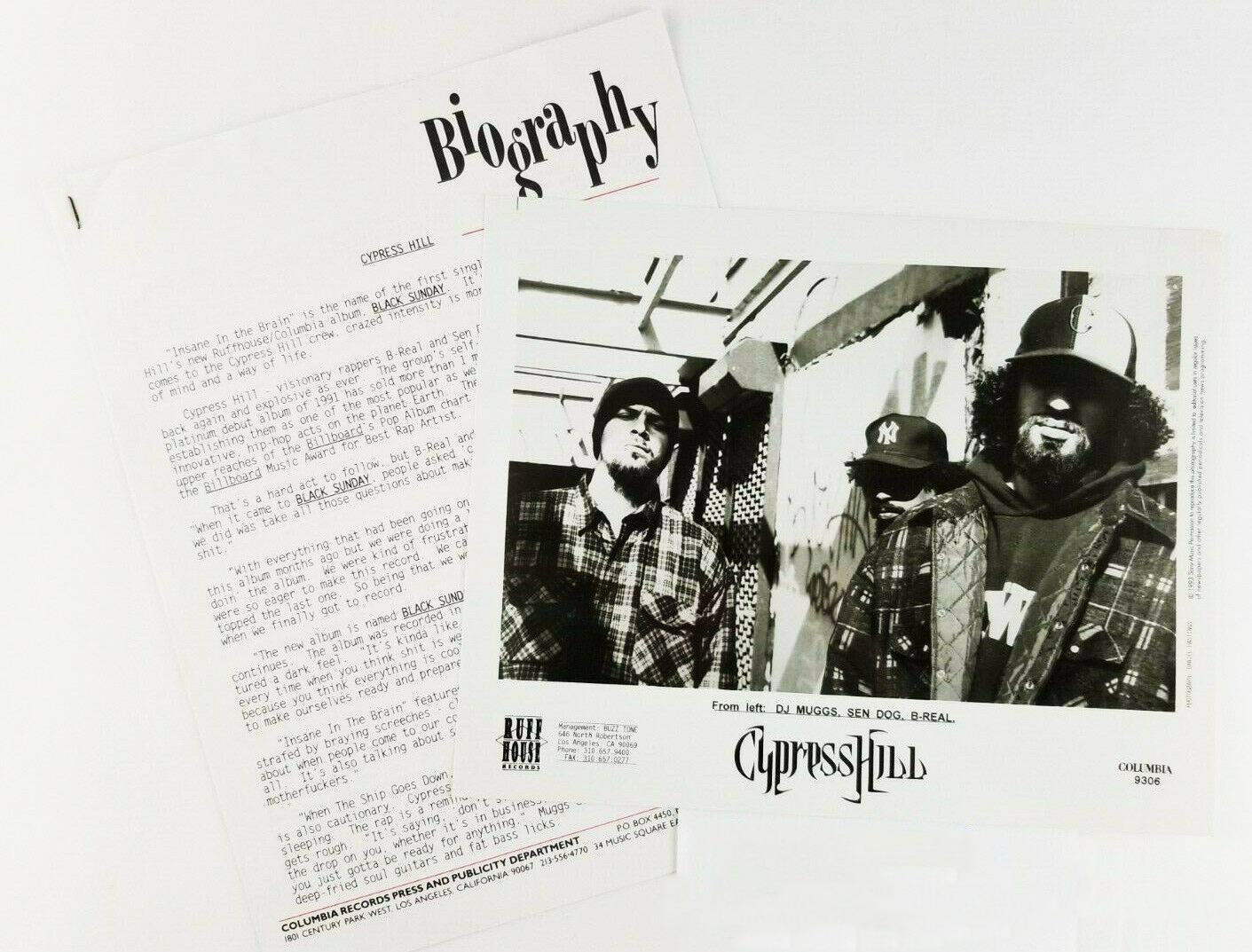
"Insane In The Brain" is the name of the first single and video clip from Cypress Hill's new Ruffhouse/Columbia album, Black Sunday. It's also a warning: that when it comes to the Cypress Hill crew, crazed intensity is more than skin deep; it's a state of mind and a way of life. Cypress Hill -- visionary rappers B-Real and Sen Dog, and DJ/Producer Muggs -- are back again and explosive as ever. The group's self-titled Ruffhouse/Columbia RIAA platinum debut album of 1991 has sold more than 1 million copies to date in the US, establishing them as one of the most popular as well as hardest hitting, musically innovative, hip-hop acts on the planet Earth. The Cypress Hill album remained in the upper reaches of the Billboard's Pop Album chart for over 73 weeks, earning the group the Billboard Music Award for Best Rap Artist. That's a hard act to follow, but B-Real and company remained cool under pressure. "When it came to Black Sunday, people asked 'can we top the last one,' you know? What we did was take all those questions about making a follow-up and asked ourselves that shit." "With everything that had been going on this year, we felt we should have made this album months ago but we were doing a lot of shows and that took time away from doin' the album. We were kind of frustrated that we hadn't started yet, because we were so eager to make this record. We came up with a lot of dope shit that we felt topped the last one. So being that we were hungry to do it, it brought out the best when we finally got to record." They continue, "The new album is named Black Sunday because its whole vibe is ominous. The album was recorded in Muggs' native New York in early '93. (Revisit the LP, the press release continues below)...


"Insane In The Bran" features a hydraulic bass groove and pounding beat being strafed by braying screeches -- classic Cypress Hill. "I wrote "Insane In The Brain" about when people come to our concerts they lose their mind in the adrenaline of it all. It's also talking about some of the people on the street, who are just crazy motherf#ckers." "When The Shit Goes Down," the B-side to "Insane In The Brain," and second video, is also cautionary. Cypress Hill may be stoners, but don't think for a minute they're sleeping. The rap is a reminder for everybody out there to be ready when the going gets rough. "It's saying, 'don't sleep,' because if you sleep and let somebody get the drop on you, whether it's in the business, sports, rap, or out on the street fighting, you just gotta be ready for anything." Muggs cooks up an ultra-funky mix of scratchy deep fried soul guitars and fat bass licks. "Ain't Goin' Out Like That" opens with looped feedback, giving way to saxophone screeches, a jazzy bass figure and crackling drums. B and Sen's raps reprise some of the rhymes from the debut album that helped establish them as the hardest and smartest hip hoppers on the street, promising more of the same and then some this time around. In addition, Black Sunday includes special new, never commercially available versions of "A to the K" (the original appeared on the Juice soundtrack) and "Hand On The Glock" (a radical remodeling of "Hand on the Pump"). In order to make the album more readily available to Cypress' younger fans, there will be a clean, unstickered version. - Press Kit '93. 

May 31, 2022

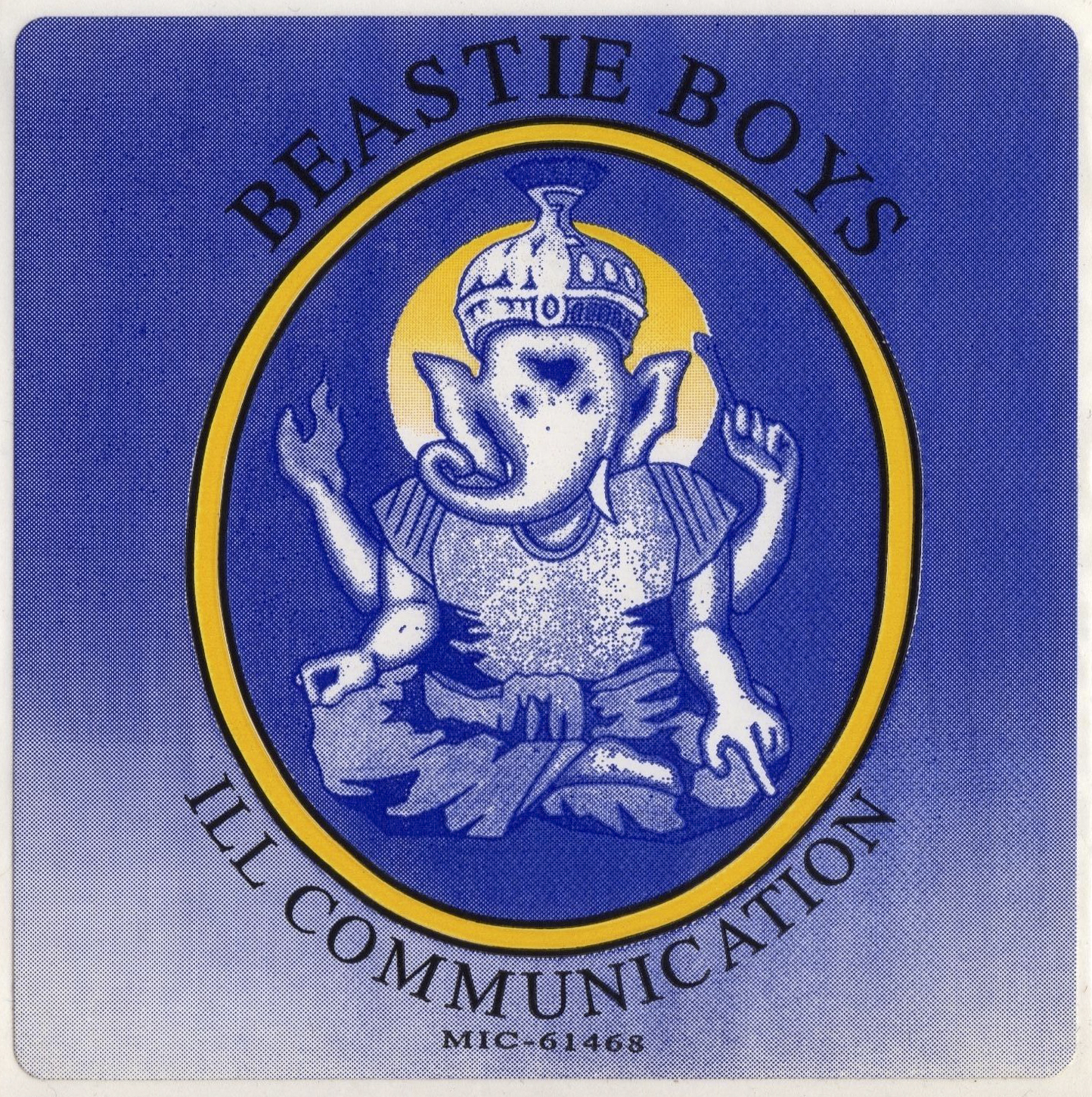
Beastie Boys "Ill Communication" (May 31, 1994)


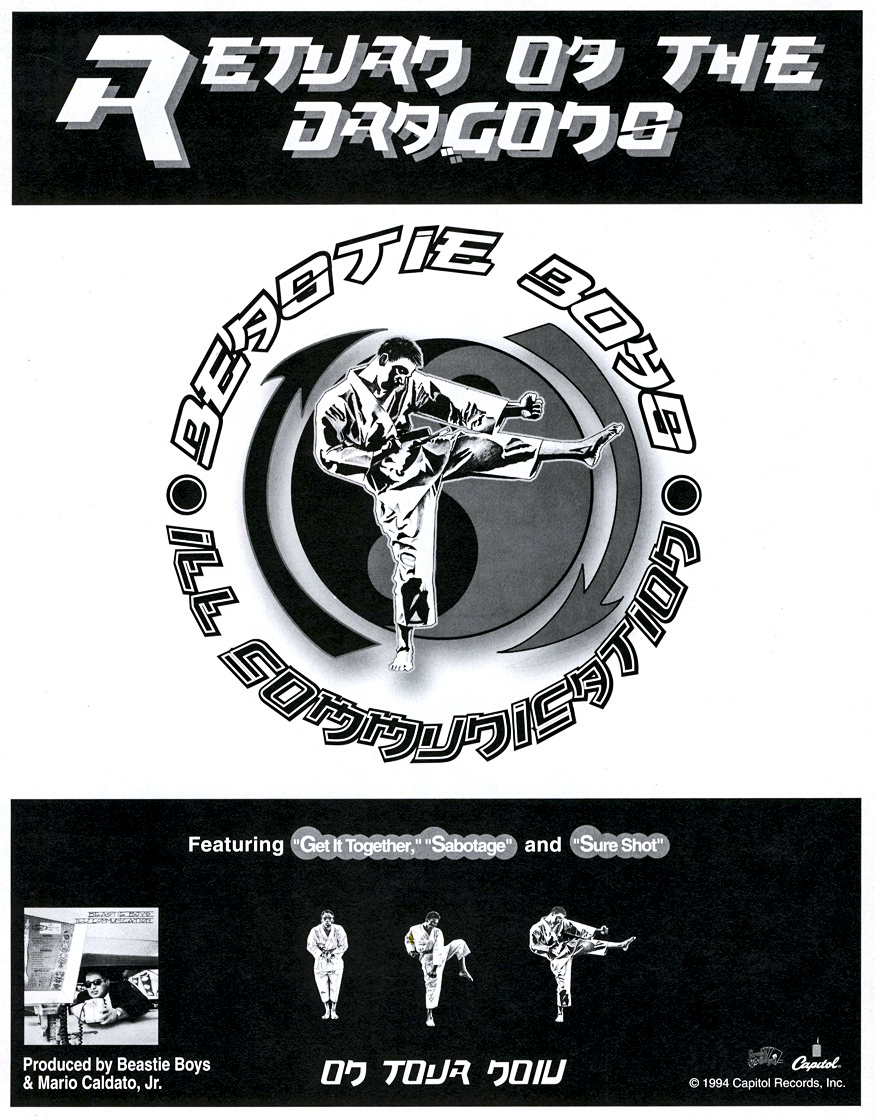
Guaranteed plan for success: Spend your formative teenage years in early '80s downtown NYC, following hip hop all-nighters with full afternoons of hardcore punk at CBGB and vice versa. Confound fans of your hardcore band by working full-on rap numbers into your repertoire, ultimately dropping instrumentation altogether. Release the first ever rap album to top the pop charts, spend a couple years as the biggest hip hop outfit ever, then go underground. Come out a few years and 180 degrees later, working live instrumental jams and straight-up punk rock back into the set. Record sales are back up past the million mark, shows selling out everywhere... and then what the f#ck do you do? Well, unless you're the Beastie Boys, you don't get this far in the first place. If you are the Beastie Boys, however, you once again release your most ambitious record to date, Ill Communication (Grand Royal/Capitol). Like its predecessor, 1992's Check Your Head, Ill Communication is a B-Boys/Mario Caldato Jr. - produced 20-song blend of genius lyrics and rhymes (John Woo/Rod Carew, Kojak/bozack, divorcee/Lee Dorsey... all by the end of the first verse of lead track/first single "Sure Shot"), soulful instrumental interludes (including the bass-overdriven "Futterman's Rule," the plaintive "Ricky's Theme," and closing cool-down "Transitions"), and the occasional blast of hardcore punk ("Tough Guy," "Heart Attack Man"). Unlike Check..., which was two years in the making, the bi-coastally recorded Ill Communication took barely seven months to complete--just over a year to the day from beginning of recording to release date--setting a precedent for a band whose fans have grown accustomed to three-year intervals between albums. "We finished the Check Your Head tour around Thanksgiving '92," Mike D recalls. "We were on tour for eight months, then we took five months off. Then we started on the new album in New York. We just got back together, set up all our equipment, and started playing right off. We then headed back to the world-famous G-Son studios in LA to sift through our collection of 'Space Truckin'-esque jams and begin working on the hip-hop tracks." - Press Kit, 1994. "Get It Together" with Q-Tip was absolutely my jam at that time. Revisit the Ill Communication album from the Beastie Boys below...


I hope history never forgets the unique impact the Beastie's had on music.

May 28, 2022

N.W.A. "EFIL4ZAGGIN" (May 28, 1991)


N.W.A. doesn't rap about life in the ghetto. N.W.A. is life in the ghetto. They're not reporters, interprets, or spokesmen. They're Real N!ggaz With Attitude, Compton's finest, and they don't give a you-know-what about nothin'. So shut up and listen closely, because N.W.A.'s second album, EFIL4ZAGGIN, is out, and it's gonna be the scariest ride of your life. After a two-year wait, MC Ren, Eazy-E, Dr. Dre, and DJ Yella have created nothing less than the world's most explosive album. EFIL4ZAGGIN is a descent into America's dirty backyard, where black males over the age of 30 are statistical miracles, where gangs are family, where guns and crack rule the streets, and where women are just things to f#ck. If you don't like it, guess what? It's reality, it's happening now in your town, and if the evening news doesn't make you care, maybe N.W.A. will. Still not sure how to feel? Then hold your breath and jump in feet first; EFIL4ZAGGIN, about an hour in length, has something terribly important to say... "Murder created by the streets of Compton/Now get it from an underground poet/I live it, I see it, and I write it because I know it." In keeping with N.W.A.'s style, the album not only seethes with anger, but ripples with sarcasm too. EFIL4ZAGGIN marks the band's singing debut with "Automobile" (perhaps the first-ever ghetto country song) and "I'd Rather F#ck You," a revamped version of Parliament's "I'd Rather Be With You." Since all pop love ballads are, in essence, about sex, N.W.A. simply brings it out front - way out front! - on these two utterly descriptive songs. Punctuated with real-life phone calls from fans, revealing in-studio chatter and dramatic vignettes about encounters with the police, EFIL4ZAGGIN covers a lot of ground. Cont'd...


Since their emergence with Straight Outta Compton, N.W.A.'s 1989 debut album, the group has carved a singular niche as the angriest and most forceful rap group on either coast. It all started in 1986 when Eazy-E decided to launch his own company, Ruthless Records. He and his friends recorded "Boyz-N-The-Hood," and it took off. A year later, N.W.A. was officially formed, and their 12" single "Dope Man" became a success. But N.W.A. blew off the roof with the release of their debut album, Straight Outta Compton, which took rap to a level never seen before. Songs like "Gangsta Gangsta" and "____ Tha Police" offered a searing portrait of life in the inner-city, told so realistically that some people weren't sure where real life ended and art began. N.W.A. met with immediate controversy. Several of their concerts were cancelled by fearful city councils, parents were terrified by the stark image of these strong young black men in Raiders caps, and even the FBI sent an ominous letter to Priority Records, stating the law enforcements "took exception" to the song, "___ Tha Police." The band was featured in scores of articles, some applauding N.W.A.'s brutal honesty, others decrying what they viewed as the band's musical mayhem. But fans don't listen to pundits. The group sold millions of albums, and became enormously popular around the world with whites as well as blacks. Meanwhile, every member of the band has been active with a variety of other projects, making them, collectively and individually, probably the most influential musicians in the hard-core hip-hop world. But for all four, the main event has always been N.W.A. Now, the long wait is over, and EFIL4ZAGGIN becomes an album for the ages. As the saga continues, so surely will the controversy, the protests, and the outrage. But as the band has tried to show all along, the outrage against them is misdirected. N.W.A. points to the appalling conditions in the cities of America and asks whether or not the focus should lie there. As they say in "Approach The Danger" on the new album: "No prison/Nobody makes bail/Everybody got to go, but you see it ain't no jail/I approach the danger/Cuz I don't give a f#ck if somebody got to get f#cked up/So you might as well kiss your ass goodbye/Cuz in the run/We all die." Have a nice day. - Press Kit, 1991. Still one of the most bone-chilling groups of all-time and a great record indeed.

May 16, 2022

Kendrick Lamar "Mr. Morale & the Big Steppers" (Album Stream)


Mr. Morale & the Big Steppers is the fifth studio album by rapper Kendrick Lamar. The album features narration by Whitney Alford and Eckhart Tolle, and guest appearances from Blxst, Amanda Reifer, Sampha, Taylour Paige, Summer Walker, Ghostface Killah, Baby Keem, Kodak Black, Sam Dew, Tanna Leone, and Beth Gibbons of Portishead. Kendrick Lamar reunited with frequent collaborators Sounwave, J. Lbs, DJ Dahi, and Bekon for the majority of the album's production. As with all of Kendrick's releases, it's a culture-shifter and meant to be sat with and enjoyed as a full body of work. Ignore the reviews/critics; the he said/she said; the comparisons to previous albums... experience it on your own and see what you get from Kendrick's Mr. Morale & the Big Steppers...


Original press release announcing the project...

May 14, 2022

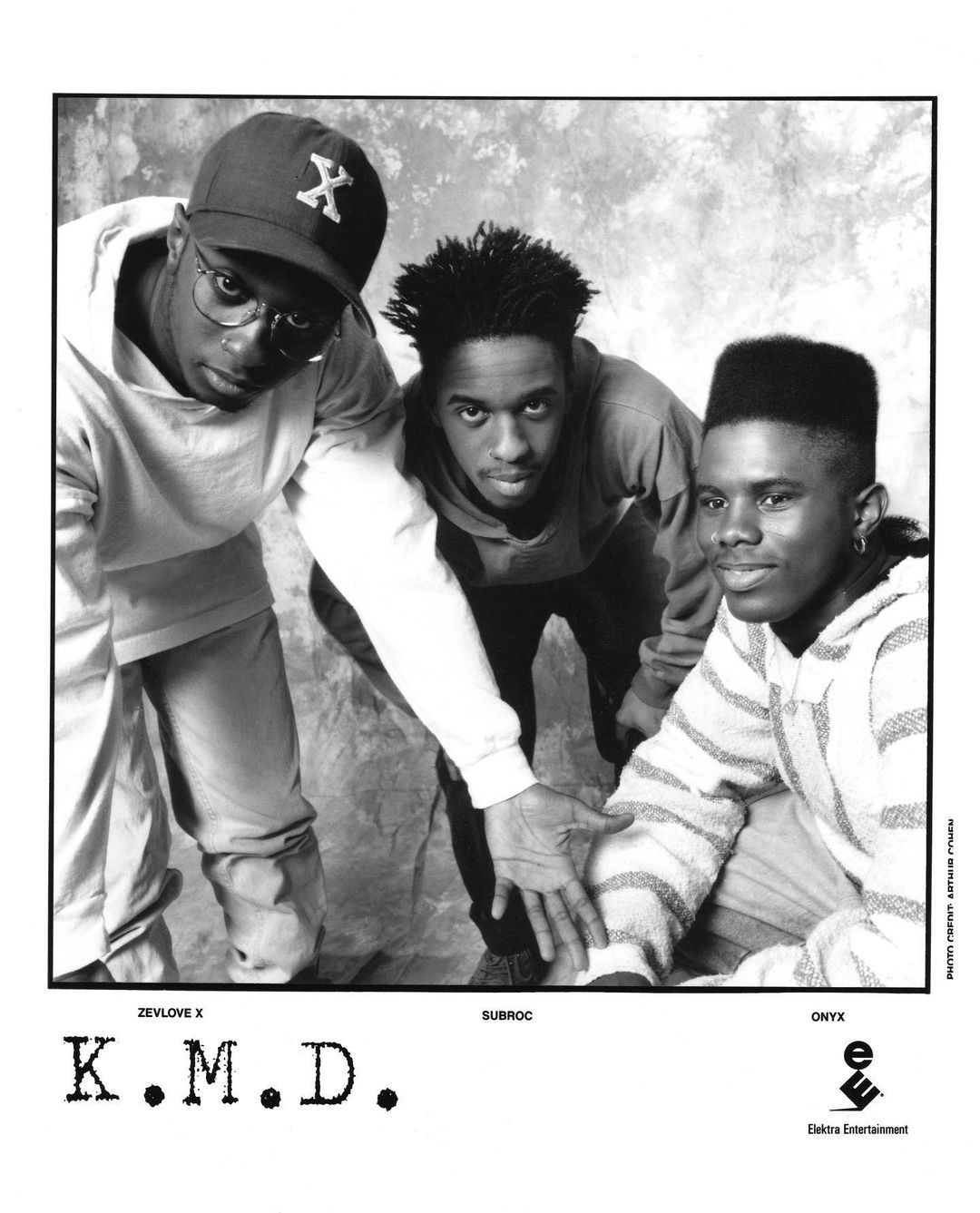
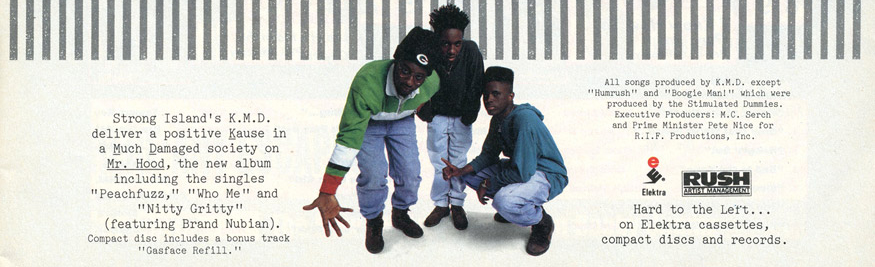
K.M.D. "Mr. Hood" (May 14, 1991)


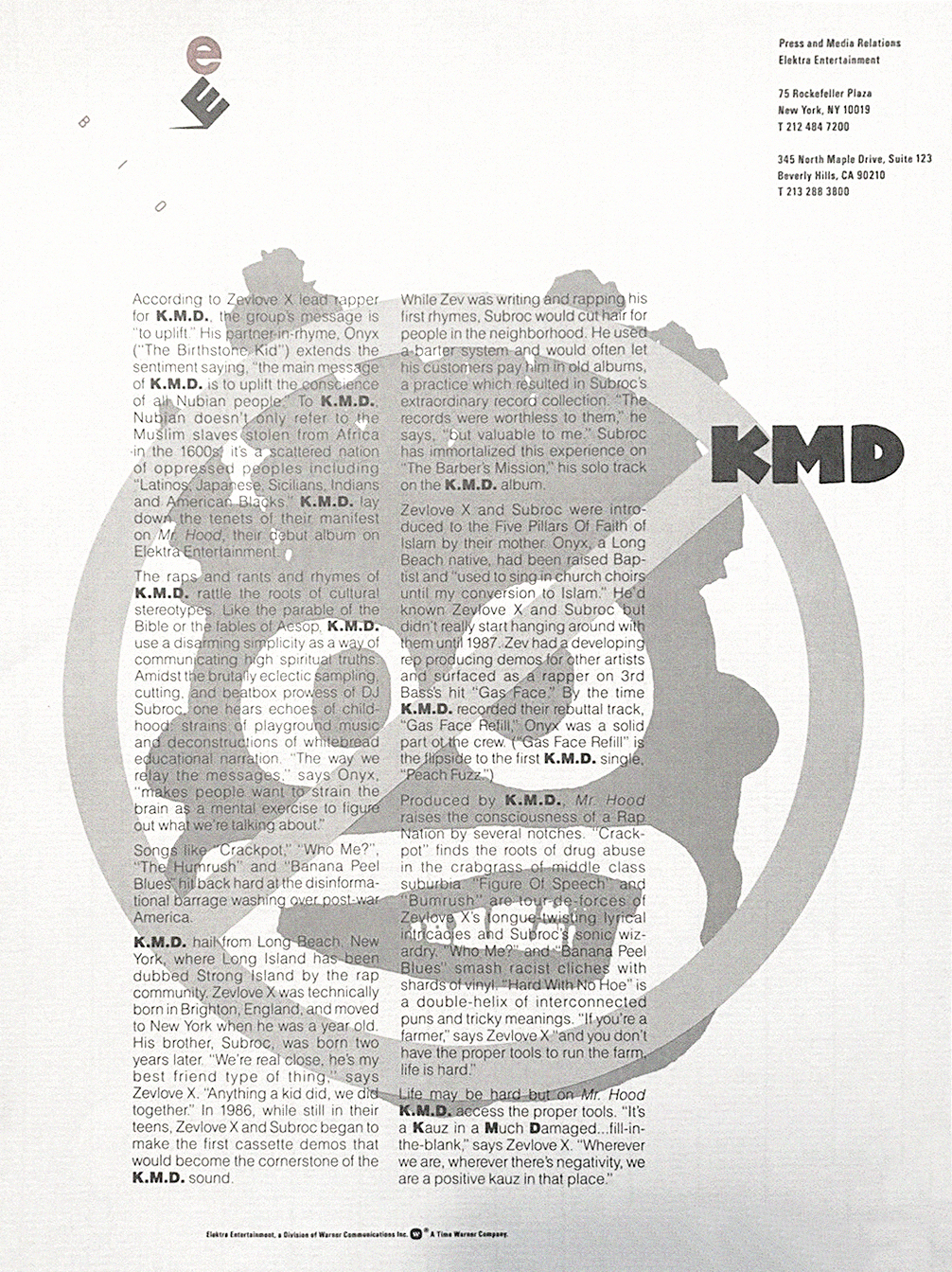
According to Zevlove X lead rapper for K.M.D., the group's message is "to uplift." His partner-in-rhyme, Onyx ("The Birthstone Kid") extends the sentiment saying, "the main message of K.M.D. is to uplift the conscience of all Nubian people." To K.M.D., Nubian doesn't only refer to the Muslim slaves stolen from Africa in the 1600s, it's a scattered nation of oppressed peoples including "Latinos, Japanese, Sicilians, Indians and American Blacks." K.M.D. lay down the tenets of their manifest on Mr. Hood, their debut album on Elektra Entertainment. The raps and rants and rhymes of K.M.D. rattle the roots of cultural stereotypes. Like the parable of the Bible or the fables of Aesop, K.M.D. use a disarming simplicity as a way of communicating high spiritual truths. Amidst the brutally eclectic sampling, cutting, and beatbox prowess of DJ Subroc, one hears echoes of childhood: strains of playground music and deconstructions of whitebread educational narration. "The way we relay the messages," says Onyx, "makes people want to strain the brain as a mental exercise to figure out what we're talking about." Songs like "Crackpot," "Who Me?", "The Humrush" and "Banana Peel Blues" hit back hard at the disinformational barrage washing over post-war America. Bio continues below...


K.M.D. hail from Long Beach, New York, where Long Island has been dubbed Strong Island by the rap community. Zevlove X was technically born in Brighton, England, and moved to New York when he was a year old. His brother, Subroc, was born two years later. "We're real close, he's my best friend type of thing," says Zevlove X. "Anything a kid did, we did together." In 1986, while still in their teens, Zevlove X and Subroc began to make the first cassette demos that would become the cornerstone of the K.M.D. sound. While Zev was writing and rapping his first rhymes, Subroc would cut hair for people in the neighborhood. He used a barter system and would often let his customers pay him in old albums, a practice which resulted in Subroc's extraordinary record collection. "The records were worthless to them," he says, "but valuable to me." Subroc has immortalized this experience on "The Barber's Mission," his solo track on the K.M.D. album. Zev and Subroc were introduced to the Five Pillars of Faith of Islam by their mother. Onyx, a Long Beach native, had been raised Baptist and "used to sing in church choirs until my conversion to Islam." He'd known Zev and Subroc but didn't really start hanging around with them until 1987. Zev had a developing rep producing demos for other artists and surfaced as a rapper on 3rd Bass's hit "Gas Face." By the time KMD recorded their rebuttal track, "Gas Face Refill," Onyx was a solid part of the crew. Cont'd...


Produced by K.M.D., Mr. Hood raises the consciousness of a Rap Nation by several notches. "Crackpot' finds the roots of drug abuse in the crabgrass of middle class suburbia, "Figure of Speech" and "Bumrush" are tour-de-forces of Zevlove X's tongue-twisting lyrical intricacies and Subroc's sonic wizardry, "Who Me?" and "Banana Peel Blues" smash racist cliches with shards of vinyl. "Hard With No Hoe" is a double-helix of interconnected puns and tricky meanings. "If you're a farmer," says Zevlove X "and you don't have the proper tools to run the farm, life is hard." Life may be hard but on Mr. Hood K.M.D. access the proper tools. "It's a Kauz in a Much Damaged... fill-in-the-blank," says Zevlove X. "Wherever we are, wherever there's negativity, we are positive kauz in that place." - Press Kit. Rest in Peace, Subroc and Zevlove X (MF DOOM). Revisit the Mr. Hood LP today.

February 11, 2022

Lord Finesse "The Return of the Funkyman" (Press Kit, 1991-1992)


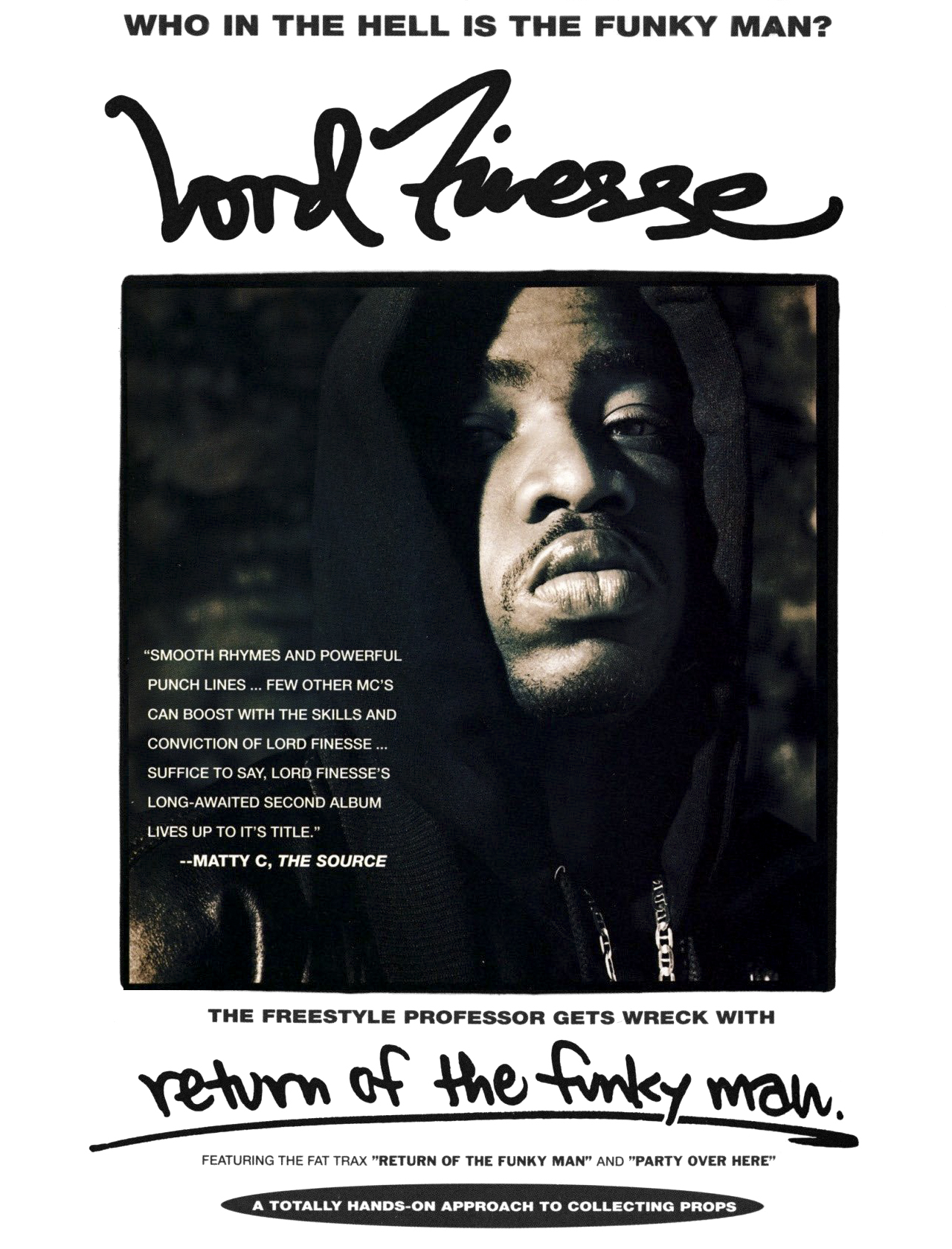
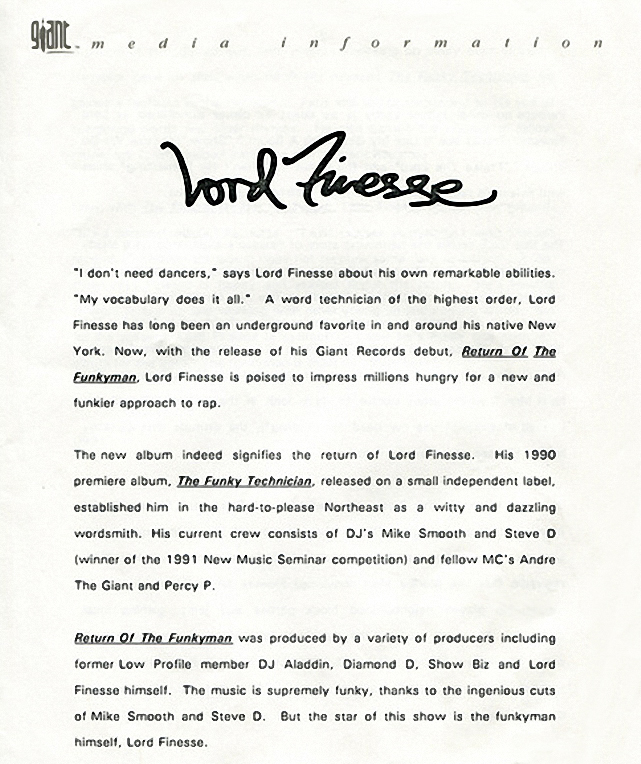
"I don't need dancers," says Lord Finesse about his own remarkable abilities. "My vocabulary does it all." A word technician of the highest order, Lord Finesse has long been an underground favorite in and around his native New York. Now, with the release of his Giant Records debut, Return of the Funkyman, Lord Finesse is poised to impress millions hungry for a new and funkier approach to rap. The new album indeed signifies the return of Lord Finesse. His 1990 premier album, The Funky Technician, released on a small independent label, established him in the hard-to-pease Northeast as a witty and dazzling wordsmith. His current crew consists of DJ's Mike Smooth and Steve D and fellow MC's Andre the Giant and Percee P. Return of the Funkyman was produced by a variety of producers including former Low Profile member DJ Aladdin, Diamond D, Showbiz and Lord Finesse himself. The music is supremely funky, thanks to the ingenious cuts of Mike Smooth and Steve D. But the star of this show is the funkyman himself, Lord Finesse. Perhaps no other rapper today is as adept at clever punchlines as Lord Finesse. Tracks like "I Like My Girls With A Boom," "Show 'Em How We Do Things," "Praise The Lord" and the debut 12" "Isn't He Something" shine with Finesse's racy sense of humor and facility for clever rhyme. The title tracks retells the harrowing story of Finesse's experience on a shady record label and he offers warning to other fledgling rappers about the dangers of signing with crooks. "Hands In The Air, Mouth Shut" takes on rappers who don't really know what they're talking about, while "Fat For The '90s" pairs Finesse and Andre the Giant in a memorable word battle. Finesse also offers insightful commentary, especially on "Stop Sweating The Next Man," which urges people to have faith in themselves ("Gonna rise instead of sinking / I use my head for thinking"), the attitude that certainly helped Finesse get where he is today. Cont'd...
 

Born and raise in the Bronx, the heartland of Rap, Lord Finesse began rhyming at young age. "When they introduced me to metaphors and similes in school, that was it," he recalls. Listening to well-known New York rap radio DJs like Marley Marl convinced Finesse he could make it as a rapper. He played neighborhood block parties and jams, gaining local popularity. However, making the transition to professional rapper wasn't easy. Family and friends told him it would be difficult, but his grandmother lent him $150 to record his first demo. "She told me, 'Follow your dreams,'" he recalls. A period of struggle ensued, with Finesse knocking on every door in town. He never gave up and, when he finally released The Funky Technician, he gained a foothold in the rap world. Fans and critics responded to his use of compound words and inner rhymes. He also earned the respect of fellow rapper Ice-T, who helped introduce him to Giant Records. Now, with The Return of the Funkyman, Lord Finesse breaks new ground. "It's a personal album," he notes. "I just express everything I went through recently." Though the album does recount some dark periods in his life, these days Finesse is happy and working with other young up-and-coming artists. But for the present, Lord Finesse is content to know he's made one slammin' album for the ages. The funkyman is most definitely back! - Press Kit (September, 1991). At the time, Finesse was easily one of the fiercest, most talented MCs! 

February 02, 2022

Brand Nubian "In God We Trust" (February 2, 1993)


"Everything is a balance," declares Brand Nubian rapper Lord Jamar. "That's what we try to show with our music -- the balance between the seriousness of trying to spread knowledge and showing that we're real people who enjoy life." On In God We Trust, Brand Nubian bring their inimitable mix of elements to a new level of precision and power. Knowledge and understanding parallel rage. Intensely held beliefs of the Five Percent Nation of Islam segue into party-hearty road tales. The ancient Muslim vocal of the first cut, "Allah U Akbar," blends with the sublime manipulation of the most sophisticated new technology. "This record is more organized and more rough," believes Sadat X. In God We Trust was recorded after the departure of original member Grand Puba Maxxwell; "It's just two different types of musical expression; people will be able to tell the difference between the two albums," says X, previously known to Nubian fans as Derek X. (Sadat is a more righteous, fitting name," he explains...) The urgent, multi-layered beats of the first single, "Punks Jump Up To Get Beat Down," set the stage: "The track is about not being taken advantage of in life," explains Jamar. "The feelings you have when someone tries to take advantage of you and what we would do if that happens. It's also beating them down with the sound," he says with a smile. "We're beating them down with the lyrics, the vocals, the mentality -- and physically, if it has to be." Brand Nubian formed less than two years before making their major label debut, when Sadat X and Lord Jamar left their retrospective outfits, the Chosen Few and KD & The Ever-Lovin' 3. Sincere, officially joined the group in time to record In God We Trust, although he had creative input on Brand Nubian's first album, One For All. "We'd been friends for a long time," Jamar recalls. "We both got knowledge around the same time." The New Rochelle, New York-based group made their debut at a 1989 New Music Seminar showcase. - Press Bio, 1993. Revisit Brand Nubian's sophomore LP, In God We Trust, below...


Here's the official press release from Brand Nubian...

January 15, 2022

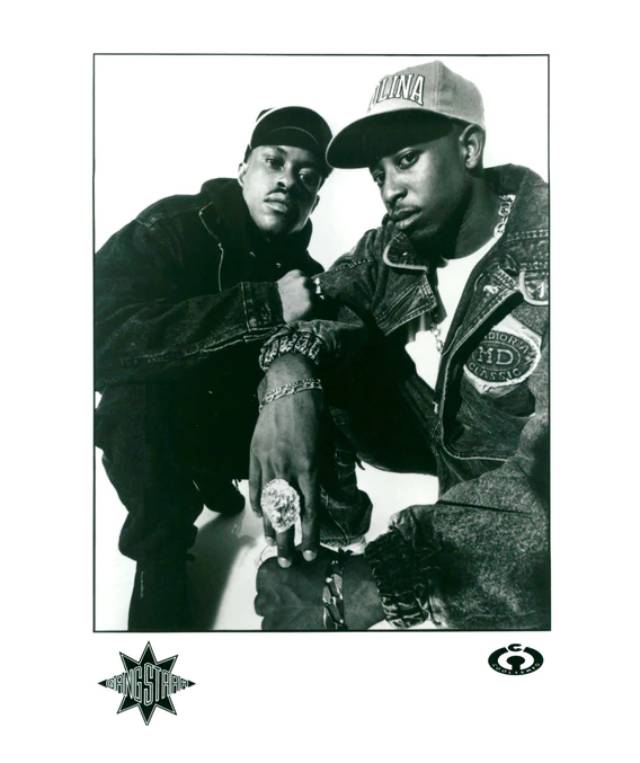
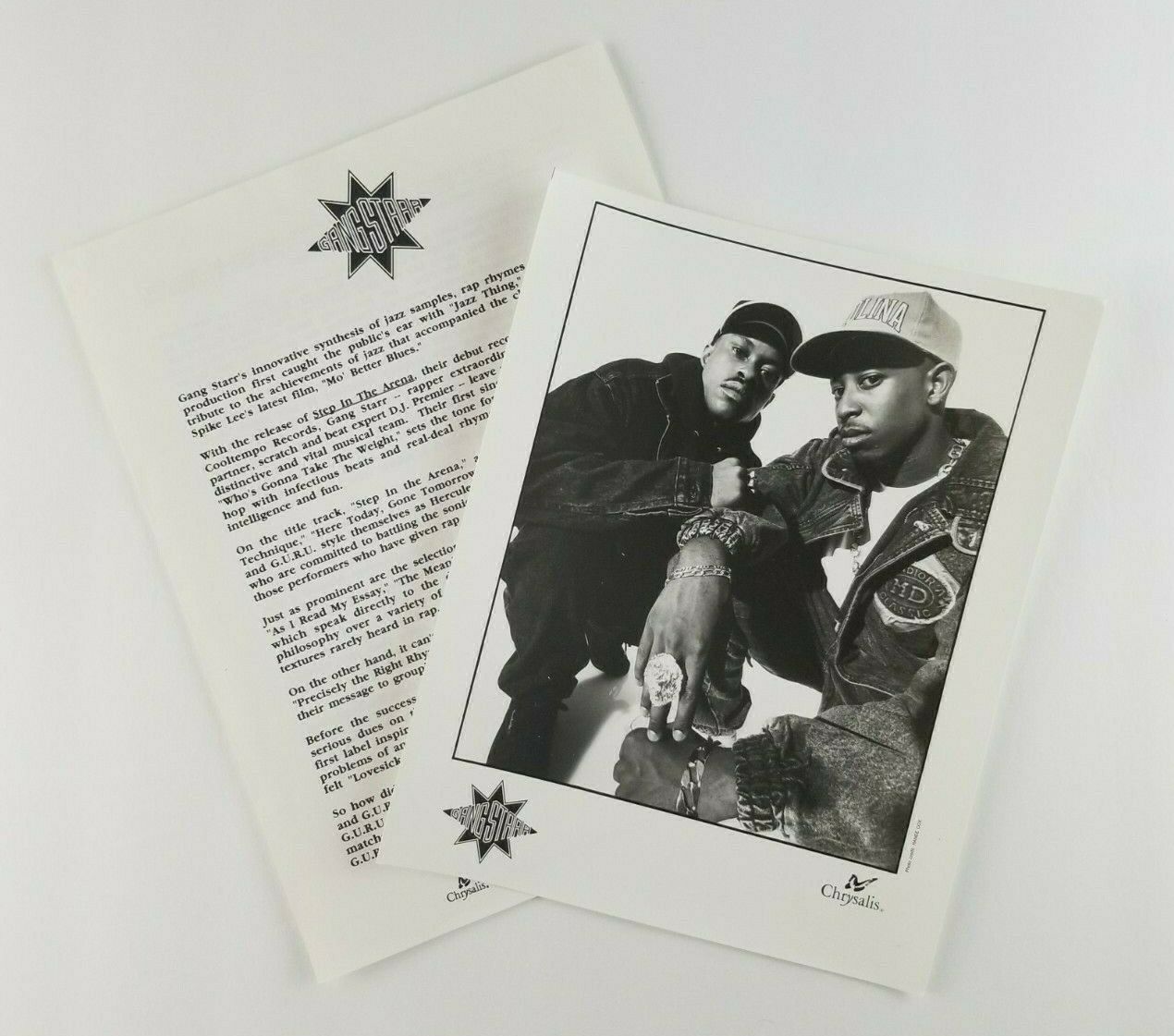
Gang Starr "Step In The Arena" (Press Kit: Jan. 15, 1991)


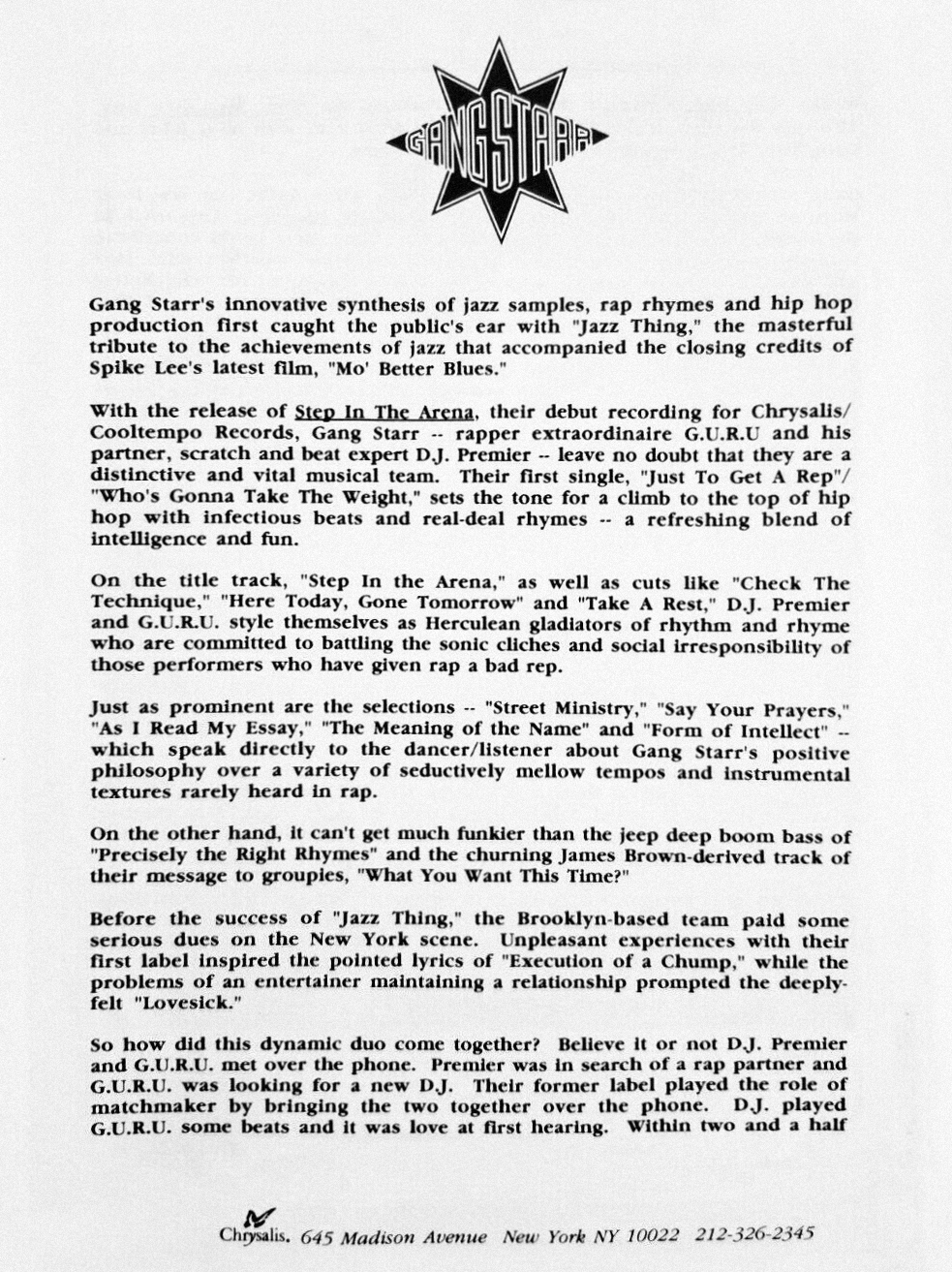
Gang Starr's innovative synthesis of jazz samples, rap rhymes and hip hop production first caught the public's ear with "Jazz Thing," the masterful tribute to the achievements of jazz that accompanied the closing credits of Spike Lee's latest film, "Mo' Better Blues." With the release of Step In The Arena, their debut recording for Chrysalis/Cooltempo Records, Gang Starr -- rapper extraordinaire G.U.R.U. and his partner, scratch and beat expert DJ Premier -- leave no doubt that they are a distinctive and vital musical team. Their first single, "Just To Get a Rap" / "Who's Gonna Take The Weight," sets the tone for a climb to the top of hip hop with infectious beats and real-deal rhymes -- a refreshing blend of intelligence and fun. On the title track, "Step In The Arena," as well as cuts like "Check The Technique," "Here Today Gone Tomorrow" and "Take a Rest," DJ Premier and G.U.R.U. style themselves as Herculean gladiators of rhythm and rhyme who are committed to battling the sonic cliches and social irresponsibility of those performers who have given rap a bad rep. Just as prominent are the selections -- "Street Ministry," "Say Your Prayers," "As I Ready My Essay," "The Meaning of the Name" and "Form of Intellect" -- which speak directly to the dancer/listener about Gang Starr's positive philosophy over a variety of seductively mellow tempos and instrumental textures rarely heard in rap. On the other hand, it can't get much funkier than than the jeep drum boom bass of "Precisely the Right Rhymes" and the churning James Brown-derived track of their message of groupies, "What You Want This Time?" Before the success of "Jazz Thing," the Brooklyn-based team paid some serious dues on the New York scene. Unpleasant experiences with their first label inspired the pointed lyrics of "Execution of a Champ," while the problems of an entertainer maintaining a relationship prompted the deeply-felt "Lovesick." Cont'd...


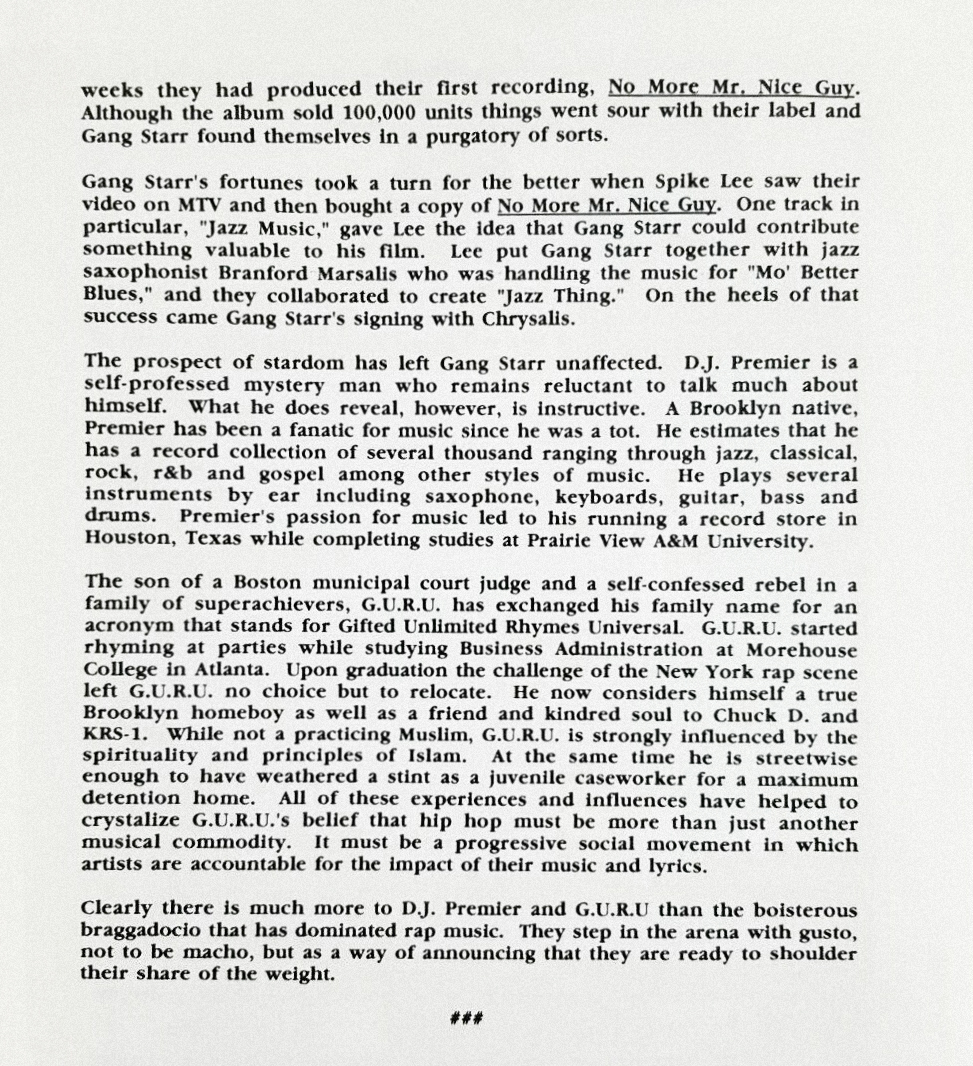
So how did this dynamic duo come together? Believe it or not DJ Premier and Guru met over the phone. Premier was in search of a rap partner and Guru was looking for a new DJ. Their former label played the role of matchmaker by bringing the two together over the phone. Premier played Guru some beats and it was love at first hearing. Within two and a half weeks they had produced their first recording, No More Mr. Nice Guy. Although the album sold 100,000 units things went sour with their label and Gang Starr found themselves in a purgatory of sorts. Gang Starr's fortunes took a turn for the better when Spike Lee saw their video on MTV and then bought a copy of No More... One track in particular, "Jazz Music," gave Lee the idea that Gang Starr could contribute something valuable to the film. Lee put Gang Starr together with jazz saxophonist Branford Marsalis who was handling the music for "Mo' Better Blues," and they collaborated to create "Jazz Thing." On the heels of that success came Gang Starr signing with Chrysalis. Cont'd...


The prospect of stardom has left Gang Starr unaffected. DJ Premier is a self-professed mystery man who remains reluctant to talk much about himself. What he does reveal, however, is instructive. A Brooklyn native, Premier has been a fanatic for music since he was a tot. He estimates that he has a record collection of several thousand ranging through jazz, classical, rock, r&b and gospel among other styles of music. He plays several instruments by ear including saxophone, keyboards, guitar, bass and drums. Premier's passion for music led to his running a record store in Houston, Texas while completing studies at Prairie View A&M University. The son of a Boston municipal court judge and a self-confessed rebel in a family of superachievers, Guru has exchanged his family name for an acronym that stands for Gifted Unlimited Rhymes Universal. Guru started rhyming at parties while studying Business Administration at Morehouse College in Atlanta. Upon graduation the challenge of the New York rap scene left Guru no choice but to relocate. He now considers himself a true Brooklyn homeboy as well as a friend and kindred soul to Chuck D and KRS-One. While not a practicing Muslim, Guru is strongly influenced by the spirituality and principles of Islam. At the same time he is streetwise enough to have weathered a stint as a juvenile caseworker for a maximum detention home. All of these experiences and influences have helped to crystalize Guru's belief that hip hop must be more than just another musical commodity. It must be a progressive social movement in which artists are accountable for the impact of their music and lyrics. Clearly there is much more to DJ Premier and Guru than the boisterous braggadocio that has dominated rap music. They step in the area with gusto, not to be macho, but as a way of announcing that they are ready to shoulder their share of the weight. - Press Kit, 1991. My favorite group of all time, periodT....