Showing posts with label Postcards. Show all posts

March 14, 2025

2Pac "Me Against The World" (30th Anniversary • 3/14/95)


Tupac Shakur is one gutsy brother. Or maybe two. The front-page Shakur is a punk, a convicted sexual felon and a fool, a hard case on a collision course with authority, a hot-head who checks himself out of the hospital hours after being shot five times and gives a stretcher-borne finger to the media. The record-making 2Pac who inhabits the recording studio, however, is a sensitive, wise and loving commentator, a straight-up observer of life and death whose measured, melodic flow gives his pained lyrics searing eloquence. In one of the many ironies that attends Shakur's existence, while the man is on his way to prison, his album is headed to the charts. Shot through the heart with grim reality and fatalism, set atop smooth, seductive atmospheres of gently rolling funk and soul, "Me Against the World" is the hip-hop album to beat in 1995. There's nothing unusual about reformed tough guys offering don't-follow-my-mistakes advice, but 2Pac cedes none of his gangsta hardness in telling young listeners not to join him in the thug life. "You could be an accountant, not a dope dealer... you could be a lawyer," he suggests, and he sounds serious. Such contradictions have always accompanied the tumult of 2Pac's combined life and art, but never before has the dichotomy been drawn in such sharp relief. The rapper-actor's fourth album begins with news dispatches about his November brushes with justice and violence, but 2Pac's obsession is evidently death, not spinning his public image. "If I Die 2 Nite," "Me Against the World" and "Death Around the Corner" ambivalently present death as everything from a fact of life to a desirable end. "I'm having visions of leaving in a hearse," he raps in "So Many Tears." "I'm suicidal / So don't stand near me / My every move is a calculated step / To bring me closer to an early death." Listen to the album, cont'd below...


Rather than an album of attempts at vindication, "Temptation" is the only song here that actually addresses the issues surrounding his sexual abuse conviction. Explaining the context of his love life, 2Pac comes off as patient and beleaguered, careful not to impose himself on a woman in the way the jury believed he did. Furthering the surprisingly positive message amid the prevailing gloom, "Dear Mama" is a tragic, tender expression of gratitude and forgiveness -- for Tupac, and for his troubled mother, Afeni Shakur. "Even as a crack fiend, mama, you always was the black queen / Mama, I finally understand for a woman it ain't easy trying to raise a man / You always was committed / A poor single mother on welfare / Tell me how you did it / There's no way I can pay you back / But the plan is to show you that I understand / You are appreciated." Likewise, 2Pac's ebullient tribute to "Old School" rap comes to terms with the past in a way that makes the future seem like an afterthought. If there's any way to separate the musician's reality from its creative translation, "Me Against the World" is one of the saddest and most affecting expositions on young black America ever offered for public display. Tupac Shakur makes the line between art and life impossible to discern, but both have the potential to leave an indelible impression. - Newsday (3/95)

June 24, 2022

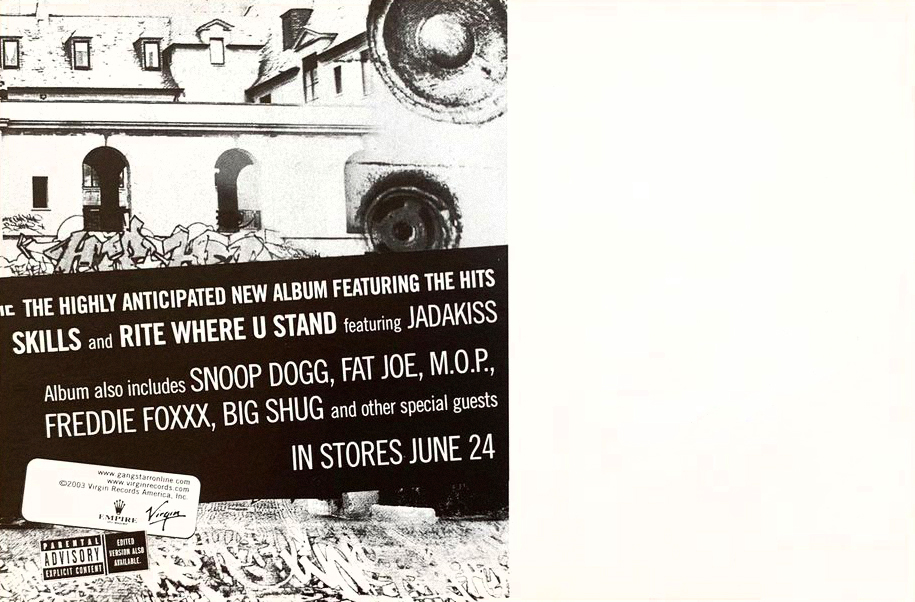
Gang Starr "The Ownerz" (June 24, 2003)


Hip-hop music is a complex art form. Similar to the rose that grew from concrete, hip-hop's roots began and will always be grounded in the street. As the years have gone by, we've seen the music make some dramatic changes, some for the better, some for the worse. Decades ago, when the critics were saying hip-hop would never last, few would have imagined the style being so big that it has broken into different genres. You have East Coast rap, West Coast rap, Dirty South, Gangsta rap, Commercial rap and Conscious rap. Back in the day the genre was much more tangible. You had your conscious rappers like Public Enemy, KRS-One and X-Clan, and then you had your smoothed out types like LL, Big Daddy Kane and MC Shan. Somewhere in the mix there were street dwellers like Rakim and Kool G Rap. Those were the cats you could really relate with, and then you had Gang Starr. If you lived in New York you could see these giants walking on the same streets you did. Hanging on the same block you hung on. But like Biggie once said, "Man Things Done Changed." Gang Starr was in a world all their own. Gang Starr embodied the rawness of hip-hop, they introduced the k.i.s.s. method to hip-hop -- they kept it simple. Noncomplicated Premier productions accompanied by Guru's no nonsense rhyme style took the music to a place it'd never been. Cont'd...


They've been in the game for 14 years and other than LL nobody from their time can say they're still hot. At the ages of 36 (Guru) and 34 (Premier) Gang Starr are back with another unscathed notch in their belt. The Ownerz is a step back into hip-hop's simpler times with hopes of taking it back to where it began. The first single, "Right Where U Stand," allows Guru the master to shine in his true battle rap greatness. He goes toe-to-toe with one of the nicest MCs in the game. We've hard Jadakiss spit over a Premier track before, but never with Guru by his side. The rhymes Guru spits on The Ownerz are along way from Jazzmatazz tryouts. Although he tries to murder the mic throughout the album, one of the album's highlights comes from the jazz-influenced "Deadly Habits." On songs like this, Guru takes the new school on a field trip and teaches them how to build a song around a topic. Guru is one of the few rappers who can pick a topic and never sway from it. While all of the shine is directed toward Gang Starr, the cameos do nothing but add more depth. Jada rips it on the single, Fat Joe and M.O.P. make you want to grab your Tim boots when they murder the track on "Who Got Gunz." But one of the most impressive rhymes comes from the one and only Bumpy Knuckles aka Freddie Foxxx on "Capture (Militia Pt.3)." Freddie should be a candidate for The Source's hip-hop quotable with this one. The verse is truly sick. Other highlights include "Riot Akt," "Same Team, No Games" and "In This Life" featuring Snoop. The Ownerz is a beautiful ode to hip-hop. Gang Starr remains undefeated in this game of one-hit wonders and drive-by artists.  - Asheville Citizen (August 1, 2003). You know the deal, my favorite group of ALL TIME! Rest In Peace, Guru!

February 08, 2022

Ghostface Killah "Supreme Clientele" (Feb. 8, 2000)


After the great Wu-Tang creative storm of 1999 was greeted with weak album sales and critical jeers, many were doubtful that the Clan Empire would be able to recover from the blow. Supreme Clientele not only eclipses the majority of recent Wu-related releases in terms of sheer hunger and in-your-face creativity, it marks a renewed sense of unification and strength within the Wu World Order. While the album's production credits go to such non-family members as Beatnut Juju, Carlos "Six July" Broady and the UMC's Hassan, all of its tracks were arranged by Ghostface and Wu sound-sensei RZA, giving the album a strong sense of focus. Beat-wise, the grooves harken back to the dungeon-raw Shaolin style of the Clan's mid-'90s prime, interwoven with early '70s soul orchestration, acid-rock guitar lines and thunderous bass loops. Lyrically, the Ironman's trademark rapid-fire cadence and vivid wordplay are as sharp as ever, particularly on the relentlessly gritty "Might Healthy" and on future-classic posse cuts such as "Buck 50," which features Method Man, Masta Killa, Cappadonna, and Redman. Supreme Clientele was well worth the wait, and a solid reminder as to why Ghostface's voice is the first one you hear on the Clan's inimitable debut. - CMJ New Music Monthly (February, 2000). Ghostface was razor sharp on this one. Revisit the LP below..

A copy of the February 21, 2000 review in CMJ New Music Report...

December 06, 2021

Black Sheep "Non-Fiction" (December 6, 1994)


....So, now it's Non-Fiction--another way of portraying what is "real," just in a more creatively flexible way. The Sheep's Non-Fiction is novel in that Dres says what others couldn't think to say. Non-Fiction also has a reality that may shock you: Lawnge gets on the mic.... If Lawnge can serve some lyrical purpose, then it could perhaps be forcing fools to appreciate Dres' resourcefulness and language manipulation. In "Autobiographical," Dres talks of his personal Hip Hop gestation and growth--but in a style that requires some ear reading. On "Peace to the N!ggas," Dres races past a plodding bass line that is reminiscent of "Similak's" homogenized mix. "N!ggas got reprimanded, remanded and then branded / I delve into myself to draw the strength to overstand it." There's certainly both a familial and communal consciousness that is nicely combined with MC combat. On "Do Your Thing": "Time zone / I groans for my sanity I told ya's / I woke up this morning and the world was on my shoulders / They say I'm destined to repeat / We'll see / I fall and rise / So when you look up to my son / You'll see me in his eyes." Furthermore, only Dres can flow "I clean up after my son 'cause that's my duty (dooty)" and sound fly on the shit. And, believe it or not, there's only two cuts about boning. Later, the Legion shows up on "We Boys." Here, Dres flows like a verbally feral Errol Flynn--spryly evading wackness with poetic parries.... With regard to most of the boardwork, Black Sheep sound like Black Sheep--needing, tweaky horns and strange bass lines that were charismatic on their vanguard debut. But some of the tracks are sheepish, shying away from the duo's hallmark edge and just keeping matters on the regular. So please treat this like a record and not some phantasmagorical myth. 'Cause it's rare to see such a keen grasp of the word go hand-in-hand with a skillfully firm grasp on the mic. And that's blessed within D-r-e-s. - Rap Pages (12/94).


The full review and backside of their promotional postcard are below...

September 26, 2021

Phife Dawg "Ventilation: Da LP" (September 26, 2000)


With Q-Tip already an established star and Ali Shaheed Muhammad scoring gold with his first post-A Tribe Called Quest project, Lucy Pearl, it's now Phife Dawg's turn to show and prove all by his lonesome. With Ventilation: Da LP, the five-foot assassin establishes himself as a streetwise iconoclast capable of mind-boggling vocal gymnastics. The album opens with a brief acoustic-guitar ditty that will make heads worry that Phife has gone soft--but only for about 45 seconds. A lyrical pyrotechnician, Phife wields the mike like a flamethrower, scorching listeners with hectic rhyme schemes that morph from one flow to another with true virtuosity. He tries on rap styles like most MCs try on sneakers, switching from the staccato assault of "Lemme Find Out" (featuring Pete Rock) to a singsongy old-school lilt on the unapologetically horny disco-flavored single "Ben Dova." On the album's best cut, "Alphabet Soup," Phife recalls the glory days of the Native Tongues but injects a harder edge. On "Beats, Rhymes & Phife," he looks back on growing up in a West Indian household in Queens, N.Y., and demonstrates that special mix of humor and intelligence that made Tribe famous. - Vibe (December, 2000). MTV deemed Phife's album "brilliant but ignored" ... don't make the same mistake! Revisit it below with production from Hi-Tek, Pete Rock, J Dilla (R.I.P.), Fredwreck and more.


Man, Phife Dawg is surely missed in Hip-Hop. Rest In Peace, 5-foot assassin...

June 03, 2021

Wu-Tang Clan "Wu-Tang Forever" (June 3, 1997)


Emerging in 1993, when Dr. Dre's G-Funk had overtaken the hip-hop world, the Staten Island, New York-based Wu-Tang Clan proved to be the most revolutionary rap group of the mid-90s and only partially because of their music. Turning the standard concept of a hip-hop crew inside out, the Wu-Tang Clan was assembled as a loose congregation of nine MC's almost as a support group. Instead of releasing one album after another, the Clan was designed to overtake the record industry in as profitable a fashion as possible -- the idea was to establish the Wu-Tang as a force with their debut album, and then spin off into as many side projects as possible. In the process, the members would all become individual stars, as well as receive individual royalty checks. Surprisingly, the plan worked.... The vision of the Wu-Tang Clan is undoubtedly due to the musical skills of the RZA. Under his direction, the group -- through its own efforts and the solo projects, all of which he produced or coproduced -- he created a hazy, surreal and menacing soundscape out of hardcore beats, eerie piano riffs, and minimal samples.... The Wu-Tang Clan's long-awaited second album Wu-Tang Forever arrived to great anticipation, and the double-disc set did not disappoint. Where contemporaries like 2Pac and the Notorious B.I.G. issued double-discs cluttered with filler, Wu-Tang Forever is purposeful and surprisingly lean (arguable, at best, in my opinion), illustrating the immense depth of producer RZA and the entire nine-piece crew. Each rapper has a different lyrical style, from Ol' Dirty Bastard's bizarre rants to Raekwon's story sketches, and RZA subtly shifts his trademark style for each song, creating an album of cinematic proportions. There are no great musical innovations on the album, since the Wu-Tang's signature blend of skeletal beats, scratchy samples, eerie pianos and spectral strings remain intact. Yet the music is more nuanced and focused than ever before, balanced equally between scary soundscapes and darkly soulful tracks. The result is an intoxicating display of musical and lyrical virtuosity, one that reveals how bereft of imagination the Wu-Tang's contemporaries are. - All Music Guide, 2002. Dig into in the archives for a lot more...


Some additional promotional items (coins + postcard) ...

March 14, 2021

2Pac "Me Against The World" (March 14, 1995)


No recent rapper has found himself better known but less understood than Tupac Shakur. Having spent more time in court than Perry Mason -- racking up charges of attempted murder along with a conviction for sexual assault -- Tupac burst into the mass consciousness as a tabloid-ready fiend. It only helped the media's cause that Tupac could fit an age-old cliche -- the angry young black man hellbent on revenge. Not that Tupac himself stood blameless in hawking this flat, inhuman image to the media. Every sneering statement and threatening gesture he made seemed calculated to appall and titillate viewers of the 11 o'clock news, leaving him a virtual cartoon of rage. Thankfully, the rapper's first album since his public demonization goes a long way toward humanizing him. While its title ("Me Against the World") may threaten more rounds of finger-pointing and macho posturing, the results offer a nuanced cautionary tale, full of vulnerability and even culpability. In "So Many Tears" and "It Ain't Easy," Tupac (aka 2Pac) explores, rather than exploits, his own nihilism, while in "Temptations" he maps out the war within himself (between doing the right thing and getting the quick fix). His most understanding passage comes in "Dear Mama" where he reconciles with his mother a former Black Panther and, later, a crack addict. Tupac's candor in describing his eventual appreciation of his mother shows true maturity. Revisit 2Pac's Me Against The World, cont'd below...


Tupac's words may stand out but his delivery and the music he matches them to hold only generic appeal. He favors a minimal style of hip-hop, with just the merest samples to decorate his bedrock of bass. This may have its draws, but originality isn't one of them a point that would matter less if Tupac's delivery had the musicality of hip-hop's greatest orators like the righteous Chuck D or the graceful Snoop Dog. In its stead, Tupac offers an Everyman quality, which at the very least ups his role as a besieged symbol. After all, "Me Against The World" hasn't held the No. 1 spot on Billboard's pop charts for the last three weeks for nothing. Tupac's public traumas resonate not only with alienated African-Americans but with teens of every race. If Tupac's articulation of his problems hasn't resulted in music as overwhelming as his notoriety, it has created a useful piece of sociology. His album offers a probing look inside a life normally seen skin-deep. - New York Daily News (April 11, 1995). Fans may not declare that 2Pac was the greatest RAPPER, but that vulnerability, trauma and everyman quality helped make 2Pac one of the most impactful artists of our generation. If you haven't already, dig in the archives HERE to read the album's original press kit. R.I.P., Tupac Shakur.

December 25, 2020

Supastition "Sounds of Xmas" + Naughty By Nature Christmas Card


Cormega shared an important message that echoes many of the sentiments that I wished to share today; he said: "2020 was a tumultuous year. Holiday season is hard to bear for those who may have lost loved ones during this challenging year. Think of your family and friends who lost someone this year and give them the gift of compassion and make sure they are OK. And if they aren't, do what you can to make sure they are. To all those who are feeling down at this moment, I send my sincere wishes of better days for you and I wish everyone a safe and good-moment-filled holiday season. Peace." Additionally, my brother Supastition released a song in 2007 that still captures relevant thoughts for the holiday season. The track is produced by D.R., and is a dedication to those less fortunate who are struggling during the holidays. You can hear that below, and as for the Christmas card above: if you were on their mailing list in the 90s, you undoubtedly got a Christmas card sent out by Tommy Boy Records. This particular card features Naughty By Nature and illustrations from the legendary Andre LeRoy Davis. The card says, "Have a Happy Holiday and a Naughty New Year! From your friends and family at Tommy Boy." I wish you all a very Merry Christmas and Happy Holidays, however you celebrate. I also wish you good health and better days ahead. Keep the faith! Much love and thanks for checking out the site and all of the support. Last minute gift ideas? HERE.

December 03, 2020

"Christmas On Death Row" (December 3, 1996)


I thought to myself... I might be the only person to want to revisit the Death Row Records Christmas album from 1996, but... I was wrong (yet again)! The good homie, Chaz Kangas, had already tackled a thorough retrospective on the album for an article in LA Weekly (12/16/14): He shares: "If you grew up an outspoken hip-hop fan around the holidays, chances are some well-meaning Secret Santa stuffed your stocking with a little holiday compilation called Christmas on Death Row. Yes, this album exists. Christmas on Death Row is an album that’s puzzled used CD store clerks since its release in 1996. It’s still baffling that the label that gave us The Chronic, Doggystyle and nationwide gangsta rap hysteria devoted its resources to a full-length album of Yuletide tunes. As great as the cover is — and we swear on Dasher and Dancer that a Death Row Christmas album couldn’t have a more perfect cover — once you press the play button, the album become quite (North?) polarizing. The cold December of 1996 was a weird, transitional time for Death Row Records. Flagship star Tupac had just been murdered. Dr. Dre had left the label, desperate to drop his “gangsta” image as he prepared his inaugural “positive” release on his new Aftermath imprint. Offshoot Death Row East was proving to be just a theory, and a roster of West Coast veterans sat with unreleased, completed albums while label head Suge Knight began what turned out to be a five-year prison bid. Wanting to ensure his label’s stability in his absence, Knight ended the year by overseeing the release of a double-disc Death Row Greatest Hits and Christmas on Death Row." Cont'd below...


"Although it’s been said, many times, many ways, this really isn’t much of a Christmas gangsta rap album. Opener “Santa Claus Goes Straight to the Ghetto” featuring Snoop Dogg, Bad Azz, Daz Dillinger and Nate Dogg, is what you would expect going into the album, both in terms of subject matter and quality. Snoop’s verse (a take on “The Twelve Days of Christmas”) sounds like it was written without really hearing the beat. Still, the track grooves enough, until we get to the album’s next cut, a surprisingly straightforward Danny Boy rendition of “The Christmas Song.” The bulk of the album contains similar rap-free, soulful renditions of Christmas standards. Some are passably cool, but then there are baffling moments, like 6 Feet Deep’s cover of “Frosty the Snowman,” which is almost insulting in its faithfulness to the original. It’s a cover of “Frosty the Snowman” on a Death Row album that sounds note-for-note like it could have been recorded by 98 Degrees... So, in the hyper-specific niche of hip-hop Christmas albums, were exactly does Christmas on Death Row fall? Probably somewhere in the middle. Death Row was far from the first hip-hop label to have a Christmas compilation. Profile’s Christmas collection in the mid-'80s gave us fun like “Dana Dane’s Coming to Town,” and 93’s A LaFace Family Christmas introduced OutKast to the world with “Player’s Ball,” a song that in its original version was about partying on Christmas Day. Christmas on Death Row wouldn’t be the last hip-hop holiday album, either. Ten years later we got A Dipset X-Mas, which wound up being the last major project to feature rapper Stack Bundles before his untimely death, as well as several Jim Jones Bad Santa-themed Byrdgang mixtapes in its wake. Compared to these projects, while it has the least amount of actual rapping, the soulful stylings make Christmas on Death Row one of the most consistent collections to throw on as background noise at the office holiday party while you try to make a move on Jennifer from accounts transferable." - Thanks, Chaz!

December 01, 2020

Jay-Z "In My Lifetime" (Postcard, 1994)

"In My Lifetime" is the debut single by Jay-Z. It is produced by Ski Beatz, and contains samples from "Oh Baby" by Aretha Franklin and two Soul II Soul songs: "Back to Life (However Do You Want Me)" and "Get a Life". The original version of the single was sold by Jay-Z and Damon Dash out of Dash's car in 1993-1994. It was then released by Payday Records in 1995, but Jay-Z had royalty conflicts with the label and decided to release his material through the label he co-founded, Roc-A-Fella Records. The single features a remix by Big Jaz and the B-side, "Can't Get Wid That," produced by Clark Kent. The song is not featured on either of Jay-Z's first two albums, but the Big Jaz remix is featured on the Streets Is Watching soundtrack and was first heard in the slept-on film, "Bullet," with Mickey Rourke, Michael K. Williams and Tupac Shakur (R.I.P.) in 1996. Above is the classic postcard sent out to promote the 12", and below you can stream the remix via Spotify. Jay-Z's career is that of a legendary hustler and business-man, who also happens to be one of - if not - thee greatest MCs of all-time! Much respect to Hov, Dame, Biggs and the whole Roc-A-Fella team!


Original artwork for the 12" single...

November 09, 2020

Wu-Tang Clan "Enter The Wu-Tang: 36 Chambers" (11/9/93)


"There have been many impressive collectives in the history of hip-hop, but none can compare to the impact, the illness, the innovation and the size of the mighty Wu-Tang Clan. The Staten Island-based lifeforce boasted nine members, all of whom could melt a mic at the drop of a dime: the RZA, the GZA, Ol' Dirty Bastard, Inspectah Deck, U-God, Raekwon The Chef, Ghostface Killah, Masta Killa and Method Man. At the epicenter of the group was producer/MC RZA, who in 1992 was fresh off a soured record deal with Tommy Boy Records. Eldest Clan member GZA was also on the rebound in '92, after releasing a full-length (as the Genius) on Cold Chillin' that he claims wasn't properly promoted. GZA, RZA and Ol' Dirty Bastard had been in a Brooklyn/Staten trio called All In Together back in the late '80s, and were well aware of each other's abilities. RZA had turned to producing his own music, and had a swarm of MCs coming through his Staten Island studio. "I had done different demos and worked with everyone in the Clan before 36 Chambers," he recalls. "My apartment was always the spot to come and rhyme." With a plan in place to form an MC army, RZA brought seven MCs (all but Masta Killa) together for a soon-to-be monumental self-released single in 1992, "Protect Ya Neck." After it jumped off, labels came calling and the Wu-Tang landed on Loud. Although their incredible debut wasn't an instant smash, it slowly built to an undeniable roar." Cont'd below...


"The album helped bring NYC hip-hop back to the forefront, momentarily stealing the spot away from Dre's left coast revolution. Boasting multiple singles, like "C.R.E.A.M." and "Can It All Be So Simple," 36 Chambers comprised a never-ending array of verbal styles and Kung Fu motifs. Says Raekwon, "It was like being in the Superfriends. You don't have the same power as the next n!gga, but you're all amazingly strong. That's what we was." RZA's tracks were also a revolution of their own, frequently pitting penitentiary-steel beats against mournful piano samples and itchy-fingered bass lines. "When we finished that album I thought it was the illest hip-hop record ever made," RZA beams. "I played that record as much as a person who had bought it." - Brian Coleman (More below).


Postcard + RZA and GZA chop through Wu-Tang's first classics below...
 

November 07, 2020

GZA "Liquid Swords" (November 7, 1995)


Genius/GZA is the fourth, and last, member of the mighty Wu-Tang Clan to demonstrate his talents in a solo format. But, like Method Man, Ol' Dirty Bastard and Raekwon's albums, these offshoots aren't typical solo records; Wu-Tang side projects never fly far from the nest. Each one, including Genius' Liquid Swords, is created with the same ingredients: rock-solid, devastatingly sparse beats and dirty hooks that infect like slow poison on the brain. It's all part of the Wu-Tang empire, which contains everything from its own line of merchandise to an amazing World Wide Web site. With all of the familiar earmarks in place, like tales about head-hunting Ninja warriors, GZA shows us his well-disciplined flow: it's unlike the double-edged rhymes of Raekwon, but more akin to Method Man's lyrical precision. "Labels" may be the most creative, as it corporates nearly every rap label into the lyrics, while "Duel of the Iron Mic" is a lyrical showcase for Ol' Dirty Bastard, Inspectah Deck, and others. Also be sure to hear Meth take over "Shadowboxin'." - CMJ, 2/96. I've posted about this classic LP numerous times over the years, so dig into the archives for reviews, videos & other promo item. It's still one of the greatest winter albums, ever! And FINALLY in the Year of the Wu...


A couple pieces from press releases + postcard up above...

November 05, 2020

2pac (Makaveli) "The Don Killuminati: The 7 Day Theory" (11/5/96)


The recording sessions that yielded Tupac Shakur's last album took place over seven Hennessy-soaked days in August 1996, while the multitalented rapper was concurrently filming two movies (Gridlock'd and Gang Release). Approximately 20 songs were put to tape at Los Angeles' Can-Am studios, 11 of which made the finished product. (Much of the remaining material - most notably three tracks produced by Quincy Jones' son QD3, whose sister Kidada was reportedly engaged to Shakur at the time of his death - would appear on various posthumous compilations.) That 'Pac's final work was produced mainly by Tyrone "Hurt M Badd" Wrice and Darryl "Big D" Harper - two Death Row Records also-rans who failed to draw interest even in the vacuum left by the departed Dr. Dre - and featured guest spots mostly from 'Pac's childhood friends and family, the Outlawz, speaks volumes about the climate at the label at the time. Released nine months earlier, 'Pac's double opus, All Eyez On Me, had been certified quadruple-platinum, making the controversial star the marquee name at the most successful company in rap music. Apparently, though, internal Death Row rivalries and tension were at play (no doubt compounded by the notorious "East vs. West" beef boiling between Tupac and Biggie and a host of other New York hip-hop figures). So with Snoop and the Dogg Pound in an adjacent studio, 'Pac closed ranks and rushed his supporting cast of underdogs through a blitzkrieg artistic process - creating a dark, insular, paranoid collection of songs he subtitled "The 7 Day Theory." The urgency of the album is palpable. (Many listeners have, in fact, suggested that 'Pac somehow "knew" that he was running out of time.) The way it captures the raw morbidity of a man staring down his enemies is as powerful as it is downright disturbing. (It's telling that Eminem, 50 Cent and Busta Rhymes chose to remake "Hail Mary" as a diss record aimed at Ja Rule.) Today, Makaveli, with all its attendant contradictions, remains 'Pac fans' favorite memorial to their hero after his passing. - XXL Magazine, 10/03. R.I.P. 2PAC. Revisit the LP below...


Below is a copy of (part) of XXL's feature on the LP in 2003...

September 13, 2020

The Notorious B.I.G. "Ready To Die" (9/13/94)


"...Though many rappers exaggerate about the lives they led before becoming performers, some are actually former drug dealers. Few have ever been as open in detailing their criminal past as Biggie Smalls, and none have ever been as clear about the pain they felt at the time. "He doesn't want anyone to see that he's not as tough as he thinks he is," said Ms. Wallace, the rapper's mother. "He cries inside. He bleeds inside. But he doesn't want anyone to see the vulnerable side of him." "Ready to Die" is, indeed, marked by pathos unusual not only in hip-hop but in pop music. "In street life you're not allowed to show if you care about something," said Mr. Combs, of Bad Boy Entertainment. "You've got to keep that straight face. The flip side of that is his album. He's giving up all his vulnerability. He's letting you know how he has felt about his mother. He's letting you know how he cried. How he has thought about killing himself." Though drug dealing carries tremendous heroic value with some young urban dwellers, he sacrifices the figure's romantic potential. His raps acknowledge both the excitement of drug dealing and the stress caused by the threat from other dealers, robbers, the police and parents, sometimes one's own. In presenting the downside of that life, "Ready to Die" offers perhaps the most balanced and honest portrait of the dealer's life of any in hip-hop. "He's trying to enlighten people to the way your mind thinks when you're broke, when you're young growing up and not feeling like nobody cares about you," Mr. Combs said. Cont'd below...


On "Everyday Struggle," for example, Biggie Smalls rhymes: "I know how it feel to wake up . . . / Pocket broke as hell/ Another rock to sell/ People look at you like you's the user/ Selling drugs to all the losers/ Mad Buddah abuser/ But they don't know about your stress-filled day/ Baby on the way/ Mad bills to pay/ That's why you drink Tanqueray/ So you can reminisce/ And wish/ You wasn't living so devilish." By expressing the self-loathing and self-doubt he felt while dealing, he hopes that his experiences may resonate with other living that life. "I want them stressed-out n!@@ers to be, like, 'Yo, this n!@@er be hitting it right on the nose, man,' "he said. "That's what I'm trying to do." And he added, venting those feelings was also therapeutic. "I got a lot off my chest with that album." And he has put a lot in his pocket. Next month he will move his mother from the apartment in which she has lived for 25 years and into a house in the Park Slope section of Brooklyn. But despite new-found economic independence and the fear he feels while sitting in his own home, he is reluctant to move. "I could never see myself moving in the suburbs," he said. "It ain't going to be right, and the lyrics are going to be soundin' nasty. I know it. There won't be nothing to rap about except the birds." - NY Times (12/18/94). Full story can be read HERE.

August 01, 2020

Big L "The Big Picture" (20th Anniversary + Press Kit, 2000)


From the time Lamont Coleman put his Children Of The Corn crew together (with Mase and Cam'ron), to the moment he met underground legend Lord Finesse (who dubbed him Big L after a jaw-dropping freestyle on the street), to his sour experience as a major label recording artist in 1992, to his founding of Flamboyant Entertainment, Big L always saw the "big picture" in this hip-hop industry. He was always setting up for the future; even his rhymes couldn't be confined to just the present. The future (and the present) is August 1st, when Flamboyant Entertainment, in conjunction with Rawkus Records will release these timeless passages, collectively known as The Big Picture. In February 1999, a bullet ended a career of memorable rhymes and punchlines. When talented individuals leave the world prematurely, it is constantly stated that they were on the verge of greatness. With Big L, this was no cliche. It is clearly evident on The Big Picture. Noted producers such as DJ Premier ("The Enemy," "Platinum Plus") and Pete Rock ("Holdin' It Down," "Who You Slidin' Wit"), as well as emerging hitmaker, Mike Heron (with the #1 single "Flamboyant") contribute on this set. The guest appearances read like a hip-hop timeline. On one end of the spectrum, there's Big Daddy Kane ("Platinum Plus"), Kool G Rap ("Fall Back"), and Sadat X & Guru ("Games"); and on the other end is another fallen soldier, Tupac ("Deadly Combinations"), A.G. & Stan Spit along with songstress and Hot 97 radio personality Miss Jones ("Holdin' It Down"), Fat Joe ("The Enemy"), and O.C. ("The Triboro"). The Big Picture is the result of hard work and careful planning.


Since Big L founded Flamboyant Entertainment to serve as an umbrella company for his music and entertainment ventures, his career was moving like pieces of Kasparov's chessboard. As a CEO in a budding enterprise, his concerns became more global. He had staff, partners, and more importantly, he had local artists who deserved a break. In 1998, when he released the now classic, "Ebonics," the purpose was to set up the D.I.T.C. album, the company, as well as his next album. Jay-Z and Roc-A-Fella Records approached Big L that year. L agreed to join the roster after he successfully negotiated (which took nearly six months) for fellow Harlemites, McGruff and C-Town, to accompany him on the label. Three days before the Flamboyant party to announce the signing, Lamont Coleman was gunned down. Big L will forever be a legend in the streets of Harlem, especially around 139th & Lenox. To know him was to love him and The Big Picture is a testament to that love. Flamboyant Entertainment and Rawkus Records present Big L's legacy... The Big Picture. - Press Kit, 2000.