Showing posts with label Adverts. Show all posts

April 09, 2026

Chino XL "Here To Save You All" (30th Anniversary)


New Jersey rapper Chino XL has had an underground following for years but now he's threatening to break through big time. Earlier this year, there was his "Kreep," an ingenious and haunting hip-hop groove based on "Creep" from English alt-rock band Radiohead. With his debut album for Rick Rubin's American label, Chino has delivered a knockout, a hurricane of ribald, rowdy rhymes and pummeling yet jazzy grooves. Chino XL is a throwback to an earlier generation of rappers who combined braggadocio with brains; their rhymes weren't just littered with profanities but often were genuinely clever. Some of Chino's lines should cause bursts of laughter among the pop-culture literate. In "Partner to Swing," he raps, "I catch more heat than a Hasidic Jew/ You catch two thumbs down like a Matty Rich movie review/ Your individuality's missing like Adam Walsh/ Your image is faker than the hair on Diana Ross." But Chino better watch his back; some of those he tackles aren't likely to be amused. Quincy Jones was so irked by Chino that he refused to allow any of his music to be sampled. Chino takes on everyone and everything: Naomi Campbell, D'Angelo, O.J. Simpson, teen pregnancy, Earth Day and even his own record label. Be warned: Some of the language and imagery are raw. The only question is what Chino XL can possibly do for an encore. As Chino says, he's so def, he needs closed captions. - Knight Rider News / Southern Illinoisan (Nov. 14, 1996). 


Rest In Peace, Chino XL.

April 06, 2026

Nas "I Am..." (Spin Magazine - June, 1999)


"My mom got me a typewriter when I was, like, 11," says Nas. "I got plenty good on it, too. I was up to 50 or 60 words a minute." Kicking back in his record label's Manhattan office, the 25-year-old Nasir Jones doesn't exactly look like he's headed for the typing pool. Decked out in the blue-and-orange haunte-urban color scheme of the season--in his own Esco line, of course--he's slouched in a chair, sipping bottled water, and talking in the airy tones of an after-hours jazz musician. "I used to freestyle all the time," he says. "Now I suck." But as any hard-core hip-hop fan will tell you, no one rocks the Olivetti like Nas. "With Nas, every lyric is visual," labelmate Wyclef Jean once said. "You could just take a song, write it down, put it in a book, and read it." Indeed, Nas all but invented a new school of hip-hop realism on his 1994 debut, Illmatic. A word-drunk masterpiece of ghetto reportage, the album describes baseheads, task force raids, and other facts of life in the projects in such quickly unfolding narratives that it defined a new genre: the book on DAT. Now, on is third solo album, I Am..., he's revisiting the early-90s New York aesthetic of spare sound and vivid imagery, leaving behind the Mafioso posturing and swooping crane shots of his recent past. In the years since emerging as hip-hop's messiah, Nas has released the more commercial solo album It Was Written, made a soundtrack for a bullet-riddled imaginary mob movie with rap supergroup the Firm, and learned a lot about the dangers of life in hip-hop's Playa's Club. "I think the big purchase I really regret was all the marijuana," he says. "I probably spent $2-3,000 a week on weed." Call this Nas's Hollywood period--he also costarred in Hype Williams's Belly as a credible, conflicted drug dealer, and even cowrote some of Will Smith's Big Willie Style. While Nas's recent projects have had their literary high points--including "I Gave You Power," a song told from the perspective of a Desert Eagle semiautomatic on It Was Written--they stray from the gritty tales of the Timberland-shod street narrator who emerged in '94. "I was just flowin'," Nas says of his early years. "It was just straight from living in the projects, with all those ideas and music in my head." 


Though Nas grew up in the rap feeder school of Queensbridge Projects--fellow alums include Mobb Deep, Biz Markie, and Rakim--at least some of that music in his head came from his father, jazz trumpeter Olu Dara (who played on Illmatic). "My pops always had a lot of music around the house, so we'd blow the trumpet and play the guitar and the flute and all that shit," Nas says. His own musical interests took a less classical direction--"I always wanted my mom to get me a Roland 808"--and Nas soon found his metier. Already writing his own comic books featuring heroes such as a boxer named Honey-boy and a superhero named Sea Man ("He was like Aquaman and Conan combined"), the young author inevitably gravitated to such hip-hop storytellers as Kool G Rap and Rakim. Nas once again looks to them for inspiration on I Am..., which he hopes will garner both the props of his first album and the multiplatinum chart success of his second. And while it does include trendy guest spots by the likes of Timberland and Aaliyah, it also includes sharp-eyed ghetto sociology, song-length metaphors, and a distinctly intellectual way with the boast. On the bombastic anti-playa-hater anthem "Hate Me Now," Nas claims not to be the richest or pimpin'-est rapper but rather the "most critically acclaimed / Best storyteller / Thug narrator." In the age of No Limit financial values, it's almost touching, as is the new song "Money Is My Bitch." "Yeah, I had a falling out with money," Nas says. "If she was a nice woman instead of a bitch, she would've treated me good. But she's just my bitch, so I can't really let her run my life." - Spin Magazine in June, 1999. 

April 04, 2026

Big Pun "Yeeeah Baby!" (The Source, 2000)


Imagine the puzzle faced by a larger cat--slightly heavier than the average entertainer--tryin' to make a name in hip-hop. If you're one of the Fat Boys, you make light of your size, using your music as a way to run one long-ass joke about your weight. If you're Biggie or Fat Joe, you come with the raw, ice grillin' any and everybody who might even think about crackin' a "fat" joke. But what do you do when you're not only one of the sickest MCs in the history of the sport, you also happen to be a genuinely funny mu'fucka? Before he left to join our fallen heroes, Big Pun gave us the answer in the form of the latest, and sadly, his final album, Yeeeah Baby! As the re-up to 1998's Capital Punishment, the portly Puerto Rock's last haymaker at the world offers an even more in-depth peep inside the heart and soul of a man in constant struggle with himself. But don't get it fucked up. Like on... Punishment, you won't hear Big Pun feelin' sorry for himself on this album. Instead, you'll get a backstage pass to the all-out jam that was Pun's personality: street-wise, intellectually sharp, sex-crazed--and funny as all hell. The album's intro, straight outta late-night shock TV, features Lord Sear (R.I.P., of Stretch & Bobbito fame) playing a Dr. Frankenstein-type who's puttin' the finishing touches on his latest creation: The Punisher, the ultimate MC genetically engineered from equal parts Kane, G Rap and, believe it or not, Eddie Murphy. From there, Yeeeah Baby! unfolds like a road-map, guiding travelers in finding more and more ways to laugh at the good, the bad and the ugly aspects of life. "It's So Hard," the Donnell Jones duet y'all have been hearin' blowin' up your radios, contains just the right mix of yin and yang that made Pun, like B.I.G. before him, so popular. And when Pun proclaims that after losing a hundred pounds, he's "ready to live," you'll fight back a tear while crackin' a smile, knowing that he lived his tragically short life to the fullest. Cont'd below...


For those of y'all dirty-fingernail types, who've been hittin' the rewind button since "Dream Shatterer," check "Leather Face," which has been makin' the mixtape and club rounds since late January, along with "Off With His Head," featuring Prospect, "We Don't Care," with Cuban and "The Wrong Ones," on which TS newcomer Sunkiss helps Pun blow some steam. And just in case all the "Latino explosion," backlash made you think he would tone down his ethnic pride, the salsa-stained "100%," featuring Tony Sunshine, will have you paradin' up Fifth Avenue with damn near every proud Puerto Rican in the New York metro area come summa'time. From straight gangsta cuts like "You Was Wrong," with fellow BX battlecat Drag-On, and "Watch Those" to hilarious stabs like "My Dick," "Laughing At You" and "N!gga Shit," Big Punisher's last hurrah testifies his penchant for the punch line. Not so much the "clincher," as in "joke," but rather the witty, "one up on that ass" remarks from someone who has had his share of life--and gone back for the free refills. Ultimately, Yeeeah Baby! will be judged more for the unfortunate circumstances surrounding its release than for its collection of true-to-form hip-hop moments. Heads, however, will realize--or recognize, if they aren't already die-hard fans--that Big Pun was a master of his craft. And as for those pop-hungry neophytes who never would've thought to pick up on his music before his death, I'd bet all the unmarked bills in your favorite radio station's stash-box that Pun is lookin' at y'all right now--laughin' his muthafuckin' ass off. - The Source, 2000. Rest In Peace to Christopher "Big Pun" Rios.
 

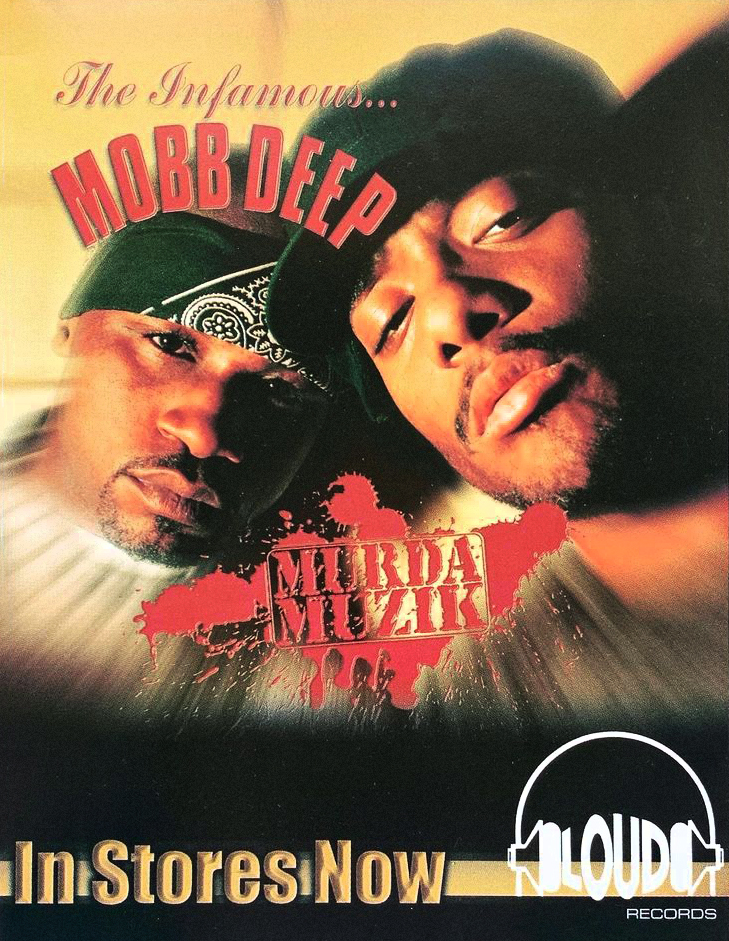
Here's the Loud Records commercial for the release of Yeeeah Baby!

April 02, 2026

Bahamadia "Kollage" (CMJ New Music Report, April 1996)


Philadelphia's Bahamadia isn't trying to go punch-for-punch with most of her male contemporaries. Her lyrics aren't the type to knock you out in one breath; instead they keep you off balance with a peppering of texture-rich rhymes that add up to a positively potent result. At a time when some MCs (Ol' Dirty Bastard and Busta Rhymes, for instance) seem ready for their own comic strip, Bahamadia remains in the shadows, honing her skills as if she's preparing for an MC battle to the death. Before we can say that she was discovered by Gang Starr's Guru in 1993, you'll notice her thick, earthy monotone flow, creeping up on you like a lyrical nerve gas that bears similar qualities to Guru's, as she remains resolute, confident and strong throughout her artistic debut, Kollage. With sparse, beat-drenched production courtesy of DJ Premier, Da Beatminerz and others, tracks like the infectious "Word Play" swoop you up in a sea of bass, while other cuts, like "Innovation," leave behind a jazzy residue as Bahamadia teaches her peers how to leave an impression without going into hysterics. "I Confess" is spiced by the use of Marvin Gaye's "Let's Get It On," making it the most accessible radio cut, but we favor her square-off with fellow Philly natives the Roots on the live "Da Jawn," inspired by Funky Four Plus One's "It's The Joint." - Glen Sansone (CMJ New Music Report, April 1996). Revisit this gem of an album below and you can still catch her live on tour.


A copy of the album review in CMJ New Music Report is below...

March 14, 2026

2Pac "Me Against The World" (The Associated Press, 1995)


"It ain't easy being me -- will I see the penitentiary, or will I stay free?" wonders Tupac Shakur, who calls himself 2Pac on his latest album, "Me Against the World." That question was answered last winter when Shakur was sentenced to a New York prison on a sex-abuse charge after a string of legal battles across the nation. But even behind bars, Shakur still remains a step ahead of the rap pack with "Me Against the World," a stellar mix of thought-provoking rhymes backed up by smooth base sounds and slick beats. In Shakur's mind, most of his problems are the cause of a troubled ghetto childhood and jealous people out to get him. His fury and anger are peppered throughout the disc, most prominently on "F The World," a fierce and foul rebuke of his many critics. But this album is more than a troubled man's outburst against the world; just when you think he is about to explode, Shakur switches gears and drops his guard to reveal a softer side. On the disc's most poignant track, "Dear Mama," a solemn Shakur gives thanks to his mother for supporting him through all the rough times. And "Old School" represents the album's rare lighthearted moment, as he gives props to all the old school rappers in a tune that will make any true-blue fan of the genre want to break out that old Run DMC or Slick Rick tape. "Me Against the World" is rife with contradictions; on "Young N!ggaz," he chastises young black males who see the thug life as their only way out of poverty; yet on other songs, he empathizes with drug selling and gang banging, a life he so often has embraced. But that doesn't take away from this disc's power, it just highlights the complexity of urban street life, and how hard it is to present difficult issues in black and white terms. - The Associated Press, 1995. My favorite song on the album: "So Many Tears." What's yours?


Arguably the best 2Pac album - yes or no?

October 31, 2025

Big L "Harlem’s Finest: Return Of The King" (Album Stream)


Big L's Harlem’s Finest: Return Of The King is a posthumous release that celebrates Big L’s lyrical brilliance and features unreleased gems, rare freestyles, remastered classics and more. Harlem’s Finest: Return Of The King features contributions from Nas, Method Man, Mac Miller, Jay-Z, Showbiz, Herb McGruff and others. The album is intended to both preserve and elevate Big L’s legacy as one of hip-hop’s most gifted lyricists and is the result of Mass Appeal, Nas and the rapper’s family and estate all working together to ensure its completion. The artist’s family wrote: “Big L has a long history with Nas as they both signed to Columbia in 1992. This is a full circle moment and we are excited for y’all to hear what we’ve been working on. As some of you may have noticed, many Big L songs have been removed from streaming services over the past few years. Those songs were unmixed/unmastered, samples were not cleared and many of the producers weren’t paid or credited properly. Thanks to the team at Mass Appeal we will be re-releasing the best versions of these songs, rare freestyles and a few surprises...” Harlem’s Finest: Return Of The King is the fifth installment in Mass Appeal’s Legend Has It… series of records by hip-hop trailblazers, following Slick Rick’s Victory, Raekwon’s The Emperor’s New Clothes, Ghostface Killah’s Supreme Clientele 2 and Mobb Deep’s The Infinite. Rest In Peace, Big L. Listen to the album below...


You can cop the physical versions HERE.

March 14, 2025

2Pac "Me Against The World" (30th Anniversary • 3/14/95)


Tupac Shakur is one gutsy brother. Or maybe two. The front-page Shakur is a punk, a convicted sexual felon and a fool, a hard case on a collision course with authority, a hot-head who checks himself out of the hospital hours after being shot five times and gives a stretcher-borne finger to the media. The record-making 2Pac who inhabits the recording studio, however, is a sensitive, wise and loving commentator, a straight-up observer of life and death whose measured, melodic flow gives his pained lyrics searing eloquence. In one of the many ironies that attends Shakur's existence, while the man is on his way to prison, his album is headed to the charts. Shot through the heart with grim reality and fatalism, set atop smooth, seductive atmospheres of gently rolling funk and soul, "Me Against the World" is the hip-hop album to beat in 1995. There's nothing unusual about reformed tough guys offering don't-follow-my-mistakes advice, but 2Pac cedes none of his gangsta hardness in telling young listeners not to join him in the thug life. "You could be an accountant, not a dope dealer... you could be a lawyer," he suggests, and he sounds serious. Such contradictions have always accompanied the tumult of 2Pac's combined life and art, but never before has the dichotomy been drawn in such sharp relief. The rapper-actor's fourth album begins with news dispatches about his November brushes with justice and violence, but 2Pac's obsession is evidently death, not spinning his public image. "If I Die 2 Nite," "Me Against the World" and "Death Around the Corner" ambivalently present death as everything from a fact of life to a desirable end. "I'm having visions of leaving in a hearse," he raps in "So Many Tears." "I'm suicidal / So don't stand near me / My every move is a calculated step / To bring me closer to an early death." Listen to the album, cont'd below...


Rather than an album of attempts at vindication, "Temptation" is the only song here that actually addresses the issues surrounding his sexual abuse conviction. Explaining the context of his love life, 2Pac comes off as patient and beleaguered, careful not to impose himself on a woman in the way the jury believed he did. Furthering the surprisingly positive message amid the prevailing gloom, "Dear Mama" is a tragic, tender expression of gratitude and forgiveness -- for Tupac, and for his troubled mother, Afeni Shakur. "Even as a crack fiend, mama, you always was the black queen / Mama, I finally understand for a woman it ain't easy trying to raise a man / You always was committed / A poor single mother on welfare / Tell me how you did it / There's no way I can pay you back / But the plan is to show you that I understand / You are appreciated." Likewise, 2Pac's ebullient tribute to "Old School" rap comes to terms with the past in a way that makes the future seem like an afterthought. If there's any way to separate the musician's reality from its creative translation, "Me Against the World" is one of the saddest and most affecting expositions on young black America ever offered for public display. Tupac Shakur makes the line between art and life impossible to discern, but both have the potential to leave an indelible impression. - Newsday (3/95)

March 08, 2025

New Jack City (March 8, 1991) + Original Soundtrack


New Jack City: a cinematic and musical powerhouse that defined an era! Few films capture the raw energy and social turbulence of the early ‘90s quite like New Jack City. Released in 1991 and directed by Mario Van Peebles, this crime drama remains one of the most influential films in Black cinema, thanks to its gripping storytelling, powerful performances, and an unforgettable soundtrack that epitomized the New Jack Swing era. A gritty tale of power and betrayal at its core, New Jack City is a modern gangster epic, chronicling the rise and fall of Nino Brown (Wesley Snipes), a ruthless drug kingpin who turns a Harlem apartment complex into a crack empire. Opposing him are Scotty Appleton (Ice-T), a street-smart cop with a personal vendetta, and Nick Peretti (Judd Nelson), his brash partner. The film also features standout performances from Chris Rock as a tragic crack addict, Pookie, and Allen Payne as Gee Money, Nino’s closest confidant whose loyalty is tested. With its commentary on the devastating impact of crack cocaine on Black communities, New Jack City was more than just entertainment—it was a cultural statement. The success of the movie helped solidify Wesley Snipes as a leading man and Ice-T as more than just a rapper-turned-actor. 


If the film was a cultural juggernaut, its soundtrack was the pulse that kept it alive. The New Jack City soundtrack, released via Giant Records, was a perfect encapsulation of the era’s dominant musical genre—New Jack Swing. Produced by titans like Teddy Riley and featuring artists at the peak of their powers, the album became a crucial companion to the film’s impact. Standout tracks: "New Jack Hustler (Nino’s Theme)" – Ice-T delivers a blistering anthem that encapsulates the ambition and ruthlessness of Nino Brown, blending aggressive lyrics with a slick beat. "I Wanna Sex You Up" – Color Me Badd’s breakout hit, a silky-smooth blend of R&B and pop, became a chart-topping success that transcended the film. "For The Love of Money/Living for the City" – Troop, LeVert, and Queen Latifah merge The O’Jays’ classic with Stevie Wonder’s soulful storytelling, creating an anthem about ambition and struggle. Upon release, New Jack City was both a box-office hit and a cultural phenomenon. Grossing over $47 million on a modest budget, it became one of the most profitable films of 1991. Critics praised Snipes’ electrifying performance and the film’s unflinching take on the crack epidemic. However, some also critiqued its glorification of gang culture and violence. More than just a movie and album, New Jack City is a defining piece of ‘90s Black entertainment—stylish, provocative, and unforgettable. Watch the movie again when you have time!

February 25, 2025

Little Brother "The Listening" (Deluxe Edition, 2003)


You don't know your future if you don't know your past. North Carolina trio Little Brother puts its own twist on this oft heard truth. The group's first album brims with reverence for hip hop pioneers, especially on "So Fabulous," into which they weave smile-inducing tributes to artists as divergent as Kool G Rap and Digable Planets. But these cats aren't just back-in-the-day revivalists--they add their own distinctive spin. Structured like a daily radio broadcast, The Listening unfolds into one of the most addictive debut platters in recent memory. Down-to-earth MCs Phonte and Big Pooh have great chemistry and thematic breadth: They craft emotional verses to an infant son and an incarcerated brother on "Away From Me," but also offer comic relief, as when Phonte recalls quoting Trick Daddy at a pretentious poetry reading ("The Yo-Yo"). Balancing their wordplay, producer 9th Wonder meticulously builds soul-drenched grooves like the bouncy swing of "Shorty on the Lookout." Having learned their lessons well from hip hop innovators, Little Brother stakes claim to a promising future. They've definitely been listening. - Vibe Magazine (April, 2003). I noticed they released a Deluxe Edition which includes all the bonus tracks in one place and the original album's instrumentals. Listen to that deluxe edition of The Listening now on it's original release date.


Props to Phonte, Rapper Big Pooh and 9th Wonder.

February 20, 2025

Lord Finesse "The Awakening" (Hip-Hop Connection, 1996)


Lord Finesse's classic 'The Funky Technician' helped establish the now-famed DITC clique, introducing Show & AG and featuring productions by DJ Premier and Diamond D. The 'Return Of The Funky Man' set continued in a similar vein, but had little success. Three years later, and now on his fourth label, Finesse returns with 'The Awakening'. Although much was recorded during his period at Bandoola Records, it still sounds fresh in '96. The recent 'Hip 2 The Game' single was a good indicator -- Fineese's well constructed lyrics over self-produced beats, which while more mellow than previously, are hard enough to satisfy. 'No Gimmicks' (featuring KRS-One), the omitted B-Side, doesn't appear here either, but its replacement, 'Brainstorm' -- again featuring KRS but also OC -- isn't likely to disappoint. Elsewhere AG successfully collaborates with Finesse on the posse cut "Speak Ya Peace'; while other efforts like 'Food For Thought' and 'Flip Da Script' are admirably solid. Although technically an EP, 'The Awakening' is another consistent effort by Finesse, and unlike some full-length efforts, contains no filler material. - HHC, 96. Finesse is still one of the best out of D.I.T.C!

The full review and an OG sticker from The Awakening are below...

August 28, 2022

RZA "Digital Bullet" (August 28, 2001)


Digital Bullet is RZA's second album under his latest alias, as Bobby Digital. It's no shock that he brought Bobby back; the first Digital outing, Bobby Digital in Stereo, was a high mark in the Wu Tang Clan producer's prolific career. What is a bit surprising is the sound of this effort, which frequently stretches all the way back to the mystical murk of the Clan's first album, Enter the Wu-Tang. The muffled beats and disorienting, late-night soundscapes of that hip-hop classic have been imitated countless times since its 1993 release, but nobody does 'em like the RZA, and uneasy tracks like "Must Be Bobby" and "Domestic Violence Pt. 2" seem to bring him full circle -- as does the presence of several Clan members, including the jailed ODB. Even the nods to the mainstream -- "Glocko Pop" and the swaying single "La Rhumba" -- seem, like RZA's best work, to have arrived from a slightly different dimension. Meanwhile, there is a storyline to this installment of the Digital story, but as on In Stereo, listeners have to use some imagination to fill it out; RZA's rhymes are often as evocative and opaque as the kung-fu flicks he loves. But as always, he creates tracks that are more about atmosphere than message -- and when he's on his game, as he is here, it's hard to argue with that approach. - AllMusic. As RZA himself put it, “My birth name is Bobby Diggs. So at the time, creatively, I felt like I was in a digital frame…As Bobby Digital, I could use a character to describe some of the earlier days of my own life. Partying, bullshitting, going crazy, chasing women, taking drugs. It was a mixture of fiction and reality together to make a character I thought would be entertaining.” Audiences reacted by driving the release up to number 24 on the Top 200 and a Top 10 position on the R&B/Hip Hop Albums chart. Now, revisit the RZA's Digital Bullet from 2001 below...


Admittedly, I didn't get into his solo albums at the time, but they grew on me.

August 25, 2022

Lauryn Hill "The Miseducation of Lauryn Hill" (August 25th, 1998)


The chocolate-skinned twenty-three-year-old working single mom named Lauryn Hill – blessed with a beauty that attracts the fellas without turning away the sistas – is that rare artist who can be righteous and not self-righteous, who thinks a lot of herself without ego tripping. That's partly because she's so very honest – "Every time I try to be," she says in the title song," what someone has thought of me/So caught up, I wasn't able to achieve" – and partly because within her self-love message you can hear her implicitly saying "Love yo'self." Her confidence – "You can't match this rapper-slash-actress/More powerful than two Cleopatras.... MCs ain't ready to take it to the Serengeti/My rhymes is heavy like the mind of Sister Betty," from "Everything Is Everything" – makes you feel confident. She sounds like an artist you could, should, look up to, like Chuck D back in his heyday. She sounds like that before you even realize what she's rhyming about, because the very timbre of her voice – that deep, oven-roasted sound when rhyming, the sweet, melancholy-tinged midrange she owns when singing, the way she always comes confidently from deep within her chest – it communicates a self-respect and self-love. The sound of a woman who takes herself seriously. A sound that recalls, for me, the sharp, strong voice of Joni Mitchell. Joni seems a musical North Star for Lauryn, with her biting honesty, her musical innovativeness that's never exposed in an ornate or showy way, her confidence to keep it simple. Both speak universal truths from a definitely female perch. Revisit Ms. Hill's The Miseducation of Lauryn Hill/album review cont'd below...


Lauryn's epic, adoring tribute to her young son, "To Zion," is one of the album's high points. While the legendary Carlos Santana plays a sweet acoustic Spanish guitar behind her, Lauryn speaks of weighing whether or not to have her baby: "Woe this crazy circumstance/I knew his life deserved a chance/But everybody told me to be smart/'Look at your career,' they said/'Lauryn, baby, use your head'/But instead I chose to use my heart." She goes on throughout the record vacillating between hip-hop-based shoulder shakers like "Everything Is Everything," dramatic ballads like "Nothing Even Matters," with hip-hop-soul king D'Angelo, and smooth and infectious joints with the warmth of old Stevie Wonder, like the hidden track "Can't Take My Eyes Off of You" and the title song. It's an album – like few hip-hop albums, like most hip-hop-soul classics – that you could play at a family reunion, or any sort of multigenerational party, and get everyone bouncing and singing along without anyone ever having to cringe. Lauryn is the sort of young woman whom the old women smile at lovingly, their eyes saying, "With people like you around, this generation, and your music, might just be all right, after all." Maybe it wasn't a deal with the devil. Maybe it was with an angel. - Rolling Stone.

August 24, 2022

Tha Alkaholiks "21 & Over" (August 24, 1993)


Ohio natives turned West Coast underground kings, Tha Alkahokiks have long been one of hip-hop's best-kept secrets: hilarious lyrical acrobats who have never received the critical or commercial support they deserve. Assembled by gangsta rapper King Tee, they offer a witty, anarchic, and party-friendly alternative to the stone-faced, largely humorless gangsta rap that ruled the West Coast throughout much of the early '90s. With the punch lines and comic timing of comedians and undeniable skills and killer delivery of topnotch MCs, rappers J-Ro and Tash have more than enough talent and energy to back up their endlessly clever boasting. Producer, DJ, and occasional MC, E-Swift is the group's secret weapon, an unjustly underrated beatsmith whose rubbery grooves and infectious production help make Tha Alkaholiks perhaps the greatest party group in hip-hop history. With titles like "Last Call," "Mary Jane," and "Only When I'm Drunk," Tha Alkaholiks will never be mistaken for members of some sort of latter-day temperance movement, but their music, rhymes, and beats are so irreverent, infectious, and just plain fun that their booze-loving shtick never gets old. Brief (only ten songs) and filler-free, 21 & Over is perhaps the quintessential West Coast party album, as well as one of the most promising debut albums of the '90s, regardless of genre. - Old School Rap & Hip-Hop. On their press kit, they encouraged fans "not to drive when they drink" and "chose to title their album 21 and Over... In other words, alcohol is not the end all and be all to Tha Alkaholiks - they simply like to drink and have fun." Art above by Alphonze. Revisit the album below...


21 & Over is an undeniable classic via Loud Records in 1993.

August 17, 2022

Mobb Deep "Murda Muzik" (Retail vs. Bootleg, 1999)


Those who think they've heard it all from Mobb Deep, think again. Building on their powerful opus that earned them 4 1/2 mics the first time The Source got its hands on it, the Mobb has taken the expression, "They murdered that shit!" to a whole new level. Memorable joints that remain part of the previous musical massacre include the gritty "Allustrious," the Eightball-assisted, boisterously in-ya-face "Where Ya From" and the highly emotional "Streets Raised Me." And while the absence of "Mobb Comin' Thru," "F#ck That B!tch" and "Pile Raps" is no doubt noticeable, the drama-inspiring, horn-laced "Spread Love" quickly reassures that Hav and P knew exactly what they were doing when making their final cuts. To aid them in their murda spree, the Mobb enlisted some notable co-defendants. Lil' Cease pops up on the keyboard-sprinkled "I'm Goin' Out," and Raekwon sets up shop on the slightly bounce-flavored (but still unmistakably Mobb) "Can't F#ck Wit," on which the time-tested Shaolin-QB connection reminds MCs to stop talking shit and "see me when you get a record deal." And just when you thought "Quiet Storm" was the epitome of murda raps, the remix raises the stakes once again, as Lil' Kim joins the Mobb in bringing the "re-e-e-eal hip hop" to the people. But the true gem of the added joints has to be "It's Mine," featuring Nas Esco, himself. The Scarface-inspired bassline and drums harder than public school lunch rolls should make it an instant QB favorite. Overall, the 19 tracks (out of the nearly 30 tracks recorded for for their fourth album) that make up the newest installment of Murda Muzik should remove any irrational doubts about Mobb Deep's status as the sanctioned soothsayers of seriously sanguineous slang. Revisit it below...


When discussing the Bootleg Version of Murda Muzik, here's what they had to say back in 1999: "We leaked some of that shit ourselves. It was some ghetto street promotion for us," says Prodigy. 'It [the bootleg Murda Muzik] probably went gold on the streets. It worked out for the better.'" I'd agree. You can compare the tracklists for the retail version of Murda Muzik and the bootleg version below to see what tracks you might've missed. I remember coppin' one of the bootlegs at a damn car wash out in Queens on Woodhaven Boulevard. It was definitely reminiscent of the Nas "I Am..." situation, which later became a lot of the tracks for his "The Lost Tapes" release [and that other album we don't talk about much]. There was a ton of quality music on the streets in Queens at that time. Rest In Peace to Prodigy, one of our culture's most talented MCs. Read more below...

August 14, 2022

N.W.A. "100 Miles and Runnin'" (August 14, 1990)


Released almost two years after the seminal Straight Outta Compton and a little less than a year before the flawed N!ggaz4life, 100 Miles and Runnin' effectively accomplishes what an EP should. It both built upon the lingering hype that had surrounded Straight Outta Compton and foreshadowed the N!ggaz4life-era N.W.A., a group that had grown increasingly dissident yet also much wiser after experiencing seemingly endless controversy. This EP's title track remains one of the group's best moments, and with the MTV-aired video picturing them fleeing from police, it was a fitting song for N.W.A. to release at the time; furthermore, the song's thick, heavy production showcases rather brilliantly the fact that Dr. Dre had furthered his production talents immensely. Though perhaps hard to stomach for some, "Just Don't Bite It" is anything but forgettable, with Eazy-E's and MC Ren's prerogatives transcending farce and heading into much more potent territory, making this they group's most amusing (in a sense) yet also its most effectively disturbing venture into misogynistic porno rap. The next song, "Sa Prize, Pt.2" functions as a sequel to "F#ck Tha Police" while "Real N!ggaz" then provides a sample of the racial belligerence that would fill the first half of N!ggaz4life and "Kamurshol" promotes the upcoming album over a foreboding beat. Poignantly employing a heavy use of cinematic skits in addition to the songs themselves, 100 Miles and Runnin' showcases N.W.A.'s strengths succinctly, balancing them perfectly across just five songs, each representing different aspects of the group's tainted ideology. Any more in almost too much -- as would arguably be the case with N!ggaz4life. - Old School Rap and Hip-Hop. Revisit the EP below...


Overshadowed by Amerikka's Most Wanted and Kill at Will but still...