Showing posts with label Ice Cube. Show all posts

August 08, 2021

N.W.A. "Straight Outta Compton" (Press Kit, 1988-1989)


The mere mention of Los Angeles, California conjures up images of sun, surf and sandy beaches -- but not to the five Compton homeboys who comprise rap crew N.W.A.: Eric "Eazy-E" Wright, M.C. Ren, Dr. Dre, Ice Cube, and D.J. Yella. N.W.A. hail from a part of town you won't find depicted in any postcards. "Straight Outta Compton," N.W.A.'s debut album, due for release in February, 1989, promises to put the tough South Central L.A. ghetto firmly on the musical/social map, and further reenforce the West Coast's contribution to a genre previously dominated by the East. "The problem with East Coast rappers is they think L.A. doesn't have any ghettos," Ren says. "They think it's all palm trees and beaches. Tell 'em to come to Compton. I'll show 'em somethin'." N.W.A. know from experience how mean the streets of inner-city L.A. can be. Ren, in fact, is lucky to still be alive. "A lot of people know you can get shot if you're not in a gang. I got shot in the leg 'cause I was in the wrong place at the wrong time. In Compton, you can get shot just goin' to work in the mornin'." Yes...


Eazy-E, reformed drug dealer turned hip-hop entrepreneur, adds, "I've seen killings, robberies, dope dealin' -- everything. I was standing next to a brother who got shot in the head. I've seen brothers get stabbed. I used to steal cars, break into houses, sell drugs and rob people... then my cousin got killed, and my homie Dre said, 'let's start a record company.' And I was like, 'yo man, this shit ain't gonna work.' Dre said, 'Go ahead and see.' Then we put out 'Boyz-N-The-Hood," ... and that shit took off! Dre keeps sayin', "I told you, I told you.' The label, Ruthless Records, is distributed by Priority Records. "Boyz," a hard-hitting account of life in Compton, was released as a 12" single in April 1986. About a year later, N.W.A. was officially formed, and the crew's 12" single and underground hit, "Dope Man" hit the streets in September 1987. Though N.W.A.'s self-produced debut album contains its share of party jams, N.W.A.'s forte is incisive social commentary. Songs like "Gangsta Gangsta," which has been released as a 12" single, "___ Tha Police" and a remix of "Dope Man," paint a brutally realistic picture of urban madness. "We're talking about the things we grew up around in Compton," Ice Cube asserts. "We focus on reality... the things that are going on in our neighborhood but don't get exposed. We tell it the way we see it, and we don't hold back. If people don't like it, f#ck 'em." Still not convinced that inner-city L.A. is as much of a jungle as Harlem or North Philly? "Straight Outta Compton" will annihilate that misconception. N.W.A. posses's in full effect, letting the world know what time it is and refusing to sugarcoat the truth. Word. - Press Kit, 1988. R.I.P. Eric Wright.

June 15, 2021

Happy Born Day, Ice Cube! (Playlist + Promotional Cube)


Ice Cube helped pioneer the gangster rap movement as both a solo artist and a member of seminal hip-hop crew N.W.A. before forging a successful Hollywood career thanks to franchise-spawning hits such as "Friday" (1995), "Barbershop" (2002) and "Ride Along" (2014). Born O'Shea Jackson in the South Central Los Angeles area of Baldwin Hills in 1969, Ice Cube developed a passion for hip-hop at high school where he adopted a stage name inspired by a threat issued by his older brother. After studying architectural drafting at the Phoenix Institute of Technology, Cube resumed his musical ambitions, forming The C.I.A. with Sir Jinx and collaborating with Dr. Dre on side project Stereo Crew. Dre was so impressed with Cube's talents that he was invited to join MC Ren, DJ Yella, Eazy-E and himself in the line-up of N.W.A., the controversial Compton-based crew credited with popularizing the sound of gangster rap. Cube reportedly wrote half of their seminal 1988 sophomore Straight Outta Compton but just a year later left the group following a contract dispute with manager Jerry Heller. Cube proved to be just as uncompromising on AmeriKKKa's Most Wanted, the 1990 solo debut which drew accusations of racism and misogyny. 1991 sophomore Death Certificate continued to court controversy in the same way before Cube showcased his acting talents for the first time as Crip gang member Doughboy in John Singleton's ground-breaking "Boyz n the Hood" (1991). Spawning his first Top 20 single, "It Was a Good Day," 1992's The Predator topped the Billboard 200 on its way to domestic sales of 3 million. Cont'd after the playlist below...


After joining fellow gangster rapper Ice T in neo-noir "Trespass" (1992), Cube embraced the burgeoning G-funk scene on 1993's Lethal Injection. Over the next five years, Cube put his solo career on hold, teaming up with WC and Mack 10 to form Westside Connection, guiding the careers of Da Lench Mob and Mr. Short Khop and contributing to tracks by Tupac, Del the Funky Homosapien and Kan. He also further established his acting credentials, appearing as a crime suspect in "The Glass Shield" (1994), reuniting with Singleton to play an Afrocentric student in "Higher Learning" (1995) and impressively writing, producing and starring alongside Chris Tucker in stoner classic "Friday" (1995). The promotional cube above (and below) was released in 2001 and also includes shots of Friday and Next Friday. Today marks Ice Cube's 52nd birthday, so give the man his flowers for having one of the most - if not thee most - successful runs of solo releases, ever. Honestly, the playlist up above is kinda phoned in -- I'm tired today -- but it's definitely got some of my favorite Ice Cube joints nonetheless. Check it out and Happy Born Day, Ice Cube! Peace...

May 15, 2021

Ice Cube "AmeriKKKa's Most Wanted" (Spin Magazine, 1990)


To the Bomb Squad's Eric "Vietnam" Sadler, the Ice Cube of AmeriKKKa's Most Wanted was an intense, thoughtful, personable guy with a heavy Southern accent and a relentless work ethic. To the rest of the world, the ex-N.W.A. frontman was the n!gg@ they loved to hate. With N.W.A., Cube's formidable storytelling ability enjoyed a sonic backdrop as incendiary as his rhymes. After an acrimonious split from the "world's most dangerous group," Cube hooked up with Public Enemy's legendary production team. "Dre had changed the game as far as the rugged street sort of vibe," says Sadler. "So we had to one-up them, and do the best work we had ever done." The Bomb Squad and Cube's crew, Da Lench Mob, worked 20 hours a day for 26 days straight, trying to make sure Cube not only came with it, but came with it before N.W.A. released their next single. The internal and external pressure produced a roiling, thunderous work that hits all the glandular response buttons--repulsing with violent misogyny ("You Can't Fade Me") and seducing with super-literary tales from the 'hood ("Once Upon a Time in the Projects"). "I know we're all addicted to sex and violence," Cube said in 1993, "but you've got to put some knowledge on top of that, so you can get the medicine you need to fight this beast we've got to fight." AmeriKKKa's "knowledge" is ugly--but combined with the Bomb Squad's unparalleled production, it was frighteningly undeniable." - Spin (September, 1999). Revisit Ice Cube's debut (solo) studio album, AmeriKKKa's Most Wanted, below...


Arguably the strongest solo run and one of the best albums PERIOD...

November 17, 2020

Ice Cube "The Predator" (November 17, 1992)


If The Predator doesn't pack the hammer-in-the-forehead wallop you might expect at first, don't blame the artist -- blame the reality that's outpaced his and our nightmares. As despicable, and perhaps inexcusable as many of Cube's pronouncements have been, none of them have been as damaging as the ill-made decision of the 12 jurors in the Rodney King trial. "I told you it would happen / You heard it / read it / But all you could call me was anti-Semitic," Cube ruminates on the furious "We Had To Tear This M.F. up," his justification for the riots and one of Predator's three crucial cuts. Cube's dangerous genius is for bringing his listener into the center of the storm. The other two outstanding cuts are the ones directly preceding "M.F."; the almost humorously hyperbolic title-cut-statement-of-purpose (where, among other outrages, Cube calls the Statue of Liberty a "lazy bitch"), and the stunning "It Was a Good Day." Behind a groove that's as close to slinky as he's gotten, Cube recounts a rare 24 hours of no hassles - "plus nobody I know got killed in South Central L.A. / Today was a good day." The rest of the record is fairly solid, with more than its share of disconcerting moments -- Cube's nyah-nyahing ("Now you ask if I'm a Five Percenter?") in particularly, um, charming, but it bogs down in the second half, weighed with a tired bitch-hating scenario ("Don't Trust 'Em," gee, there's a new spin) and a follow-up to AmeriKKKa's "Gangsta's Fairytale" that cries out for an Andrew Dice Clay cover version. By the time Cube mounts his own cop-killing sketch of the last cut, it comes off as more than just a bit of pro forma. The music is a big help throughout -- riffs reminiscent of Sly and Funkadelic but put into an atom smasher, enriched with noise and compressed till they create a backdrop as dense as a black hole. But as always, it's the voice that grabs you, holds you, and demands to be heard." - Spin Magazine (01/93).


The full album review in Spin Magazine, January 1993...

August 09, 2020

N.W.A. "Straight Outta Compton" (The Rap Year Book)


N.W.A. was a gangsta rap group from Compton, California. They had a few different line-ups, but the strongest version was the too-brief period when it was Ice Cube, Eazy-E, MC Ren, DJ Yella, and Dr. Dre. That's the core group behind Straight Outta Compton, which has become the most impactful album within the gangsta rap genre. N.W.A. was substantial for a handful of reasons, but they all wiggle back to the same premise: They were the first rap group that America actively tried to ignore, and then eventually tried to stop. They were railed on by politicians and members of the media. They were blocked from the radio and TV and banned from performing in certain cities. They were just too crude, too aggressive, too mean; these were the main complaints, at least. Even the cover of Straight Outta Compton, which was a photo of the group's members gathered around looking down directly into the camera very much in a manner that seemed to represent that they were either going to shoot you (Eazy-E is aiming a revolver) or had already shot you, was scary. And so they were bottlenecked.... Straight Outta Compton was a rough-cut job - recording took six weeks and it was done on a budget of approximately $8,000 - but that only seemed to confirm the rawness of the group. In less than two months, the album sold more than five hundred thousand copies, later topping the three-million-copies-sold mark following the buzz of media talking about how nobody should be talking about the group. It was the first time in history an album had gone platinum without being played on the radio... Straight Outta Compton was not the first gangsta rap record. But it was the one that fully bent the trajectory toward reporting the dejection and desolation of the inner cities of the country. And that meant it was no longer just for those populations anymore. Straight Outta Compton popularized gangsta rap in America.... - Rap Year Book. Hmm... I am not 100% sure of the album's official release date (late '88?/early '89?) but I do know a letter from the FBI was written on August 1, 1989 and the album reached the charts also in 1989. Here's some more content for the TL, which has been discussing the album the last couple of days.


Taken from Shea Serrano's The Rap Year Book. Read below...

May 15, 2020

Ice Cube "AmeriKKKa's Most Wanted" (30th Anniversary)


"If one album encapsulates the racial strife in L.A.'s concrete jungle before the 1992 riots, AmeriKKKa's Most Wanted is it. The densely sequenced, frenetic Bomb Squad production laid down the rich sonic terrain for Ice Cube to rage against Oreo-cookie-sellouts, gestapo tactics, and female manipulation on this West Coast counterpart to Public Enemy's Nation of Millions. Humor and vitrol are juxtaposed, producing a visceral classic: "I think back when I was robbin' my own kind / The police didn't pay it no mind / But when I started robbin' white folks / Now I'm in the pen with the soap-on-a-rope." (Vibe, 6/02). The Adler Hip Hop Archive has a clipping that says, "It's the end of gangster rap," Chuck D said of Ice Cube's solo debut AmeriKKKa's Most Wanted in a fax from Public Enemy publicist Harry Allen last week. "That shit's so hard it's scary. You gotta cut it off, catch your breath, and then turn it back on. Cube says the word 'bitch' 83 times on that album." Chuck may be overstating the case. A preliminary Bitch Count revealed 51 occurrences of the B word. A F#ck Count, however, turned up 72 f#cks, or variations thereof (motherf#cker was included; pretty f#cking often, in fact), among them hiphop's first Andrew Dice Clay sample." In his 30th Anniversary Retrospective, Dart Adams adds, "Ice Cube’s output and evolution between 1988 and 1992 is easily one of the best and most impactful 5 year periods of any Rap artist in the genre’s history. It’s insane to think that span only covers Ice Cube between the ages of 18 to 23. By the time he was 25, he was considered a legend who was instrumental in launching several Rap careers, including Yo-Yo, Del The Funkee Homosapien (and Souls Of Mischief & Hieroglyphics), Threat, Da Lench Mob, Anotha Level & Kausion amongst others." Lastly, check out Brian Coleman's The Making of Ice Cube’s AmeriKKKa’s Most Wanted HERE. Happy 30th Anniversary, listen to it HERE.

March 24, 2019

Del Tha Funkee Homosapien "Press Kit" (1991)


How Funkee can one Homosapien be? "With clever rhymes and a humorous style, DEL tha funky homosapien is staking his claim on the hip hop scene, as well as reclaiming his home, on his debut single "Sleeping On My Couch (And I'm Tired of That)." Over a fat mid-tempo beat, funky horns and live piano riffs, Del orders his homies to stop freeloading at his crib, eating his food and playing his video games: "And you can save your crocodile tears / Don't even start with the sob stories / I got enough from the other seven brothers / In the den playing Genesis / Damn I can't win at this." With the Bridges of Funkenstein, former background singers for Parliment-Funkadelic, picking up the chorus, it's a sound that's straight up funk." Peep the visuals to the track, cont'd below...


"Hailing from Oaktown (Oakland, CA), Del's sound is distinctive from West Coast hip hop. Along with his crew, the HIEROGLYPHICS (Randy (DJ), Kwame, CM-PX, Bert, Kalif, and The Emperor), Del combines clever lyrics with an amusing, offbeat delivery. With Ice Cube and DJ Pooh at the helm, Del's production style combines 70's P-Funk with 90's hip hop to form a new sound that can only be described as "D-Funk." Although he's 18 years old, Del is definitely not a new jack. He co-wrote "Jackin' For Beats" and "Make Way For The Motherlode" for Yo-Yo. He also makes an appearance on Cube's Amerikkka's Most Wanted, calling in on a simulated radio talk show to say "F#ck the radio!" But radio most definitely will be funkin' with Del on the "Sleeping On My Couch," and the radio-friendly tracks from his soon to be released debut album, I Wish My Brother George Was Here (Street Knowledge/Elektra Entertainment), 'cause Del's too dope to ignore." - Press Kit, '91


Not to gloss over it, the press release (1991) confirms that Del co-wrote his cousin Ice Cube's "Jackin' For Beats," at the young age of 17-18. It's clear that Ice Cube doesn't need a ghostwriter, yet he threw Del work (for Cube and Yo-Yo), trusting that his pen was strong enough to write for one of the greatest lyricists of all-time and a true pioneer in music as a whole. That's as impressive a stat as you could ask from an artist that had yet to release their debut single. To repay the favor, I believe Ice Cube played a role in writing one of Del's break-out tracks, "Dr. Bombay," also on I Wish My Brother George Was Here. They kept the money in the family! Watch the visuals below...


The original press release, as well as the Dr. Bombay one-sheet are below.

October 20, 2018

Ice Cube "Death Certificate" (October 20, 1991)


Ice Cube has unleashed his second solo album and it ain't no gangsta's fairytale. Death Certificate begins with "The Death Side, a mirrored image of where we are today" and continues with "The Life Side, a vision of where we need to go." The catalyst in this vision is the Nation of Islam (Cube is now a member). Cube's lyrics draw on the Nation's messages of knowledge of self, economic self-sufficiency, and self-determination. The "Death Side," begins with "The Wrong N!@@a To F#ck With," an all out attack similar to "The N!@@a You Love To Hate." "My Summer Vacation" tells the tale of gang-banging LA drug dealers who start scramblin' in East St. Louis over a funky "Atomic Dog" loop. "Givin' Up The Nappy Dug Out," exposes a father's supposedly immaculate Catholic school daughter as the tramp of the neighborhood over a fat "Hip Hugger" loop. "A Bird In The Hand" is the story of a young Black male who must sell drugs to support his family. The track uses the slamming loop from recent Cube/EPMD St. Ide's commercial... On the "Life Side" Cube assaults white supremacy on "I Wanna Kill Sam" and "Horny Little Devil," while "Black Korea" takes aim at Korean merchants with businesses in Black communities who Cube sees as being insensitive to Black people. Cont'd below...


"Be True To The Game," loops the Gap Band's "Outstanding," while Cuba blasts the "sellouts," for forgetting their roots after making some money. "Us," is Cube's call for the Black community to stop destroying itself and unite in order to become self-sufficient. Using the old "Dazz" sample, Cube saves the final deathblow for a blistering rebuttal to NWA entitled "No Vaseline." After Boyz N The Hood, people may have been expecting to hear a "politically correct" Ice Cube record. The sometimes harsh rhetoric is part of his mission to help the Black community and that may be hard for some to swallow. Death Certificate's production is good and will keep your ear, but it doesn't really break new ground like Amerikkka's Most Wanted. Many of the samples are recognizable and the overall sound has a funk vibe... Ice Cube's lyrical styles and concepts carry the album and make it something hip-hop fans must have." - The Source, Record Report (1991) Full review is below...

June 15, 2018

Ice Cube "The Predator" (Press Kit, 1992)


"In all the controversy that's surrounded his career since he wrote a tune called "Boyz N The Hood" for his homeboy Eazy-E five years ago, there's one thing that journalists sometimes forget to mention about Ice Cube: he's one of the most mesmerizing MCs in hip-hop. Well, that's an issue quickly put to rest on "Wicked," the first single off his new album, The Predator. What's the song about? "I just wanted to get loose," he says, laughing. "I entertain, too. I make records and I can bust. That song describes the way I feel when I'm doing a show and the crowd's going crazy: I feel wicked." A bouncy, noisy jam, "Wicked" typifies Ice Cube's approach to music-making. "I don't stick to one producer. That's why my records sound so different," he explains. "Otherwise it'll sound stale." Cube hooked up with Torcha Chamber, who laid thee tracks for "Wicked," in an unconventional way." 


"In addition to longtime Lench Mob crew members Pooh and Jinx, Cube was joined in the studio by Mixmaster Muggs of Cypress Hill who injected his gangsta swagger in three tracks: "Now I Gotta Wet 'Cha," an ominous warning to cowards and punks, "We Had To Tear This M.F. Up," a look back at the Rodney King uprising which is full of horns and a furious acoustic bass, and "Check Yo Self," featuring back-up by Das EFX on its chorus. "Muggs is the kind of guy who'll work all night if he has to. The trip about him is that he'll create a whole song and will stop and say, 'Fuck it, I don't like it.' He'll erase the loop that he worked ten hours on and replace it with a better one. Most people can't criticize themselves enough to do that ... their ego is too big to start all over."


"The Predator differs from Death Certificate in that last year's flavor was more of a concept album, with it's "Death Side" and "Life Side." "I didn't want to go with a format on this record. I just wanted to do the tracks that I wanted to do." Did you find that is limiting in a way? "No, I didn't find it limiting. I just felt as if it's already been done and I'm not into doing records that's already been done or trying to recreate any old records..." Between the enthusiasm of newcomers like Torcha Chamber and the professionalism of vets like Muggs, Jinx and Pooh, The Predator's sound is anything but boring." - Press Kit. The Predator was released on November 17th, 1992. 

August 08, 2017

N.W.A. "Straight Outta Compton" (Letter From Dept. of Justice)

N.W.A. Letter from FBI to NWA
N.W.A. Straight Outta Compton 1988

"A song recorded by the rap group N.W.A. on their album entitled "Straight Outta Compton" encourages violence against and disrespect for the law enforcement officer and has been brought to my attention. I understand your company recorded and distributed this album, and I am writing to share my thoughts and concerns with you. Advocating violence and assault is wrong, and we in the law enforcement community take exception to such action. Violent crime, a major problem in our country, reached an unprecedented high in 1988. Seventy-eight law enforcement officers were feloniously slain in the line of duty during 1988, four more than in 1987. Law enforcement officers dedicate their lives to the protection of our citizens, and recordings such as the one from N.W.A. are both discouraging and degrading to these brave, dedicated officers. Music plays a significant role in society, and I wanted you to be aware of the FBI's position relative to this song and its message. I believe my views reflect the opinion of the entire law enforcement community." The letter was signed by Milt Ahlerich (Office of Public Affairs) to Gui Manganiello (Priority Records). N.W.A.'s album "Straight Outta Compton" was released in late 1988 or more likely early 1989, and the letter above was dated August 1, 1989. The World's Most Dangerous Crew ... this was the only release with Ice Cube, who departed the group in 1989. The production was handled by Dr. Dre and DJ Yella. The album has since gone Triple platinum, without receiving any radio play! Straight Outta Compton is a historic album and a very important piece of Hip-Hop history. It's being discussed today, but an official release date is unclear, so my apologies for any misinformation. Updated.

N.W.A. Straight Outta Compton CD Longbox 1988

Follow-up on October 5, 1989 in the L.A. Times, FBI vs. Rap...


Revisit N.W.A.'s Straight Outta Compton album below...

May 27, 2017

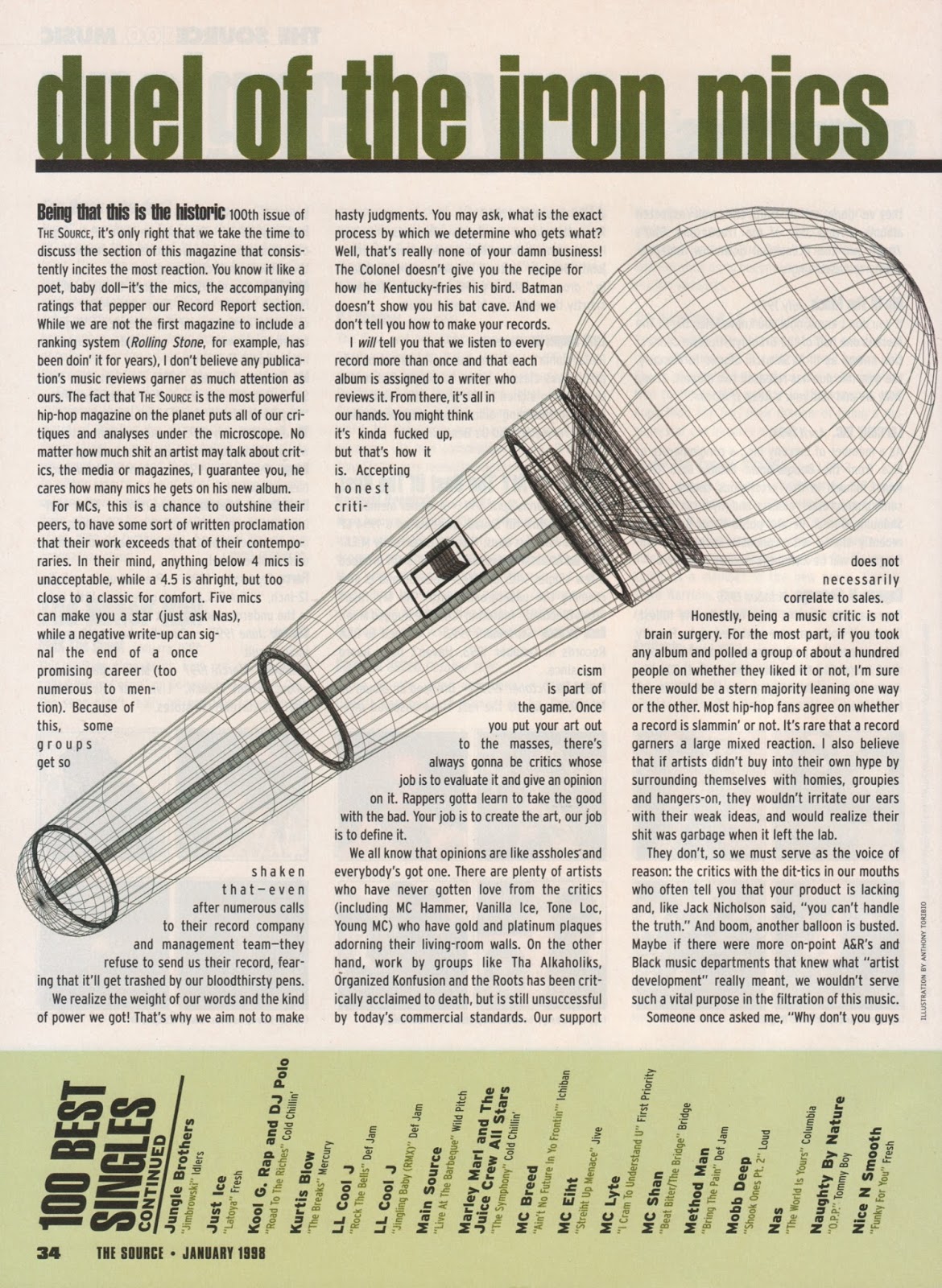
Duel Of The Iron Mics (The Source, 1998)

The Source 5-mic ratings Illmatic Biggie

The Source's 100th issue in 1998 had LL Cool J on the cover and a nice article that highlighted 8 classic albums that had previously received 5-mic ratings. Back when the mic rating truly meant something, artists aspired to make an album that would receive that coveted award. And, for fans, as Elliott Wilson said, ''The mics are one of the main reasons that The Source flies off your newsstands. More importantly, there are over 3 million hip-hop fans worldwide who look to The Source for honest reviews of the multitude of rap albums released each month...'  That was true for a long time. The 8 albums selected for the article are: A Tribe Called Quest's 'Peoples Instinctive Travels & the Paths to Rhythm,' Ice Cube's 'AmeriKKKa's Most Wanted,' Brand Nubian's 'One For All' (note to the editor: 'All For One' was the single), De La Soul's 'De La Soul is Dead,' A Tribe Called Quest 'Low End Theory,' Nas' 'Illmatic' and finally, The Notorious B.I.G.'s 'Life After Death.' Interestingly, Elliott explains the historical context of 'Life After Death' and even offers that he originally scoffed at 'Illmatic' receiving a 5-mic rating. Time has proven that Miss Info was correct for her review, but it's not rewriting history to say sales were mediocre and only us real heads were championing it early. Would you argue against any of these records receiving 5 mics? Personally, I've always been on the fence on 'Let The Rhythm Hit Em' but I can see their logic.

The Source 5-mic ratings Illmatic Biggie

May 15, 2017

Ice Cube "AmeriKKKa's Most Wanted" (May 15, 1990)

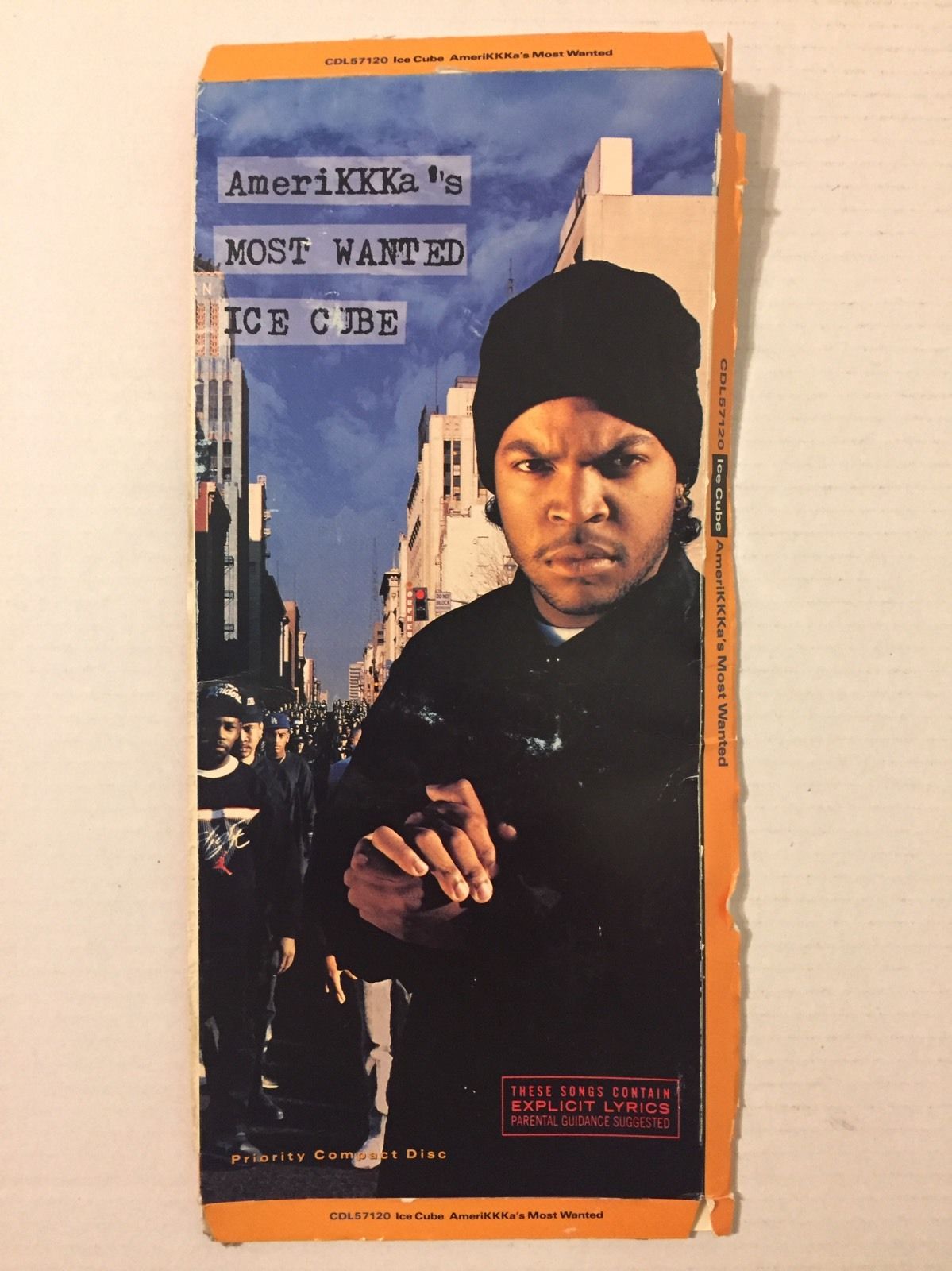
Ice Cube AmeriKKKa's Most Wanted 1990 Longbox CD
Ice Cube AmeriKKKa's Most Wanted 1990 Classic Material Album Review

Ice Cube released his debut solo album 'Amerikkka's Most Wanted' through Priority Records on this day in 1990. "As the lyrical architect behind N.W.A.'s groundbreaking debut, Straight Outta Compton, Cube helped usher in the gangsta rap era, and positioned himself as one of Hip-Hop's most feared lyricists. That reputation expanded even further when the Cali native severed ties with N.W.A. in 1990 because of shady business practices, and went solo on that ass." With production by the Bomb Squad, Ice Cube "crafted a thought-provoking manuscript that tackled everything from racism and politics to gang culture and sex. Hailed for its superior production, and equally exceptional lyricism, the project went gold within two weeks -- a feat that was unheard of for rap in the early '90s." Arguably Ice Cube's greatest LP, the impact & inspiration from this album are still felt today. 

Ice Cube AmeriKKKa's Most Wanted 1990 Advertisement

Ice Cube's 'AmeriKKKa's Most Wanted' Documentary 1, 2, 3.

May 01, 2016

NWA "The Strength Of Street Knowledge" (The Source, 5/89)


"If there's one phrase that describe NWA's approach to music, it's "don't hold back." Anywhere you drop the needle on their new album "Straight Outta Compton" (Ruthless/Priority), clear, hard, and funky sounds blow you away. The MC's of the group confront issues head on, painting a very real picture of the violent urban setting of Compton, a part of Los Angeles known for gang activity. The members of NWA are the rebels of rap, overlooking the political rebellion of PE or the poetic rebellion of BDP for straight-up, gun-in-your-face rebellion.... The MC's of the group - Eazy E, MC Ren, and Ice Cube - are each talented lyricists with distinct styles. Eric "Eazy E" Wright mixes comedy with hardness, going to all lengths to brag of his sexual prowess. He is also the executive producer of all Ruthless releases, and a solo artist with a recent gold album of his own, "Eazy Does It" (Ruthless/Priority).  Ren is the most skillful rhymer, using quick reversals and complex rhymes to create a great style, especially on "If It Ain't Ruff". Ice Cube is the power source of the group, giving off incredible energy and street-wise knowledge, at its best in "Gangsta Gangsta" (the first single) and "I Ain't The One." Dre even gets into the MC side of things on a few of the cuts, and he's no joke! Ren, Ice Cube, and Eazy team up and kick it on the most striking cut, the searing, revolutionary "F#ck Tha Police." The hard-edged music, the rhymes, and the voices sound great, but it's difficult to digest the subject matter.... In fact, NWA is widely criticized for the excessive profanity and violence found on their records. All in an effort, the group claims, to "reflect reality." - The Source, 5/89. Continue reading for a lot more on one of the best groups in Hip-Hop history!

December 18, 2015

Ice Cube "Kill At Will" EP (The Source, 2/91)


"Let's get this straight from the giddy up - Ice Cube fans will not be disappointed by this EP. Cube's rhymes are in there as usual and the production by Sir Jinx and the rest of Da Lench Mob may not be on the same classic level of Amerikkka's Most Wanted but don't sleep. There are three remixes plus brand new cuts. "Jackin' For Beats," "The Product" (Ice Cube's hype recital of his past and present), the somber "Dead Homiez," (a dedication to deceased friends) and even the quick shout jam "I Gotta Thank" will keep the hardcore masses satisfied till the vinyl becomes warped. Of the remixed jams, "Endangered Species" stands out the most, as new breakbeats and basslines solidify Cube and Chuck's powerful lyrics. The cut that mostly likely will have people saying "Oh Shit!" is "Jackin' For Beats." On this track, Cube holds true to the song's title as he rhymes over beats from "Call Me D-Nice," "So Wat Ya Sayin," "The Humpty Dance," "Big Ole Butt" and others. No Sa-Prizes here. If Ice Cube is only out for one thang, it's coming out with dope records." - The Source, 2/91.


You can save a copy of Ice Cube's Kill At Will in The Source below...

August 02, 2014

Ice Cube "It Was A Good Day" (Hip Hop Connection, 1993)


"It Was A Good Day" is perhaps the most obvious, radio-friendly single to come from Ice Cube since "Express Yourself." A seriously smooth rap slips like soft ice cream over a loop from the Isley Brothers' laidback "Footsteps In The Dark" as Cube soberly reflects on a rare day without trouble in South Central... "Most of my records is talking about how f#cked up shit is," says Ice Cube. "But realistically, as far as day-to-day living is concerned, some days are cool. Some days, shit don't go wrong, don't nobody f#ck with me. I just wanted to do a record on a day where everything was cool and it wasn't no beef. But the next day it goes back to the same ol' thing. That's why, on the album, I put "We Had To Tear This MF Up" right after that song." Check the visuals for it below...


"I have people scared to come up and say 'wassup' to me 'cause they think I'm the meanest motherf#cker ever. I'm not mad 24 hours a day, but I'm thinking 24 hours a day." - Hip-Hop Connection, 1993. "It Was A Good Day" was released in February 1993 as the second single from his third solo album, The Predator. Although fans have taken clues from the lyrics and attempted to pinpoint the exact date the song was written, it remains an unsolved mystery, as Ice Cube states the song was purely fictional. It has clearly mad for some entertaining blog posts nonetheless. 

May 15, 2014

Ice Cube "Amerikkka's Most Wanted" (Press Kit, 1990)


"He calls his solo debut album Amerikkka's Most Wanted, but ever since exploding on the scene as a chief lyricist for N.W.A., Ice Cube has been one of America's most acclaimed rap artists. However, if anyone thinks the Platinum success of N.W.A.'s Straight Outta Compton may have watered down Ice Cube's scorching images of life in the neighborhood, forget it. Amerikkka's Most Wanted is a steel-hard collection of fourteen new raps, told from the point of view of the kid on the block: a perfect description of Ice Cube himself. The album is a classic example of East Meets West. The L.A. born-and-bred Ice Cube traveled to New York to join forces with Public Enemy's Chuck D. in the recording of Amerikkka's Most Wanted. Also on the production team were Hank Shocklee, Keith Shocklee, Eric Sadler, and Sir Jinx, a friend and member of Ice Cube's new band, The Lench Mob. "Chuck D. is a real good friend," says Ice Cube, "and we just took control of this record." Cont'd...


"...Ice Cube views himself as a reporter, both informing an ignorant world about life in the inner city and holding up a mirror to Black America. "Rap is the network newscast Black people never had," he says. Of course, not everybody sees it that way. Ice Cube and N.W.A. found themselves at the center of controversy last year when a regional F.B.I. Director wrote a public letter condemning the rap group for its song, '**** tha Police.' "Anytime you have kids talking to a mass of other kids - and they're listening - you're going to have controversy," says Ice Cube. "My first thought was to get out a new 12" remix of '**** tha Police.' I've had much worse done to me before than get a letter." Growing up in the rough L.A. neighborhood of Compton, Ice Cube indeed knows first hand how much worse it can be. As a kid, he loved the music of Parliament / Funkadelic and the comedy of Richard Pryor. But it was rap that turned his head around for good. "When I first heard 'Rapper's Delight,' I couldn't stop rewinding it," he recalls. "It did nothing but grab be." By age 14 he was writing his own raps, and seeing Ice-T in concert for the first time sealed his determination to turn pro." - 1990.