Showing posts with label New York Times. Show all posts

August 09, 2022

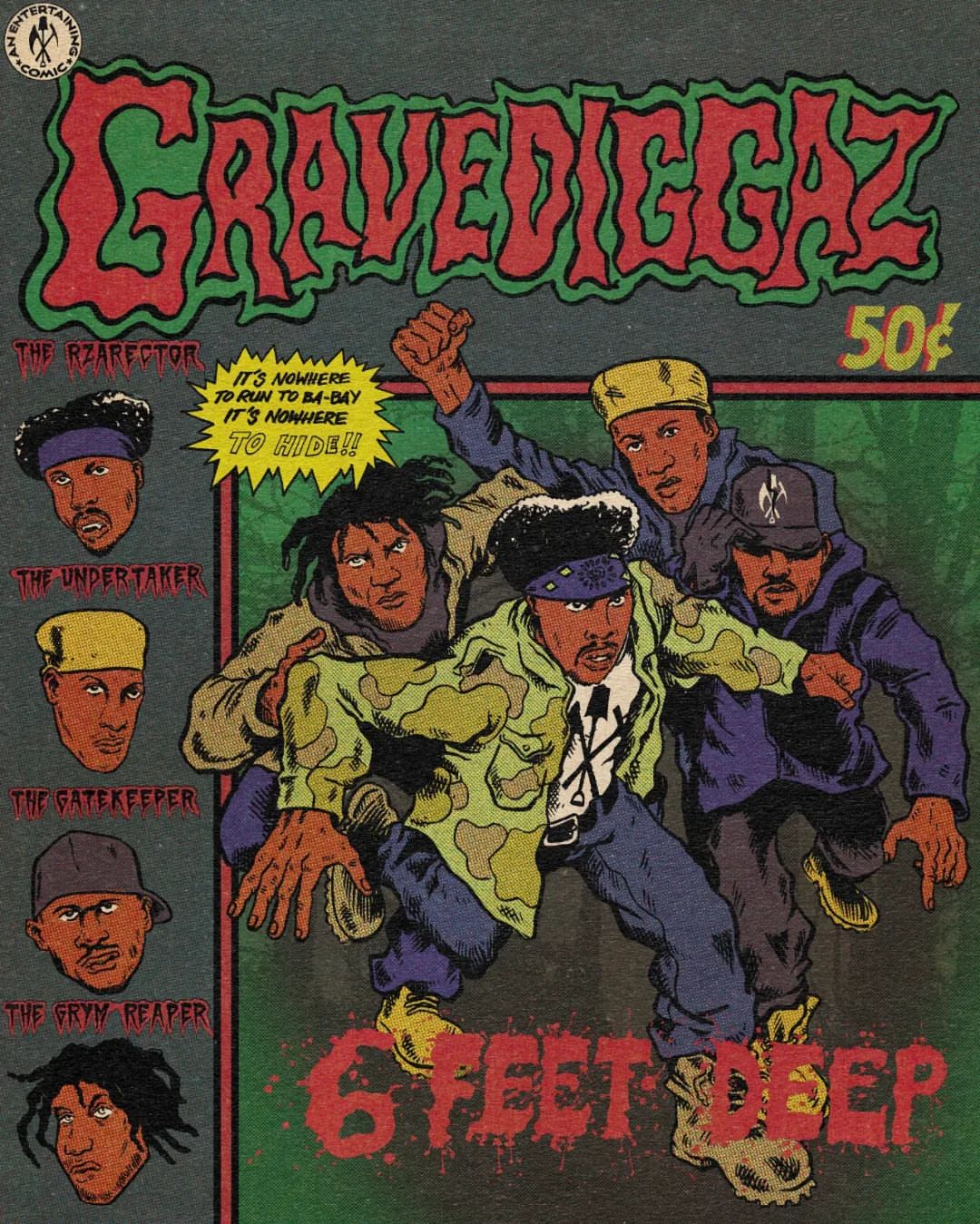
Gravediggaz "6 Feet Deep" (August 9, 1994)


The video for "Diary of a Madman" by the rap band the Gravediggaz includes a warning that the clip does not condone Satanism or blasphemy; the video for "Live Evil" by the Flatlinerz depicts members of the hip hop band rapping from the inside of a grave, and the video for "Hellbound" by the Almighty RSO takes the deaths of the band members as a starting point and climaxes when the rapper E. Devious is shown with the mark of the Devil, 666, shaved into his head. With gangsta rap having exhausted nearly every imaginable murder scenario, a new breed of rappers is taking hip-hop beyond the grave. Some call this development horrorcore because it uses horror film as metaphors for ghetto life. Others prefer the term death rap because the genre takes hip-hop to musical and lyrical extremes in the same way that death metal bands like Obituary and Carcass bring rock to a boiling point. To a certain degree, both death metal and death rap try to escape from reality, offering nihilism as a cure-all. But in doing so, both end up commenting on a reality so grim and alienating that the only direction its outcasts turn is toward darkness. The fans of the two genres find comfort in fantasy, in finding a collective myth for their private pain. Unlike heavy metal, rap has had death on its agenda since its inception. The genre's earliest tracks were usually counterbalanced by cautionary tales of drugs and shootings. Rap has also always looked to horror films to conjure a quick image, from the Sugar Hill Gang dropping "Rapper's Delight" to DJ Jazzy Jeff and the Fresh Prince parodying Freddy Krueger in 1988's "Nightmare on My Street." Cont'd below...


A few years ago, rap and death metal began to recognize that they were sitting on opposite sides of the same cell wall. Public Enemy sampled the Satanist band Slayer, Ice-T collaborated with them on the soundtrack for the horror film, "Judgment Night," and Cypress Hill put a Gothic-looking graveyard on the cover of its latest album, "Black Sunday." Not until this year, however, have hip-hop bands been willing to complete their move from the streets to the graveyards. "I'm the resurrector," the Gravediggaz rap on their first album, "6 Feet Deep." "Be my sacrifice. Commit suicide, and I'll bring you back to life." For those who cross the Gravediggaz, a band made up of members of the Wu-Tang Clan, Too Poetic, De La Soul and Stetsasonic, death is only the beginning of their punishment. "First I'll assassinate 'em," they rap on "Diary of a Madman." "And then I cremate 'em, and take all of his... ashes and evaporate 'em." Citing suspense-film directors from Alfred Hitchcock to Wes Craven and displaying an impressive knowledge of anatomy, the Gravediggaz rap about means of dismemberment, rituals of exorcisms and torments of hell. They never credit heavy metal as an influence, but "Diary of a Madman:" is also the title of a 1981 Ozzy Osbourne album and the song "Bang Your Head" borrows its name from the 1984 Quiet Riot metal album. Musically, death rap is developing its own repertory and cliches. The Gravediggaz use creaking doors and howling wolves as rhythm tracks and often rap in a cartoonish, exaggerated style. - New York Times (October, 1994). RZA and Prince Paul were such an amazing combination on 6 Feet Deep!

April 17, 2022

Rest In Peace, Black Rob (April 17, 2021, NY Times)


Robert Ross, the rapper known as Black Rob, whose husky, seen-it-all voice powered turn-of-the-millenium hits like "Whoa!" and "Can I Live" for Bad Boy Records, died on Saturday in Atlanta. He was 52. His death, at Grady Memorial Hospital, was attributed to cardiac arrest, said Mark Curry, a friend and one-time Bad Boy artist. He said Mr. Ross had had numerous health problems in recent years, including diabetes, lupus, kidney failure and multiple strokes. He had been undergoing dialysis from Piedmont Atlanta Hospital this month, Mr. Curry said. In a video that was posted online and spread across the hip-hop world, Mr. Ross detailed his ailments and recent struggles with homelessness. "He didn't have a home, but he always had us," said Mr. Curry, who called Mr. Ross "a true poet." He added: "He's known for telling stories, and his music described his life. You can feel it." Last week, Mr. Curry, along with producer Mike Zombie, began promoting a GoFundMe campaign to raise money for Mr. Ross -- "to help him find a home, pay for medical help and stability during these trying times," the campaign's description said. The fund-raiser collected about half of its $50,000 goal. Mr. Ross, who was born in Harlem, began rapping around the age of 11, influenced by local artists like Slick Rick and Doug E. Fresh, whom he credited with helping him develop his storytelling prowess. Sounding both motivated and weathered even as a young man, he was best known for the hard-hitting 2000 single "Whoa!", which reached No. 43 on the Billboard 100, and a string of electric guest verses on songs by Mase, 112 and Total. Thrust into more of a leading role after the murder of his Bad Boy label mate, the Notorious B.I.G., in March 1997, Mr. Ross became, by the end of the 1990s, another fast-burning star under the imprimatur of the budding hip-hop mogul Sean Combs.


His debut album, the fittingly named "Life Story," was released by Bad Boy in 2000, when he was 31. Already he had spent more than a decade in and out of juvenile detention, jail and prison, and the music reflected that. "It's hell," Mr. Ross said of his past. "Once they get their teeth on you, they keep biting, until they feel like, 'Let's throw away the key on this cat.'" "Life Story" featured intricate street tales of stickups, shootouts and the family struggles that could lead to such things, and it reached No. 3 on the Billboard album chart, eventually becoming platinum. Five years later, "The Black Rob Report," the rapper's second album, failed to find the same success, in part because Mr. Ross was back in prison, having failed to report to sentencing for a 2004 larceny charge. His career never recovered. "Bad Boy left me for dead," Mr. Ross said on his release from prison in 2010. Two subsequent independent releases on different labels foundered. He is survived by his mother, Cynthia; four siblings; nine children; and five grandchildren. Many people on social media offered condolences for Mr. Ross, including Diddy, the entrepreneur Daymond John and the rappers Missy Elliott, LL Cool J, GZA and Styles P. On Twitter, LL Cool J described Mr. Ross as a storyteller, gentleman and an M.C. Ms. Elliott lamented that the death of Mr. Ross closely followed that of another New York rapper, Earl Simmons, known as DMX, who died this month. "It's hard finding the words to say when someone passes away," Ms. Elliott said on Twitter. "I am praying for both of their families for healing." - New York Times (April 18, 2021). Rest In Peace, Black Rob. That's WHOA!

May 04, 2021

Roc Marciano "Marcberg" (May 4, 2010)


Marcberg,” the eerie and captivating debut full-length album from the Long Island rapper Roc Marciano, has 15 tracks but only one idea: the preservation of a style long abandoned. Calling Roc Marciano a classicist doesn’t quite do him justice, though. This is an artisanal album, no rhyme or drum out of place. In addition to rapping with morgue-cold delivery — “Turn the tube to Channel 2/And there was you/Your parents just can’t handle the news” — he also produced the album in its entirety, favoring abraded samples and mild, persistent static that gives “Marcberg” a decidedly claustrophobic air. Even in 1995, the year his sound most closely evokes, this album would have been anomalous, almost flamboyantly, tauntingly spare. But the density comes in the rhymes, which are sinister and clever. Roc Marciano even takes an effective stab at a trite conceit on “Jungle Fever,” anthropomorphizing drugs as a woman: “Had to hide you from my mother ’cause you didn’t have color.” That’s what passes for humor on this otherwise entrancingly dark record. More typical is the chilling “Thugs Prayer,” which reads as one long sigh: "Perhaps let a couple off / Skin bubble off / Hustling soft up in the loft / Ain’t no love lost / Just thug lords and drug wars." - Jon Caramanica (New York Times). I was servicing Eternia's At Last album at Fat Beats at the time and Jon asked me for a copy of Marcberg... above was his initial review. Revisit Roc Marci's true school classic below...


Below are additional scans from the 2LP copy of the album...

November 03, 2020

Belly "Opening Scene" (Video, 1998)


"In ''Belly,'' Mr. Williams, a graduate of music videos making his feature film debut as writer and director, uses rapid cuts, multiple images, superimpositions, slow motion and highly dramatic lighting among other devices as he assembles an assortment of rap artists in a tale set in 1999 among mostly undereducated urban black teen-agers. The focus is on the friendship of two of them, who appear older than their years. Pals since childhood, Tommy Brown (Earl Simmons, also known as DMX) and Sincere (Nasir Jones, also known as Nas) have achieved a measure of success in their chosen criminal life, and with a gang of confederates at the outset of the film pull off a murderous, bloody and very remunerative heist at a popular nightclub." - New York Times. That nightclub scene is widely accepted as one of the BEST opening scenes to a movie, ever. As the movie was released in November (1998), let's revisit that intro and check out the soundtrack, too, for tracks like "Top Shotter" with DMX, Sean Paul & Mr. Vegas; the heartfelt "Sometimes" by Noreaga; Half-A-Mil's (R.I.P.) "Some N!ggaz"; "Movin' Out" by Mya, Nore & Raekwon, "Crew Love" by Hov and more. While the movie didn't get rave reviews, I bet you still watch it when it comes on TV!? Yup... I thought so, too.

September 13, 2020

The Notorious B.I.G. "Ready To Die" (9/13/94)


"...Though many rappers exaggerate about the lives they led before becoming performers, some are actually former drug dealers. Few have ever been as open in detailing their criminal past as Biggie Smalls, and none have ever been as clear about the pain they felt at the time. "He doesn't want anyone to see that he's not as tough as he thinks he is," said Ms. Wallace, the rapper's mother. "He cries inside. He bleeds inside. But he doesn't want anyone to see the vulnerable side of him." "Ready to Die" is, indeed, marked by pathos unusual not only in hip-hop but in pop music. "In street life you're not allowed to show if you care about something," said Mr. Combs, of Bad Boy Entertainment. "You've got to keep that straight face. The flip side of that is his album. He's giving up all his vulnerability. He's letting you know how he has felt about his mother. He's letting you know how he cried. How he has thought about killing himself." Though drug dealing carries tremendous heroic value with some young urban dwellers, he sacrifices the figure's romantic potential. His raps acknowledge both the excitement of drug dealing and the stress caused by the threat from other dealers, robbers, the police and parents, sometimes one's own. In presenting the downside of that life, "Ready to Die" offers perhaps the most balanced and honest portrait of the dealer's life of any in hip-hop. "He's trying to enlighten people to the way your mind thinks when you're broke, when you're young growing up and not feeling like nobody cares about you," Mr. Combs said. Cont'd below...


On "Everyday Struggle," for example, Biggie Smalls rhymes: "I know how it feel to wake up . . . / Pocket broke as hell/ Another rock to sell/ People look at you like you's the user/ Selling drugs to all the losers/ Mad Buddah abuser/ But they don't know about your stress-filled day/ Baby on the way/ Mad bills to pay/ That's why you drink Tanqueray/ So you can reminisce/ And wish/ You wasn't living so devilish." By expressing the self-loathing and self-doubt he felt while dealing, he hopes that his experiences may resonate with other living that life. "I want them stressed-out n!@@ers to be, like, 'Yo, this n!@@er be hitting it right on the nose, man,' "he said. "That's what I'm trying to do." And he added, venting those feelings was also therapeutic. "I got a lot off my chest with that album." And he has put a lot in his pocket. Next month he will move his mother from the apartment in which she has lived for 25 years and into a house in the Park Slope section of Brooklyn. But despite new-found economic independence and the fear he feels while sitting in his own home, he is reluctant to move. "I could never see myself moving in the suburbs," he said. "It ain't going to be right, and the lyrics are going to be soundin' nasty. I know it. There won't be nothing to rap about except the birds." - NY Times (12/18/94). Full story can be read HERE.

July 30, 2020

Rest In Peace, Malik B. (11/14/72 – 7/29/20)


Malik B., the elusive M.C. best known for his work with the Roots, died on Wednesday. He was 47. His death was confirmed by his cousin Don Champion. Members of the Roots also posted public statements on their Instagram and Twitter accounts, though the statements did not say where he died or specify the cause. Malik joined the hip-hop group then known as the Square Roots after he met the founders, Questlove and Black Thought, in 1991 at Millersville University in Millersville, Pa. By 1993, the Roots had dropped “Square” from their name and self-released their debut album, “Organix.” Touring relentlessly, they soon developed a cult following in Europe. New members filtered in and out each year. Malik appeared on three more albums - “Do You Want More?!!!??!” (1995), “Illadelph Halflife” (1996) and “Things Fall Apart” (1999) - and then left the band... Though none of the members ever explicitly said why Malik had left, “Water,” a song off the group’s album “Phrenology” (2002), openly referred to his departure. Black Thought recalled meeting Malik, whom he called “Slacks,” and hinted at the ways they had grown apart: “But inside people down with me started to change/It was a couple things, lil’ syrup, lil’ pills/Instead of riding out on the road you’d rather chill.” “Things Fall Apart” - the title was taken from a 1958 novel by the Nigeran writer Chinua Achebe - became the group’s breakthrough album, peaking at No. 4 on the Billboard chart...


Though Malik left the ground around that time, the other members have continued to acknowledge his influence as the grounded emotional core of the group. “I always felt as if I possessed only a mere fraction of your true gift and potential,” Black Thought wrote on Instagram after Malik B.’s death. “Your steel sharpened my steel as I watched you create cadences from the ether and set them free into the universe to become poetic law, making the English language your bitch.” Malik released solo music after leaving the Roots, including the EP “Psychological” in 2006, and two studio albums: “Street Assault” (2005) and “Unpredictable” (2015), which was a collaboration with the producer known as Mr. Green. He also returned as a featured artist on the Roots’ albums “Game Theory” (2006) and “Rising Down” (2008). Malik Smart Abdul-Basit was born on Nov. 14, 1972, in Philadelphia. Information on his survivors was not available. - NY Times. Playlist via Philaflava below...

April 17, 2018

Kendrick Lamar Wins Pulitzer Prize for "Damn"


Kendrick Lamar’s Pulitzer for “DAMN” makes him the first nonclassical or jazz musician to receive the prize since the awards expanded to music in 1943. In late January, the Compton, Calif., rapper Kendrick Lamar lost the Grammy Award for album of the year to Bruno Mars. “DAMN.,” Mr. Lamar’s fourth LP, was his third straight to be nominated but ultimately fall short of the trophy, considered by most to be the top prize in popular music. --- But perhaps not anymore. --- On Monday, Mr. Lamar’s “DAMN.” took home an even more elusive honor, one that may never have even seemed within reach: the Pulitzer Prize for music. Kendrick is not only the first rapper to win the award since the Pulitzers expanded to music in 1943, but he is also the first winner who is not a classical or jazz musician. “The time was right,” Dana Canedy, the administrator of the prizes, said in an interview after the winners were announced. “We are very proud of this selection. It means that the jury and the board judging system worked as it’s supposed to - the best work was awarded a Pulitzer Prize.” - NYT // Congratulations to Kendrick Lamar!! Listen to the LP one mo' gain, below...

March 22, 2017

In Remembrance of Phife Dawg

Phife Dawg Malik Taylor A Tribe Called Quest Obituary Hip-Hop Nostalgia

Malik Izaak Taylor aka Phife Dawg of A Tribe Called Quest passed away one year ago today. I still can't believe he's gone & that it's already been a year. His passing hit our culture hard and it still saddens the teenager inside of me that grew up on Tribe. As fans, our connection to Phife is through the music - that's where we can support and honor his legacy. So, as I think back on Phife's career, it's his verse from 'Buggin Out' that was one of the defining moments in his career, and it was definitely worthy of 'Dopest Rhyme Of The Month.' Phife kicked in the door with 'Yo! Microphone check one two what is this..." all while that bassline had your neck snappin' along. 'Low End Theory' is the definition of a classic. My thoughts are with Phife's family and loved ones today (especially Jarobi), and Tribe's music will definitely be turnt up in my headphones. Rest in Beats, Phife; always on point! Credit: New York Times, March 24, 2016. Hip-Hop Quotable below.

Phife Dawg A Tribe Called Quest Hip Hop Quotable Buggin out

June 03, 2016

Wu-Tang Clan "Wu-Tang Forever" (New York Times, 1997)


Listening to ''Wu-Tang Forever'' by the Wu-Tang Clan as it has slowly infiltrated the city since -- blasting out of clubs, boomboxes and car stereos -- has offered clear evidence of why this group is probably the most important one in hip-hop today. The album effortlessly slices through the noise and music around it, thanks chiefly to its producer, known as the RZA, whose precision beats ring crisply and sharply in the air while the sound snippets he uses to back the raps propel them like slingshots... Even before listening to the album it is clear that the Wu-Tang Clan is a slick, innovative crew... Since its debut, ''Enter the Wu-Tang (36 Chambers)'' from 1993, the Wu-Tang Clan has turned from a group into a powerful virus, with five of its nine members having released successful solo records (each on a different record label) in the four years it has taken for this long-awaited follow-up. ''Wu-Tang Forever'' may not be as groundbreaking as the band's debut, but it does show an evolution. The band seems to be moving forward lyrically and acoustically while moving backward stylistically, taking less of a frenzied end-of-the-millennium approach and favoring simpler, old-school beats. Instead of flowing over the sides with skits, movie dialogue and foaming-at-the-mouth rapping, ''Wu-Tang Forever'' is a smooth, clean set of 25 songs with only a few throwaways... 


Violins are all over the album. They're used to reach for sentimentality in the positive-minded anthem ''A Better Tomorrow'' (named after the John Woo movie soundtrack it samples) and to add a fast, infectious lilt to the band's powerful comeback song, ''Reunited.'' At the same time, the album doesn't make a complete break from the past, offering a sequel to its hit ''C.R.E.A.M.'' in ''Cash Still Rules/ Scary Hours'' and using rhythms and sped-up samples that sound very close to those on ''Liquid Swords,'' the solo album by the Wu-Tang member Genius/GZA. ''We return like Jesus, when the whole world needs us,'' the RZA immodestly claims in ''Reunited.'' Probably the biggest similarity ''Wu-Tang Forever'' has to religion is that, like the Bible, the album was written by many different, often contradictory voices. Where Ol' Dirty Bastard breaks new ground in misogyny, bragging about adultery and gonorrhea, U-God gives a lesson on sensuality and respecting the body in ''Black Shampoo'' and Ghostface Killa tells a horror story of a broken condom in ''The Projects.'' Where the RZA blasts rappers trying to water down hip-hop with rhythm-and-blues on ''Intro,'' the song ''Second Coming'' is 90 percent rhythm-and-blues. - (NYT, June 10, 1997). Video from the Wu-Tang Forever Enhanced CD  (thanks to Unkut) is above and revisit the album below, released on 6/3/97.