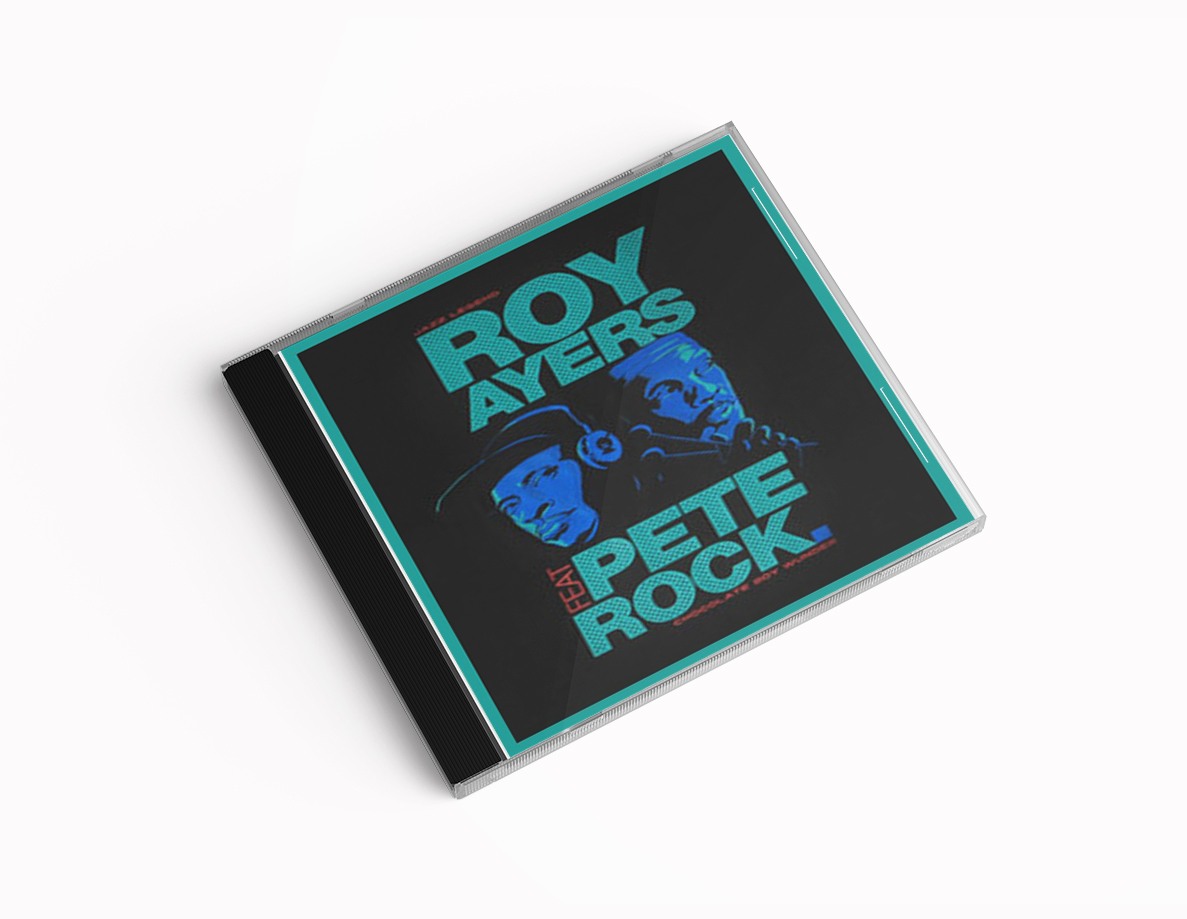
A digger's delight and samples galore as Pete Rock mixes Roy Ayer's & RAMP's back catalog with the artists who sampled Roy Ayers. In case you are unfamiliar RAMP means Roy Ayers Master Production. Heavily sampled (most notably on A Tribe Called Quest’s “Bonita Applebum”) and much adored for their sublime version of "Everybody Loves The Sunshine," RAMP has maintained a musical presence despite a lack of music and info. Pete Rock cuts through some classics, dig into it below...
February 28, 2014
February 27, 2014
J Dilla "Welcome 2 Detroit" (CMJ, May-June, 2001)
"Whether you know it or not, Jay Dee's been rocking you for years. Probably best known as a member of the Ummah production team (who worked with A Tribe Called Quest) and the underground crew Slum Village, he's produced tracks for heavyweights like Busta, Common, Erykah and De La. Welcome 2 Detroit, dedicated to the Jay Dee stomping ground more famous for its brushed-metal techno than wood-grained hip-hop, echoes the subtle, soulful vibe of all the above. It's as understated as Slum Village's Fantastic Vol.2, trading in its rosy glow for a blunter, darker feel. The real action creeps in the background, with beats skulking like alley cats around the perimeter of a streetlight. On "Y'all Ain't Ready," a fidgety typewriter balances the breakbeat, as an instant staccato pings faintly in the distance. And who'd have thought that the Clapper theme (that's right, as seen on TV) could be turned into a grindingly funky jam? Jay Dee's also got a knack for finding MCs to balance the tenor of his tracks - on "Beej-N-Dem Pt.2," Beej's nasal style plays perfectly off the hallowed bass and compressed soul sample. And his cover of Donald Byrd's "Think Twice" exemplifies the producer's respect for his soul roots. Welcome to Jay Dee's Detroit: Get comfy, you may want to stay a while." - CMJ, 2001. (Updated, 2016). Listen to Dilla's Welcome 2 Detroit below...
The review for Jay Dee's Welcome 2 Detroit in CMJ is below...
February 26, 2014
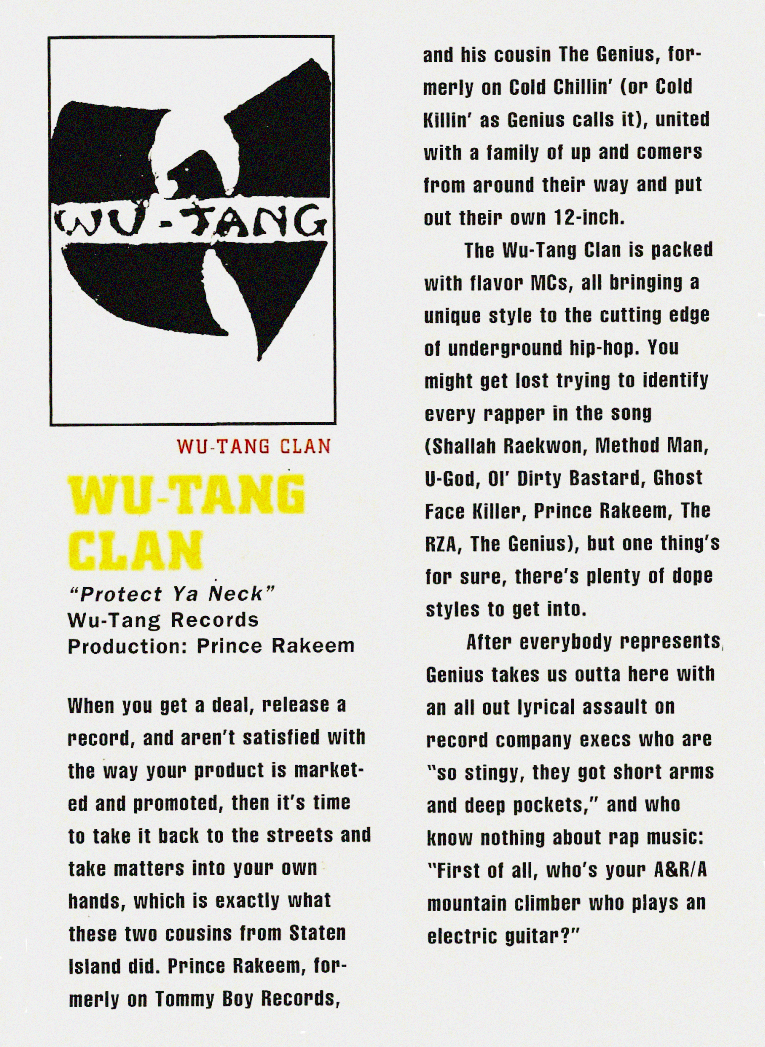
Wu-Tang Clan "Protect Ya Neck" (The Source, 2/93)
"When you get a deal, release a record, and aren't satisfied with the way your product is marketed and promoted, then it's time to take it back to the streets and take matters into your own hands, which is exactly what these two cousins from Staten Island did. Prince Rakeem, formerly on Tommy Boy Records, and his cousin The Genius, formerly on Cold Chillin' (or Cold Killin' as Genius calls it), united with a family of up and comers from around their way and put out their own 12-inch. The Wu-Tang clan is packed with flavor MCs, all bringing a unique style to the cutting edge of underground hip-hop. You might get lost trying to identify every rapper in the song (Shallah Raekwon, Method Man, U-God, Ol' Dirty Bastard, Ghost Face Killer, Inspectah Deck, The RZA, The Genius), but one thing's for sure, there's plenty of dope styles to get into. After everybody represents, Genius takes us outta here with an all out lyrical assault on record company execs who are "so stingy, they got short arms and deep pockets," and who know nothing about rap music: "First of all, who's your A&R / A mountain climber who plays the electric guitar?" - The Source.
The review of "Protect Ya Neck" in The Source (2/93) is below...
Tags:
1993,
Adverts,
Nostalgia,
The Source,
Videos,
Wu-Tang Clan
February 25, 2014
A Tribe Called Quest "The Low End Theory" (The Source, 1991)
"What do you do for an encore after making one of the most ground-breaking unique and outstanding hip-hop albums ever? Instead of moving ahead to an uncharted musical plateau that may be over everyone’s head, the Tribe have veered off to the side, molding their jazz-infused samples with fat hardcore beats to give their progressive sound a streetwise edge. The most prevalent theme on this record is the Tribe’s disillusionment with the music industry. Song topics address shady promoters, bootleggers and the greedy, insensitive record labels that rip-off artists. Meanwhile, Tip and Ali drop some more fat loops from their secret sample vaults. The tracks are kept simple and feature the type of fat drum beats that can be heard from a boomin’ system three blocks away... They add the right touch - whether it's a live bass with singing on Q-Tip’s "Verse From Abstract," or the jazzy sax loop on Phife’s "Butter." Q-Tip has already proven he is a highly skilled lyricist with his own distinct style and once again he flows lovely, dubbing himself "The Abstract Poet. Those who questioned Phife’s microphone techniques on the first album will swallow those doubts as he practically steals the show on this one. Phife provides a more straight-up b-boy approach to complement Tip’s mellow vibes. Other outstanding cuts include "Buggin’ Out," an uptempo jam with a catchy bassline, "Rap Promoter" with its chunky guitar samples, "ShowBiz," featuring Brand Nubian and ex-Ultimate Force member Diamond D, and “Scenario” a duet with the Leaders Of The New School that feature some incredible lyrics from Busta Rhymes. There’s no sophomore jinx to be found here only real hip-hop." - The Source (1991). A well-earned 5-mic review!
You can save a copy of The Source's Low End Theory review below...
February 24, 2014
A.D.O.R. "Let It All Hang Out" (12", 1995)
A.D.O.R.'s "Let It All Hang Out" is an undeniable Pete Rock classic from 1992 on Atlantic Records. A.D.O.R. was born in Washington Heights, but moved to Mount Vernon as a kid and later met Pete Rock, Heavy D, Puff, etc. in High School. A.D.O.R. was also known as "Another Dimension of Rhythm" and/or "A Declaration Of A Revolution." He received his deal through DJ Eddie F, who was Heavy D's DJ, and the first single they recorded was "Let It All Hang Out." The song had a video and solid promotion behind it -- I can remember seeing A.D.O.R. perform the track live on "In Living Color" that same year. It was also mentioned in The Source in October 1992, "I don't know about you, but I thought that cut, "Let It All Hang Out" by A.D.O.R. was fat. Pete Rock definitely hooked him up and will be supplying beats for the rest of his album." Despite the single's success, The Concrete was only released as a promo and was not entirely produced by Pete Rock. It did, however, have joints from Diamond D, as well as K-Def and Marley Marl. A.D.O.R. came back in 1998 with his own label and released "Shock Frequency," which also had the Pete Rock-produced "Let It All Hang Out," plus 2 more joints from Pete Rock and tracks from Diamond D and Clark Kent. With Pete Rock's success - then and now - you've undoubtedly heard these tracks on compilations, if not the actual A.D.O.R. release. However, "Let It All Hang Out" remains his only true classic. Listen below...
February 23, 2014
The Roots "Things Fall Apart" (February 23, 1999)
On their fourth effort, Things Fall Apart, the Roots find themselves on the cusp of a commercial breakthrough. Like De La Soul and A Tribe Called Quest, the Roots have always stood for innovation in hip hop, both sonically and lyrically. Borrowing the title of Chinua Achebe's literary masterpiece, Things continues the evolution the Roots have undergone since their independently released debut, Organix (Motive/MCA, 1993). To paraphrase Chuck D, from the Roots' album, Illadelph Halflife in 1996, the Roots are an enigma, perhaps even to themselves. They certainly remain one to critics, who have tried to pigeonhole the group ever since they released Organix and their critically acclaimed sophomore album, Do You Want More?!!!??! (Geffen, 1995). Stuck with the "alternative" label, the Roots were then falsely accused of restructuring their sound on Illadelph to gain a harder, more authentically "hip hop" sound. Fusing the free-throwing live instrumentations of their first two albums with the methodical, yet still revolutionary, in-house production and engineering techniques of Illadelph, the Roots have finally perfected their sound. This synthesis, coupled with the vocal gymnastics of Black Thought & Malik B., makes for one of the most complete albums of the decade.
The plush beats on "The Next Movement" and stripped-down acoustics on "Dynamite" exemplify that wholeness. "Dynamite," which features the background harmonies of next-school soul group Jazzyfatnastees, captures the Roots at their most nuanced. Using structure, chord changes, and unorthodox time signatures, the Roots take techniques associated with hard bop-era jazz and put them in a hip hop context. The seemingly simple guitar licks on "Dynamite" provide another example of the group's creativity. Black Thought, using his voice as an instrument, stutters his way up the scales, while the guitar accents his vocal riffs. Even when they take a more traditional approach, the Roots manage to raise the standards for hip hop. The aptly named "Adrenaline" features a sparse piano loop that spurs the wordsmiths to new heights. Thought, Malik B., Dice Raw, and newcomer Beans each outshine the other in a battle of lyrical one-upmanship. But it's the tracks' subtleties that separate the group from their peers. Rahzel channels live turntablism through his transcendent beat-boxing, while Thought and his cohorts display stunning verbal calisthenics. The Roots have reconfigured the pyramid again, placing themselves at the top. Although some things in hip hop continue to fall apart, the Roots pick up the pieces and construct a new order. - Vibe, 1999.
February 22, 2014
Chris Read "Classic Material: 1989" (Mix, 2011)
In January '11, Chris Read continued his monthly Classic Material series paying tribute to the hip hop of 1989, another year in which the genre's dominant sounds changed drastically. As the James Brown influenced sound that had dominated the late 80s played out its final days, producers from all corners of the genre turned their attentions to sampling the bass heavy West Coast sound of Parliament, Funkadelic and Zapp. Acts such as De La Soul and the Jungle Brothers burst on to the scene injecting a light hearted honesty into their lyrical content which paved the way for the emerging 'new school' sound of the early 90s. Early releases from the likes of X Clan hinted at the 'afrocentric' sound that would come to prominence in the following years. As with previous editions, the mix places classic cuts alongside the lesser heard. Hit the archives for more, listen below...
February 21, 2014
The Notorious B.I.G. "Next" Feature In Vibe Magazine (August, 1994)
"Fulton Street (or the avenue, as it's known in Fort Greene, Brooklyn) looks like one of those New York City ghetto neighborhoods you see on the Box or MTV: kids making trips to the corner store, drinking 40s, smoking blunts, and playing C-Lo. There's Biggie picking up the dice with his right hand, taking a wide step backwards, shaking his hand furiously - and with a twist of his wrist, the dice spill onto the concrete as he snaps his fingers and lets out a satisfied "Hah!" Rolling out a 4-5-6, he wins the bank of $6. It may not seem like much, but as a new-to-the-rap-game hustler, Biggie is happy to collect. On the regular, the Notorious B.I.G. (also known as Biggie Smalls) can be found on Fulton Street - he used to be there more when he was hustlin' full-time. Twenty-year-old Biggie first appeared last year on the Who's The Man? soundtrack. Even though the movie flopped, Biggie's debut, "Party and Bullshit," will not be forgotten..." Cont'd below along with some bonus remixes...
"Surprisingly, Ready To Die is nothing like "Party and Bullshit." The album's beats are an East Coast interpretation of West Coast pimp flavor. There are a lot of lyrics about suicide ("Ready To Die" and "Suicidal Thoughts"). "I'm just trying to touch on angles that other brothas is scared to touch," he explains. "Ain't no brotha I know that been hustlin' or been f#cked up in the street shit that can tell me they ain't never wish they was f#cking dead. I know plenty of nights I laid down and wished it was just over. For now, he's only just begun, and what's real for Biggie is making a better life for himself. This means moving out of Fort Greene, getting a record deal for his boys (the Junior Mafia) and buying a house for his mother (in Florida). It also means selling a lot of records. "Whatever I got to do to make this paper," he says. "Can't make no moves when you're broke." - Vibe, August 1994.
Tags:
1994,
Next,
Nostalgia,
R.I.P.,
The Notorious B.I.G.,
Vibe Magazine,
Videos